


winter migrants have arrived
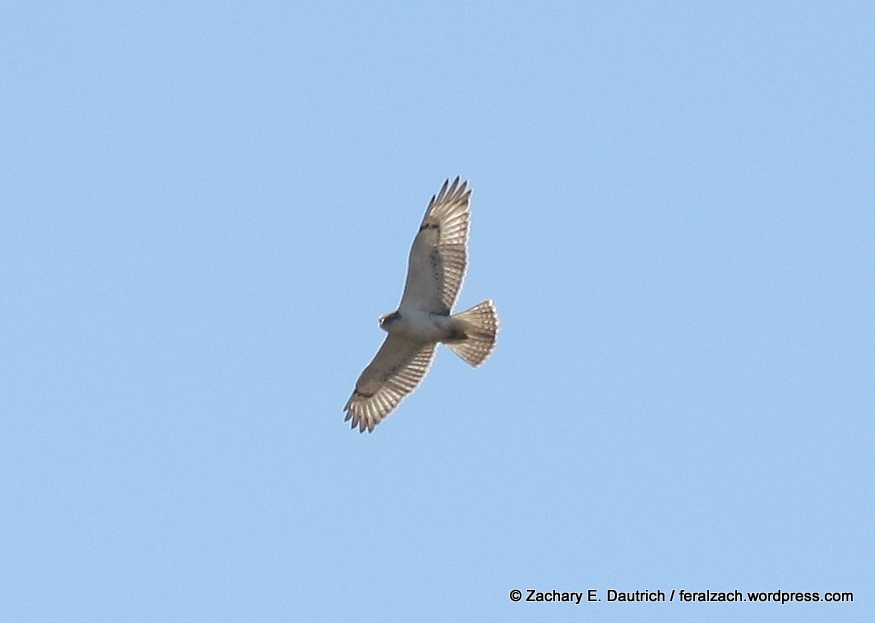 juvenile ferruginous hawk, point reyes national seashore
 juvenile ferruginous hawk, point reyes national seashore
 great egret and three river otters / point reyes national seashore
 adult female northern harrier / point reyes national seashore
 a flushed bobcat on the run / point reyes national seashore
juvenile bald eagles
a few weeks ago, i had the pleasure to accompany some friends and dedicated raptor-enthusiasts to see a bald eagle nest in alameda county that had two newly fledged juveniles. bald eagles have been slow to return to the Bay Area, and there are only about 16 nests currently in the vicinity from Monterey up to Mendocino County. a good sign to see them coming back.
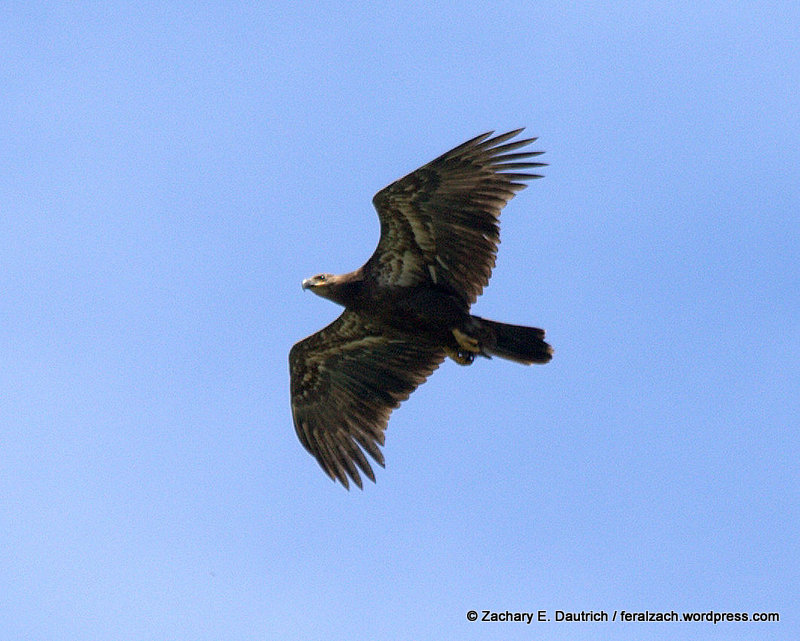
juvenile bald eagle / alameda county CA
they were comical to watch – flying was fairly easy, but the landing part was still a challenge. they would put their feet down 100 meters before their intended perch, and often overshoot it and have to fly around for a second attempt or find another spot.
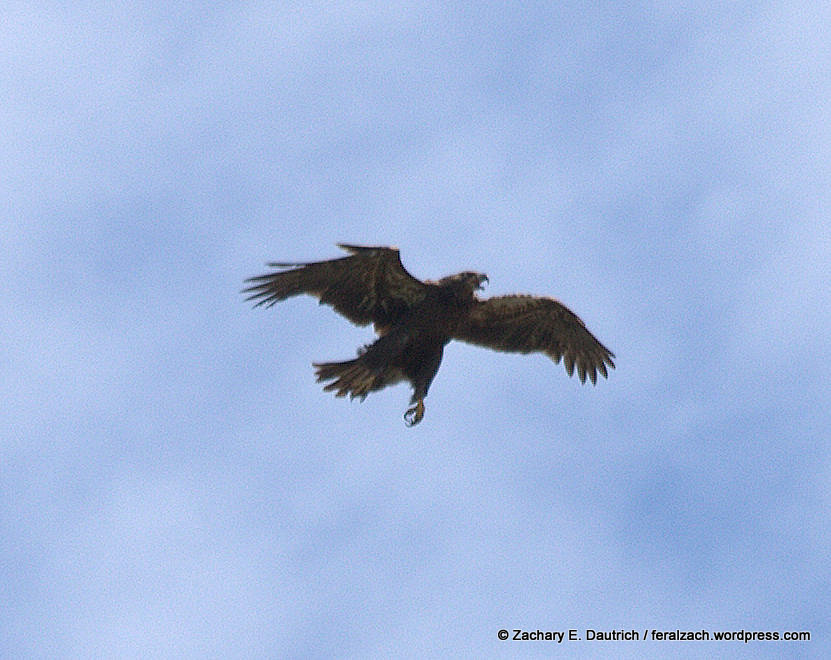
they were begging for food from their parents – pa was about a mile away (out of ear shot, likely, from the incessant begging), and ma seemed un-phased by their constant calls, looking regal on her perch as she preened ignored their calls.
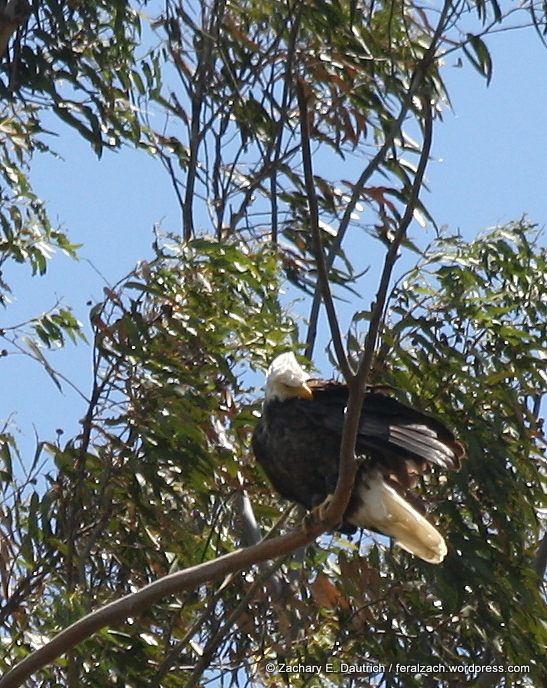
adult female aka ma bald eagle / alameda county CA
she did make one or two half-hearted attempts at a fish in front of us in our boat, but it was a leisurely sunday morning for all involved overall.
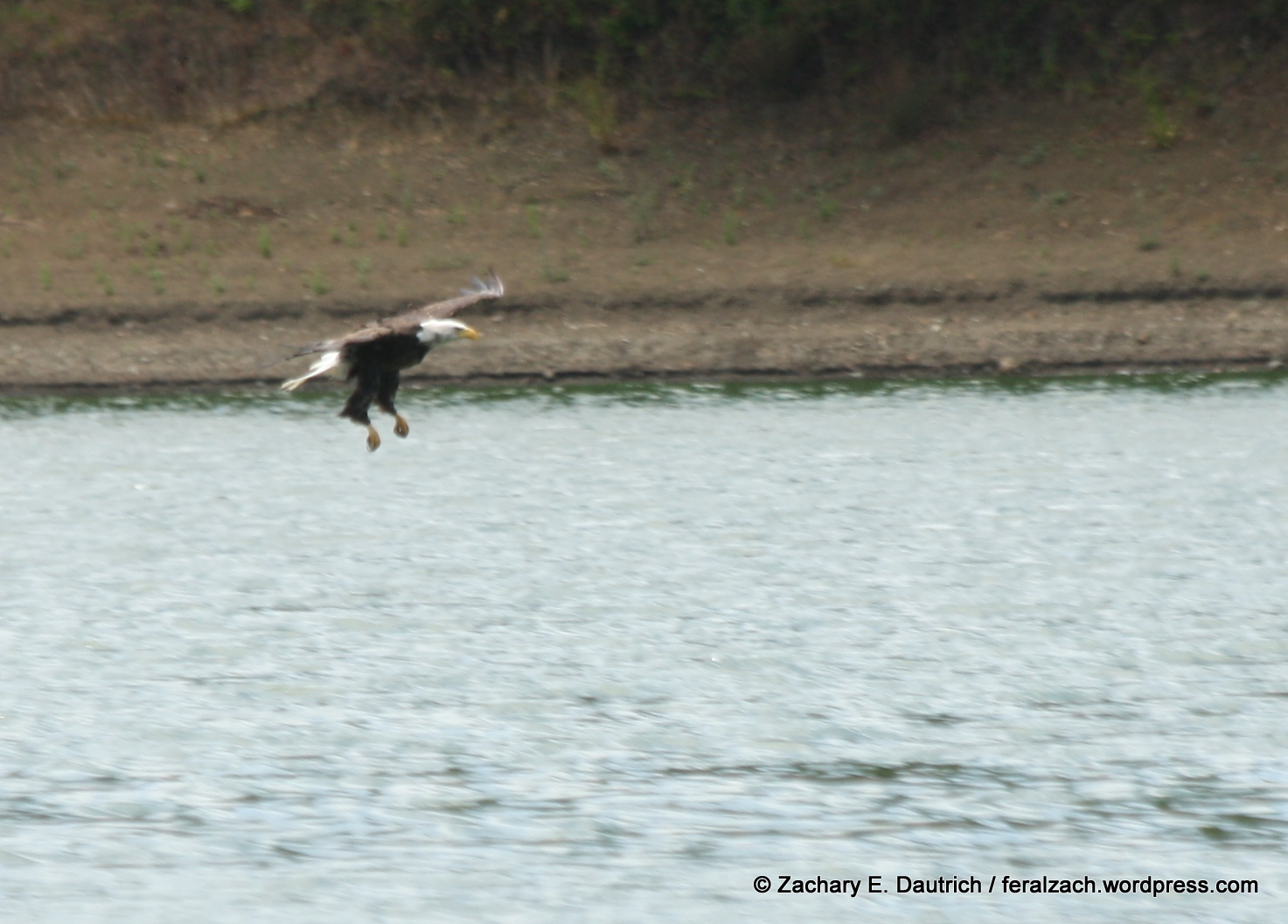
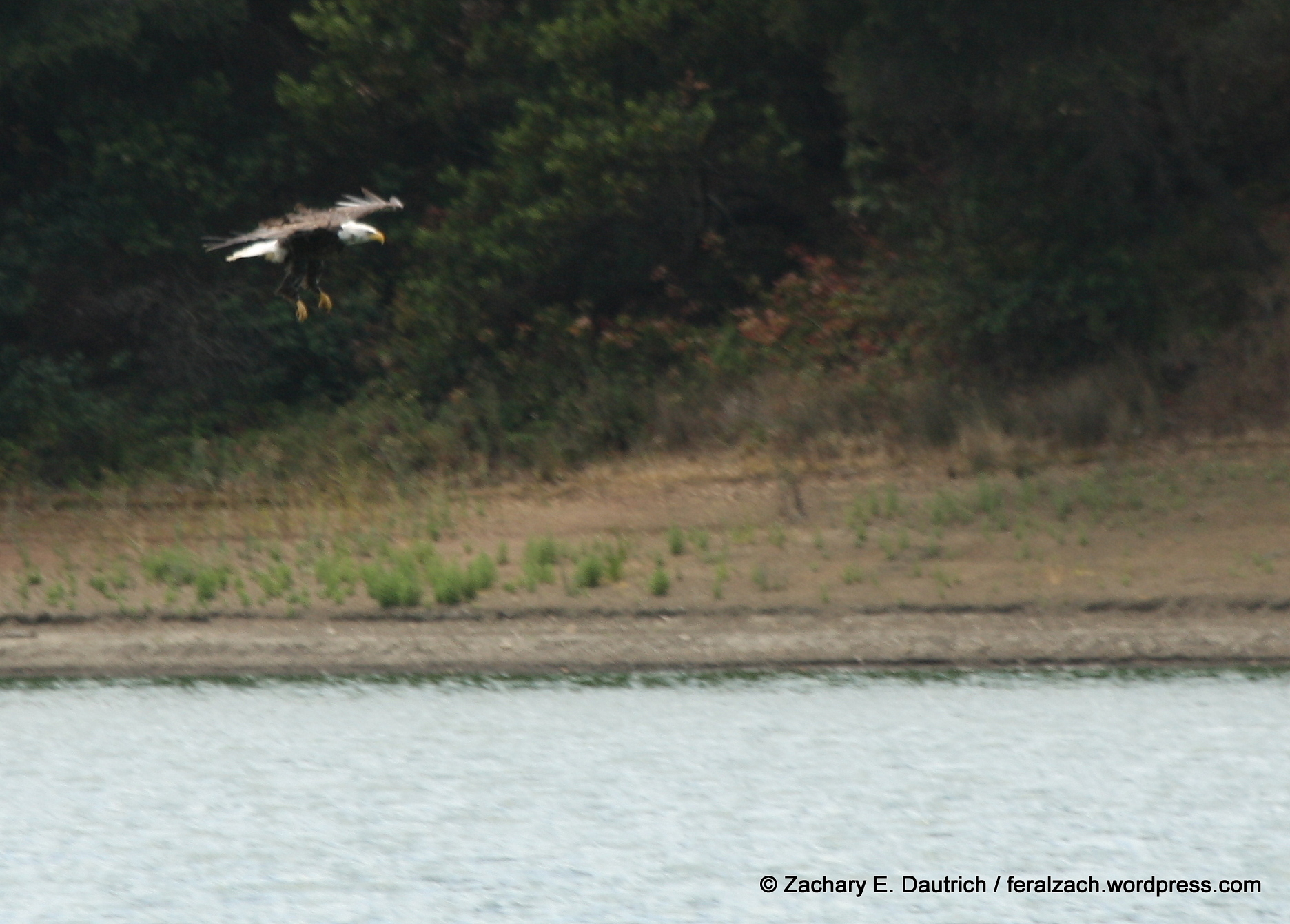
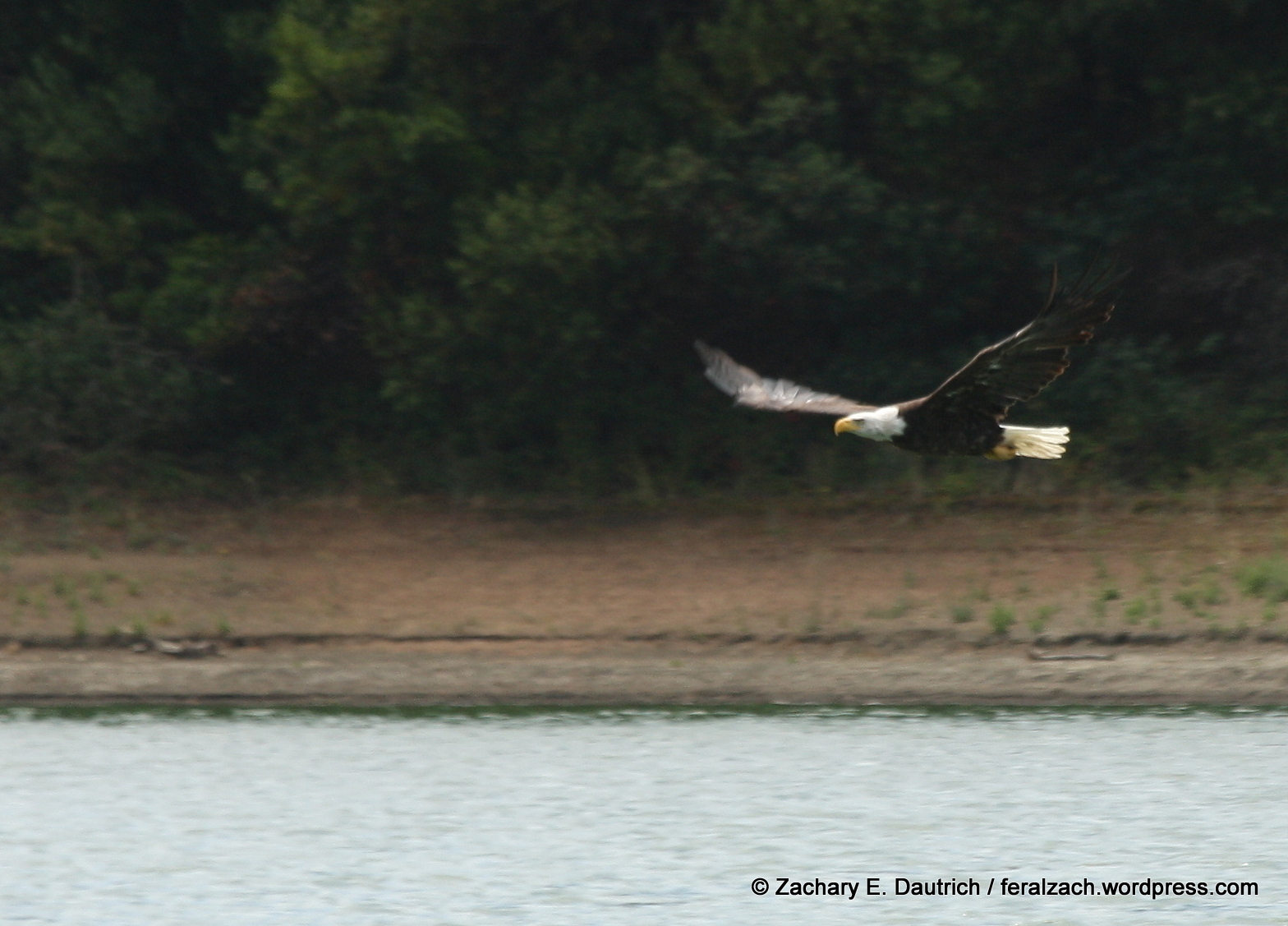
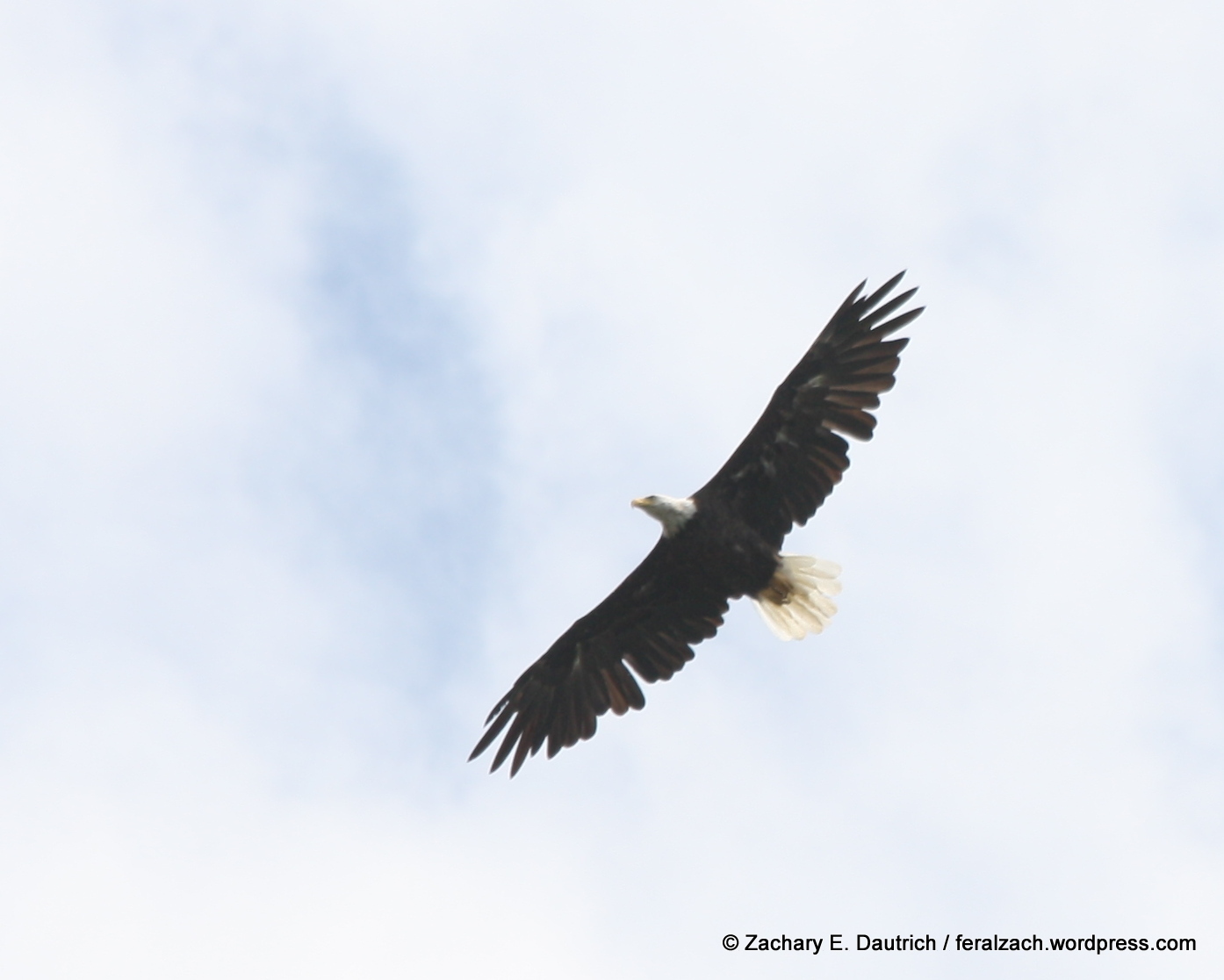
adult female bald eagle
an amazing day out on the water with these majestic birds. special thanks to Mary, Roy, Carol, Megan and Cagney for this adventure!
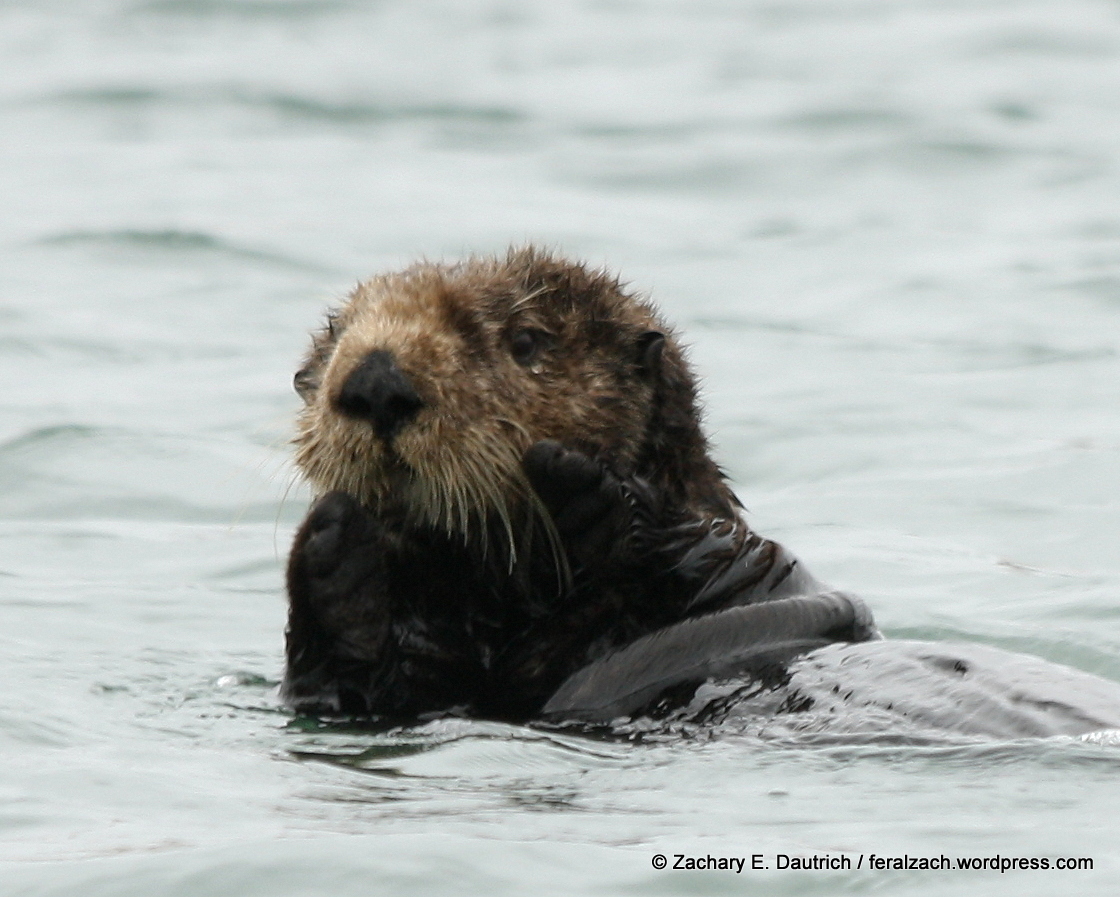
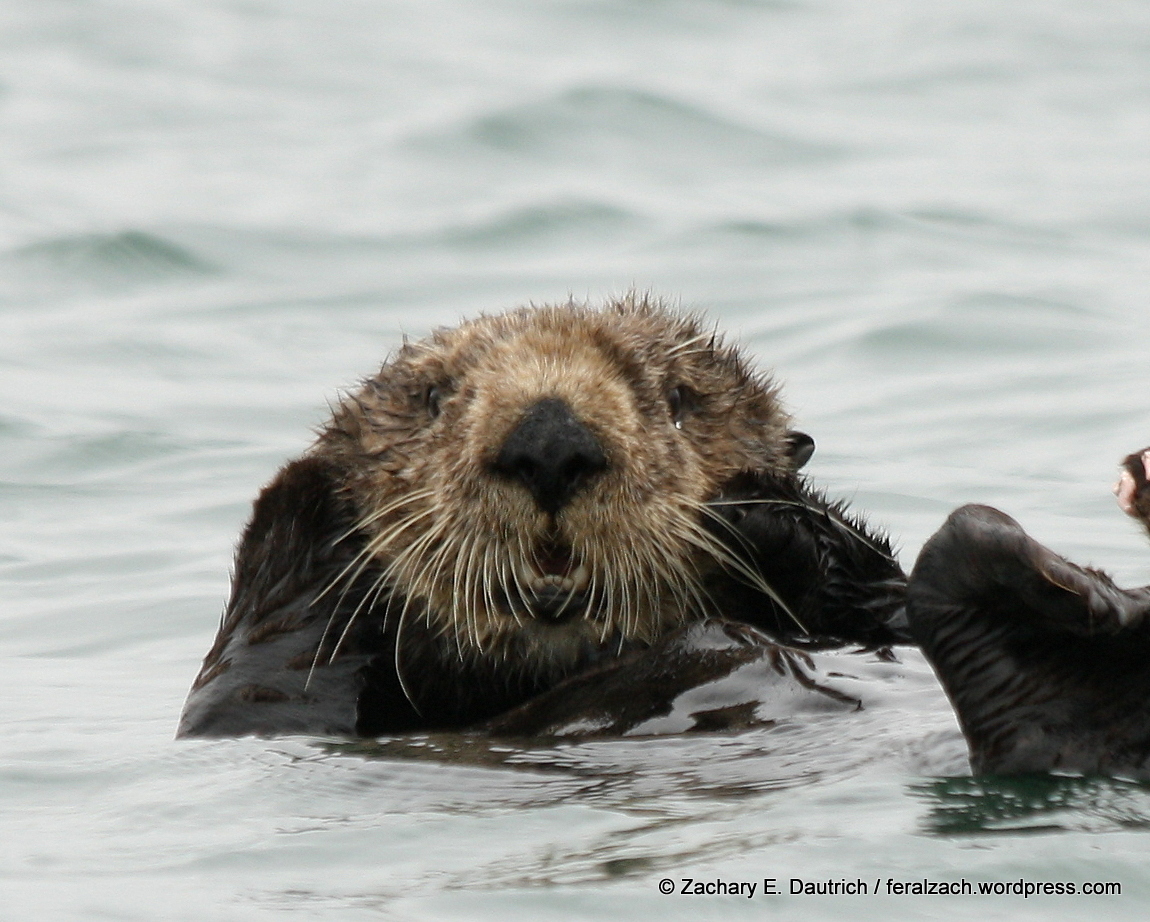
moss landing sea otters

sea otter / moss landing CA
wow, so many sea otters! humpback whales spouting and breaching right off the coast, brown pelicans soaring pteradactyl-like overhead by the dozens. two-foot diameter egg yolk jelly fish undulating just under the surface, offering a glimpse into another world, as if a specter appearing at midnight through a mist to an unbelieving eye. sea lions making a enough noise to drown out the ocean itself. harbor seals popping up like prairie dogs in a field, to take an inquisitive look at the strange creatures paddling around them – or with heads protruding vertically from the surface to nap and rest in the relative safety of the inlet. gulls, whimbrels, and other sea birds floating to and fro over the waves rolling into the bay, or picking their way over the sand flats in search of food.
this is a special place. monterey bay, and the monterey bay national marine sanctuary – a living testament to the efforts of many people to preserve an ecological diamond.

brown pelican / moss landing CA
otters in huge rafts, 15-40 of them in each. groups of male otters rolling, splashing, sparring, wrestling in the water. others grooming, some sleeping wrapped in their blanket of kelp to stay put in their rolling, flowing beds of water.

“raft” of sea otters / moss landing CA

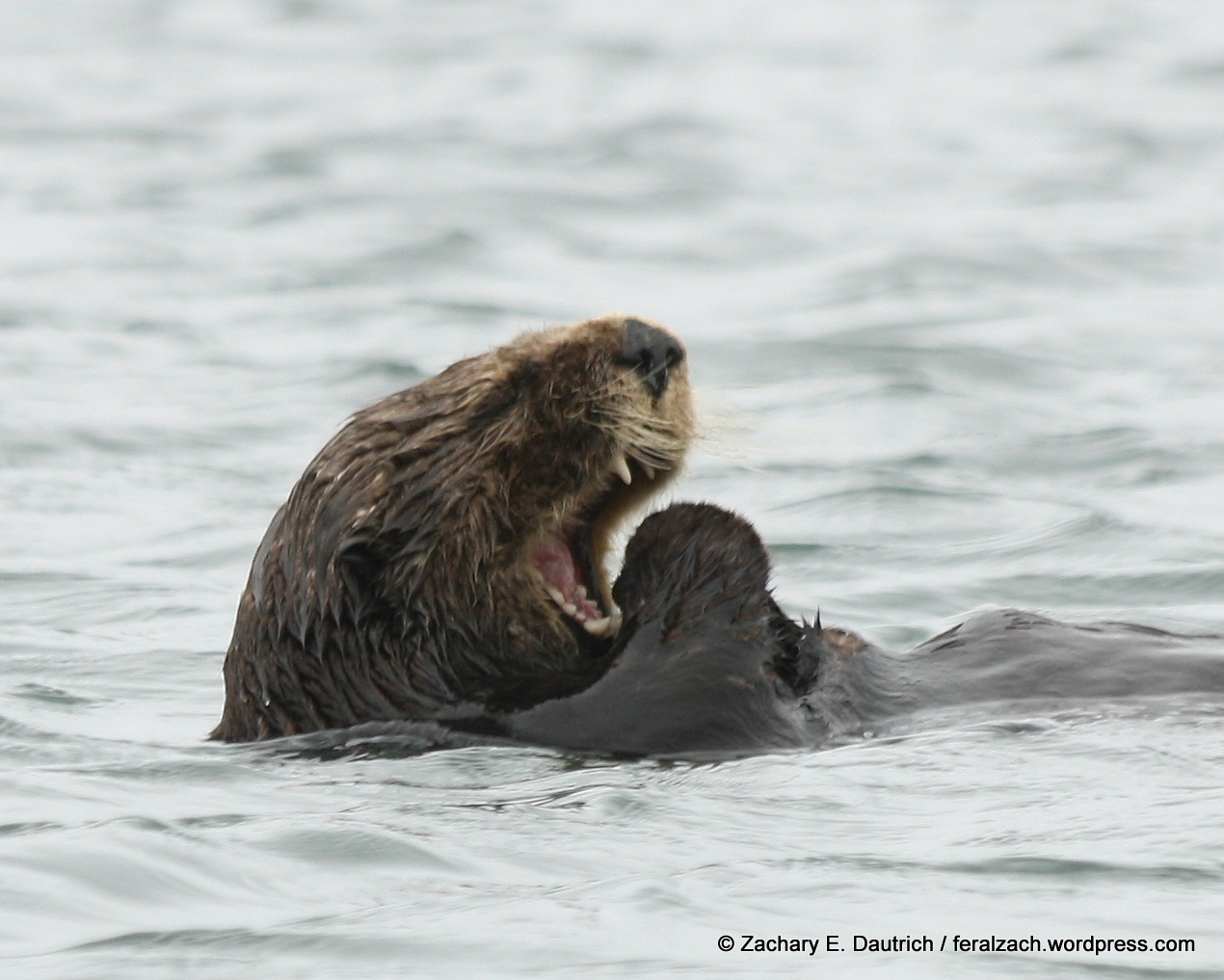
sea otter eating a clam / moss landing CA

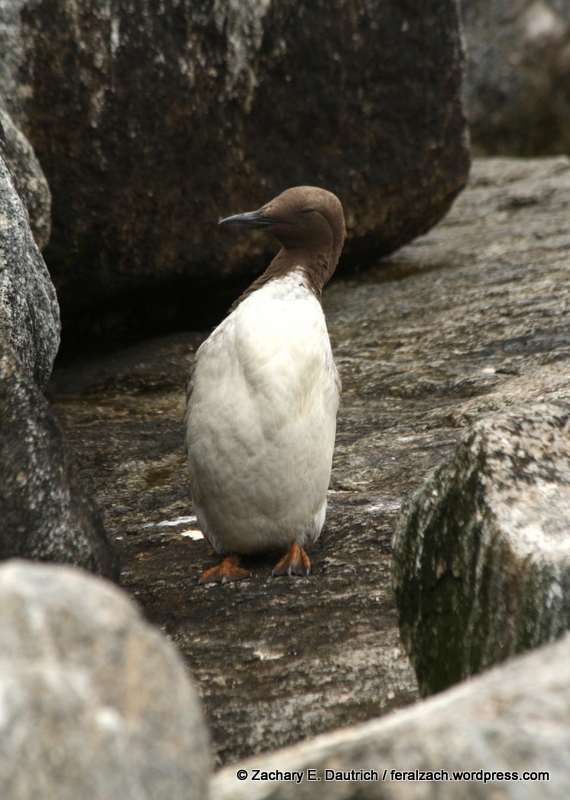
common murre taking a break / moss landing CA
they are a photogenic bunch. i could have watched them all day, despite the evidence of boredom shown by the subjects towards their onlookers …
pine marten
While backpacking in Lassen National Park, we came upon this lady/fella along a lake. Initially I just saw something glowing along the lake and thought it was a person with a very dim led headlamp on. Then the glow disappeared and re-appeared about 5 feet away from where I saw it last – and being focused on it, I could see it was two small glowing blue eyes!!!! It continued to go ahead of us for a series of two or three starts and stops, then while I was paused in the trail, it hopped up on the trail and came towards me! We had a few moments of just staring at each other – it seemed as curious about us as we were about it. After it approached us on the trail, it climbed a nearby tree to give us a thorough inspection from a safer vantage. So awesome!!!
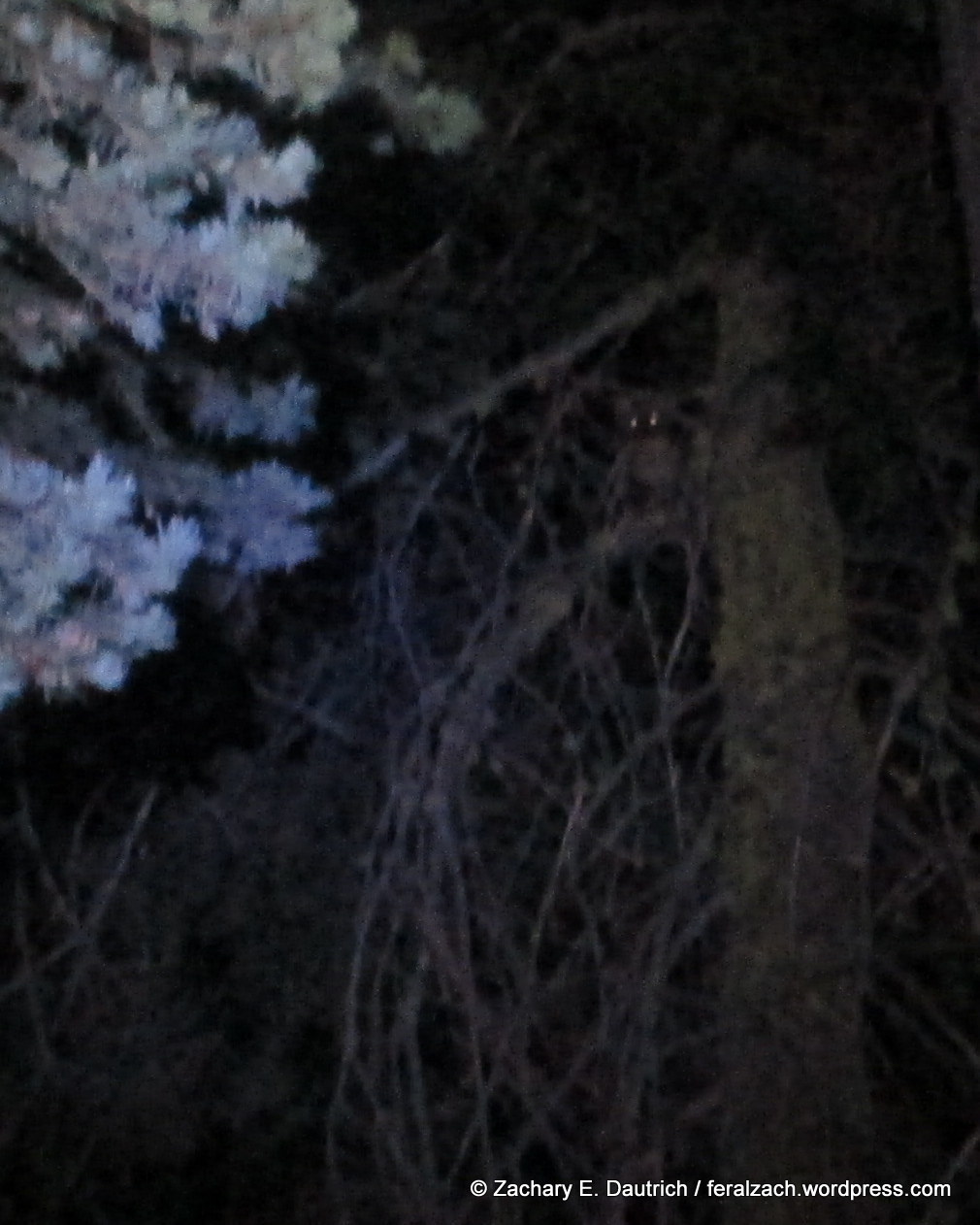
american pine marten / Lassen Nat Park CA
About 100m down the trail after our encounter, I found what is likely fresh pine marten scat.

pine marten scat
Quite an encounter, so amazing to get to see this creature up close and to have such a personal interaction with it. I love the weasels!!

sunset under a falcons’ playground
The winds surged onto the coast
like a flood of oncoming water;
And seemed to convince even the water below
that on this evening,
they could together move the giant rocks around which they are usually forced to flow.
But as the wind and the water
danced with the rocks in their daily ritual,
debating who is mightier;
The falcons flew above and through it all.
I had nearly given up on seeing the falcon fledge(s) from this nest, located on the side of the sea cliffs – instead I was ready to yield to the winds that seemed determined to drive people and most living things to seek shelter elsewhere. I watched as cormorants and gulls flapped their wings so hard and fast, only to barely make headway in the gale. Instead of leaving though, I took refuge behind a lupine bush that afforded slight shelter from its relentless surge. The rock face that rose in front of me was glowing in a yellow light that made all the colors of the coastal plants seem to glow, with hints of orange starting to invade the palette before me, foreshadowing the oncoming setting of the sun. I was astounded how the small plants that made a home in the crags on the face of the rock barely moved in the 40 mph winds, and was a bit disappointed not to see the familiar form of a falcon hiding somewhere in the midst of it all.
My eyes shut for a few moments after an already long day, and when they opened I immediately saw that familiar form on the very top of the rock – a peregrine!

juvenile peregrine falcon / Sonoma Coast, CA
It seemed to look at me for a few seconds, then it jumped off its perch and floated into the air, a few quick flaps of its wings propelling it with speed right into the strong winds.
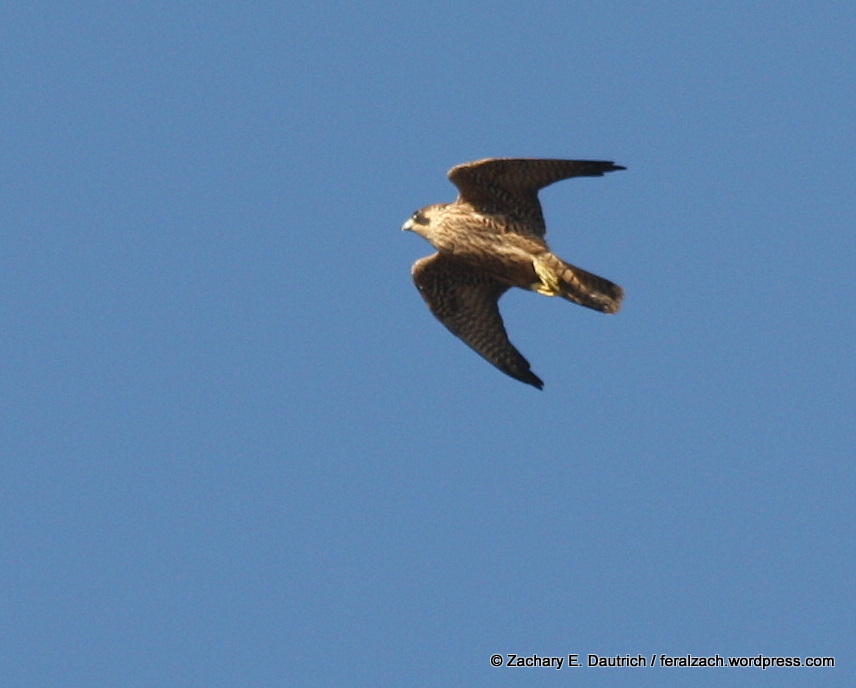
Soon it broke its relatively even glide with some quick dives at a few small birds in the chaparral – exuberant, youthful frolicking – and a bit ungraceful! It was happy to be alive and happy to be a falcon. Flying! It was definitely a newly fledged bird, and I was happy to see it had survived this long. Moments later it had disappeared.
I soon gave up my plan to watch the sunset over the waters, as the wind now was my only companion now and it seemed intent on its solitude.
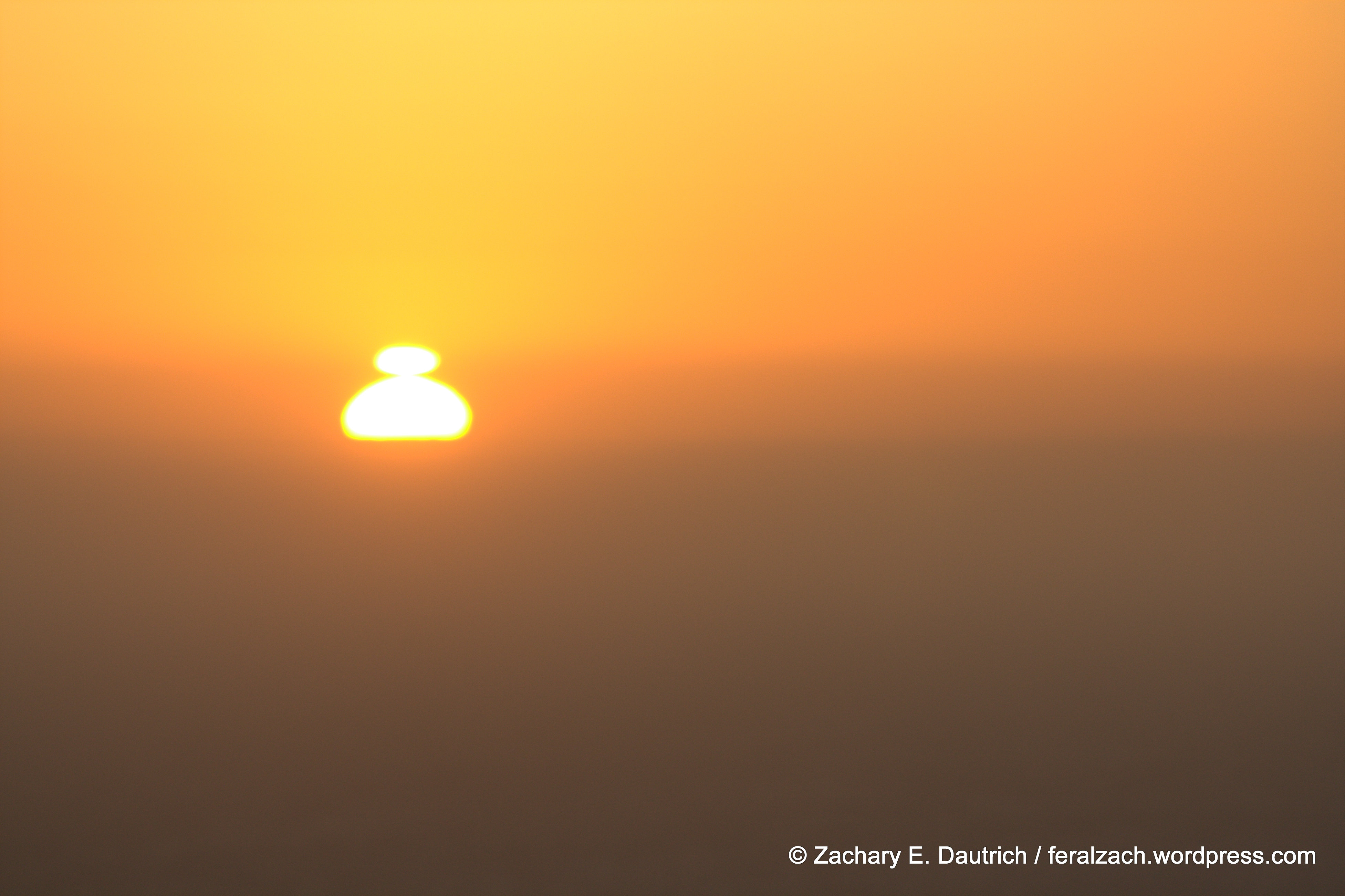
On a whim, or an intuition (or an invitation?), I decided to drive a little further into the park instead of starting my journey “home” (though wasn’t I already home?). As I crested a hill, and the Pacific Ocean once again dominated my view to the west, the sun seemed to renew its invitation to watch its daily finale. Suddenly out of the corner of my eye, two small darting forms caught my attention in the sky above the tallest hill over the cliffs of the sea …
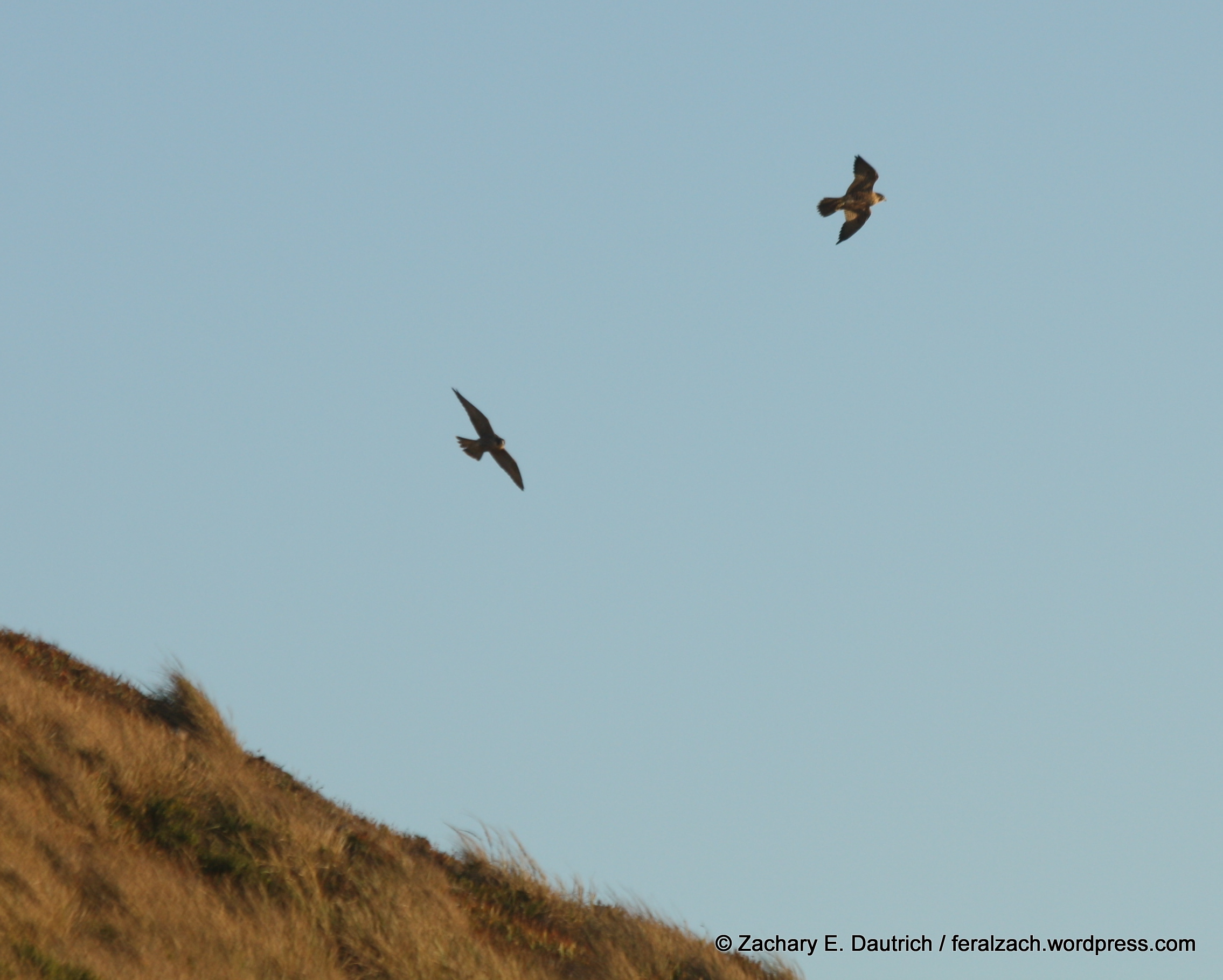
Falcons!
There were two falcons playing in the updrafts of wind on the large hill side – chasing each other, diving at one another, flipping upside down to grasp talons – an aerial game of tag! I immediately pulled over, jumped out of my vehicle and ran to join them, shouting out loud into the wind and forgetting for a moment that I couldn’t leave the ground to join them.
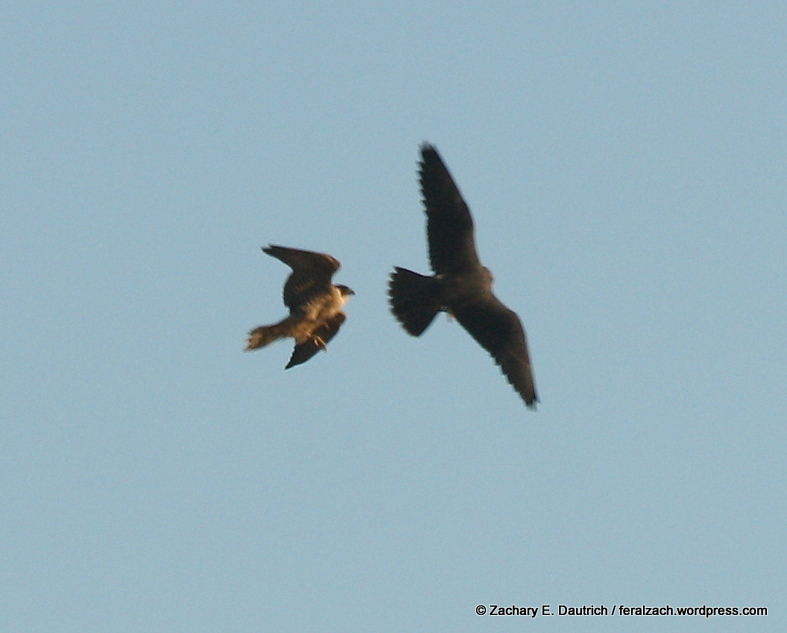
In my previous trips to check out the nest, I had only confirmed one baby, but apparently there were at least two that survived. And now these recently fledged falcons were testing and honing their flight skills with each other in the sky above me. So amazing to witness, so fun!


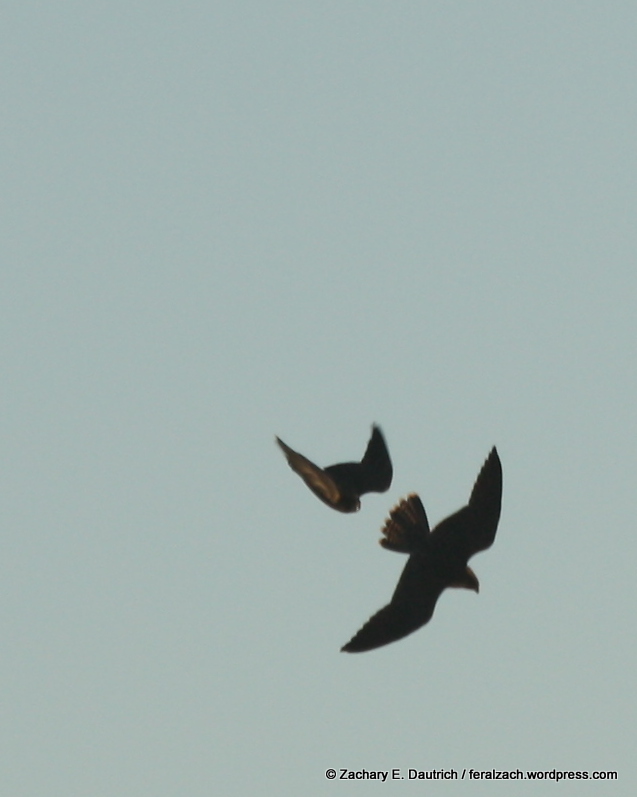

I had no choice but to accept all the invitation before me, so I settled in on a deer path that cut across the slope of the hill facing towards the setting sun. The falcons continued to come back above me a number of times, and at one point when one of the two disappeared, the other left its hover in the wind and banked in my direction, and I could feel its eyes on me! I got a fly-by! They are inquisitive creatures, and especially at this time in their lives they are investigating everything. Or maybe it could tell I would have like to join them up there.

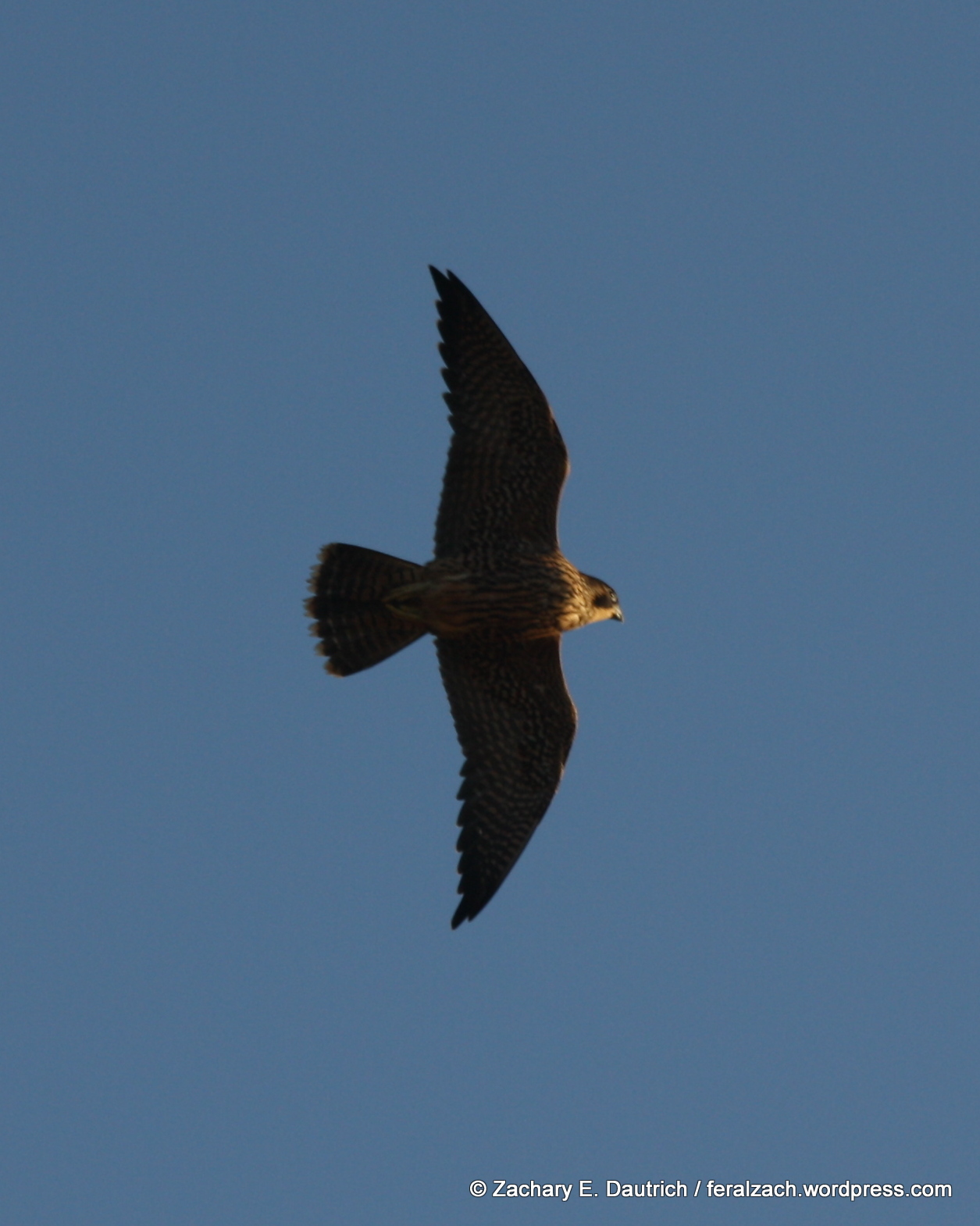
There are few things that are as fun to see (or be a part of) as young animals or kids playing, and I felt really grateful to have gotten to see this short moment of time, when these birds don’t have a care in the world and are just bursting with life and joy and excitement about being alive. Inspiring, and a reminder that we still have that in each of us if we can just take a bit of time to reconnect with it.
a black hawk in sonoma county – an inter-species love story
First off, let me say that I don’t count myself as a “birder” – not in the commonly understood definition of it, anyway. I’m not into checking boxes by a species and keeping track of my life bird count. Don’t get me wrong, I understand why people do it, and I’m happy they enjoy it. It’s just not me (so don’t call me a birder).
But I do love birds, and find myself drawn to them in particular among all my relations in the plant and animal world. For me, it is the interaction, the connection, with these other lifeforms that is the real juiciness. That is what drives my passion to be out in nature – genuine connection. Often that takes the form of simply witnessing … which in and of itself is extremely rewarding. Sometimes it’s not even seeing the animal, just its track & sign. But occasionally there’s an actual interaction, and when it happens – on the animal’s terms – it is magical. Sometimes too, it’s the story that accompanies a sighting that makes it memorable. It’s always about the story though, isn’t it?
So the appearance of a black hawk in Sonoma County – while certainly alluring to birders who get to check another box on their list – is of more interest than just that. It is also a unique love story.
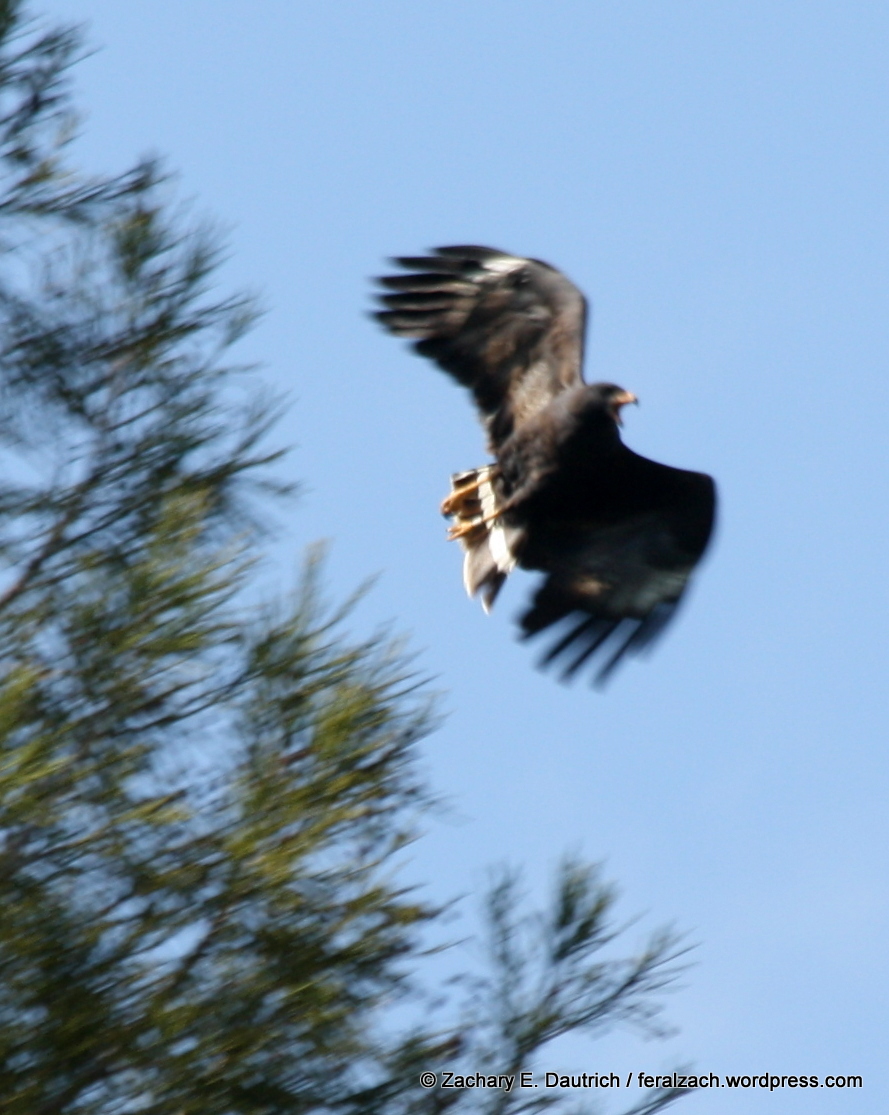
(not so) common black hawk / Sonoma County, CA
Not only has a black hawk (normally native to texas, arizona, new mexico and points south) chosen to make its home here, it has taken a mate of another species (no, it’s not me) – a red-shoulder hawk!
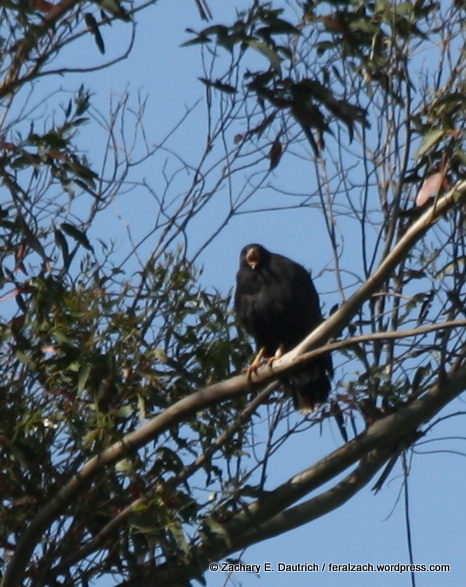
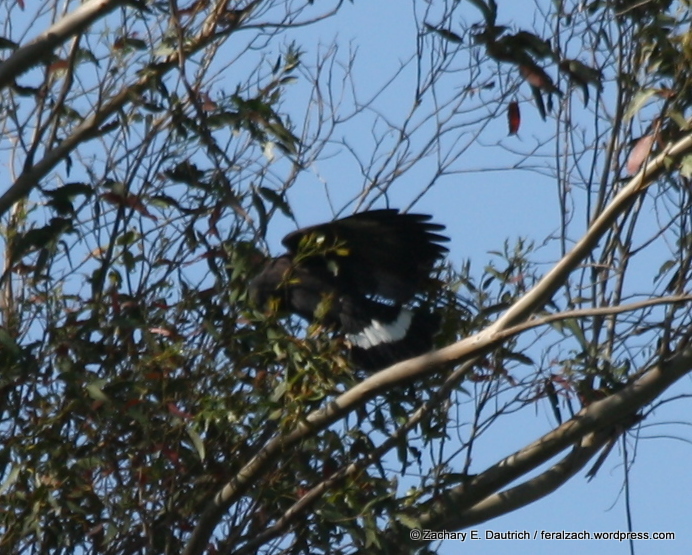
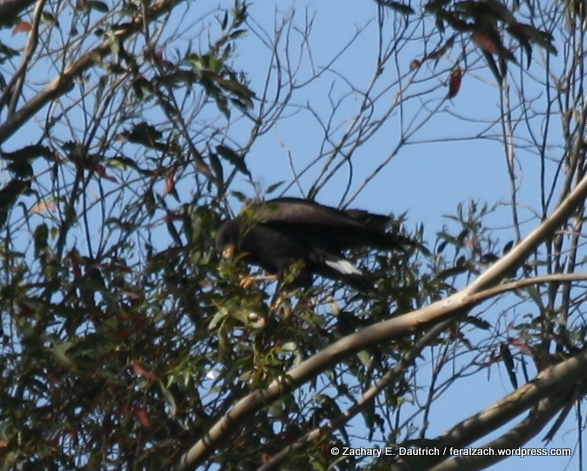
I started watching the nest about a month ago after being notified of its whereabouts by some friends at West County Hawk Watch. It is located in a tall eucalyptus tree, and not easily viewed due to a lot of other trees around it (and private property). My first day there, they were brooding and I got to see two nest exchanges. Initially the black hawk was on the nest, then after a bit of time she started to make some vocalizations that reminded me of a kestrel. A few moments later, a red-shouldered hawk appeared in the air and flew to the nest, taking over incubation duties for enough time for the black hawk to stretch and do a little bit of preening. Then she was back on the nest – but not until she grabbed another few branches to add to it …
I’ve returned to the nest a number of times since, most recently on Sunday. It was a very hot day with temperatures in the upper 90’s (f), and when I arrived the black hawk was in the nest panting (black feathers are an interesting feature on a bird that typically lives in the hot dry desert?!). Once I set up a scope, my eye was treated to what I had been hoping to see – a fuzzy white head! There is at least one baby!
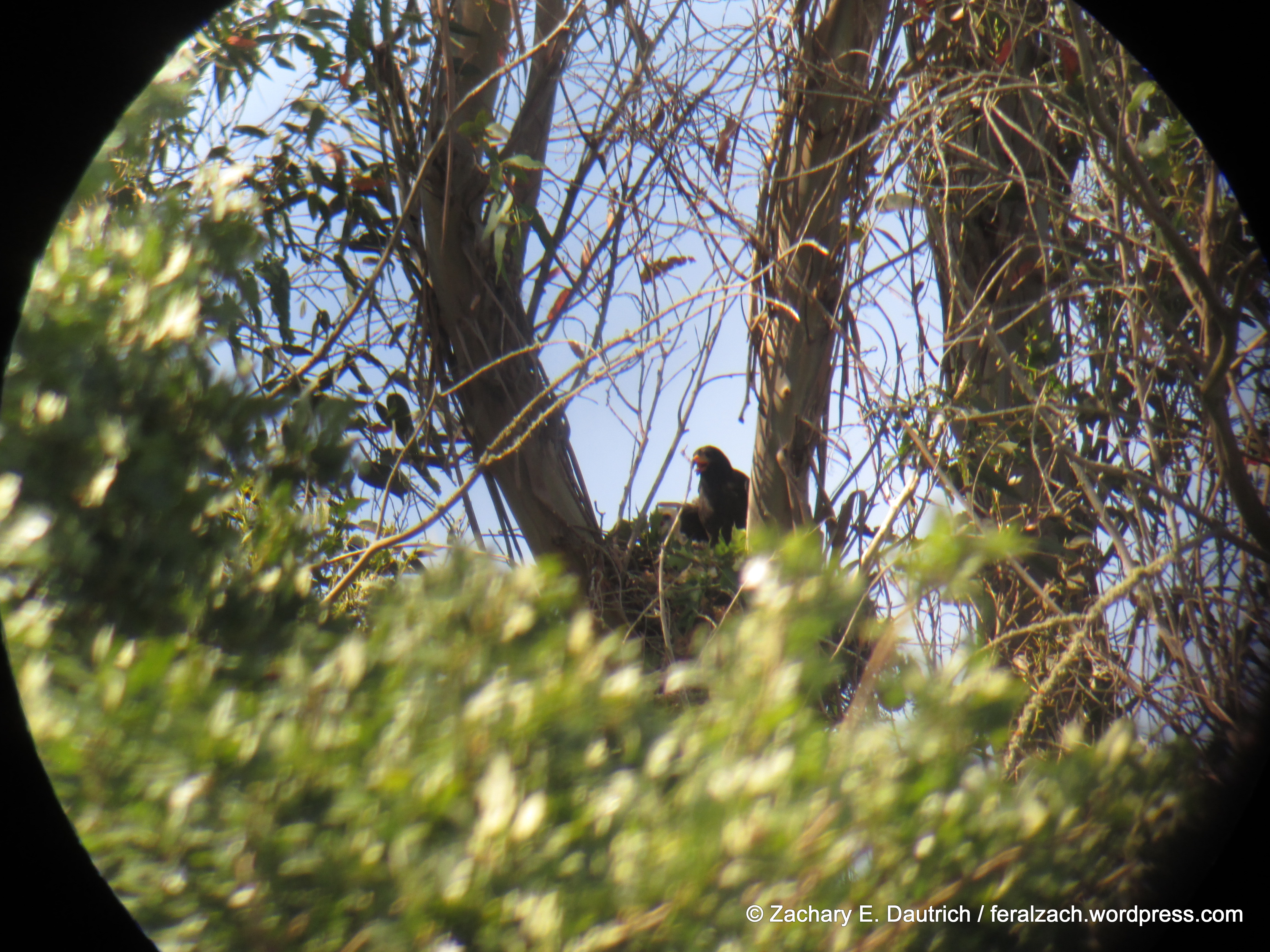
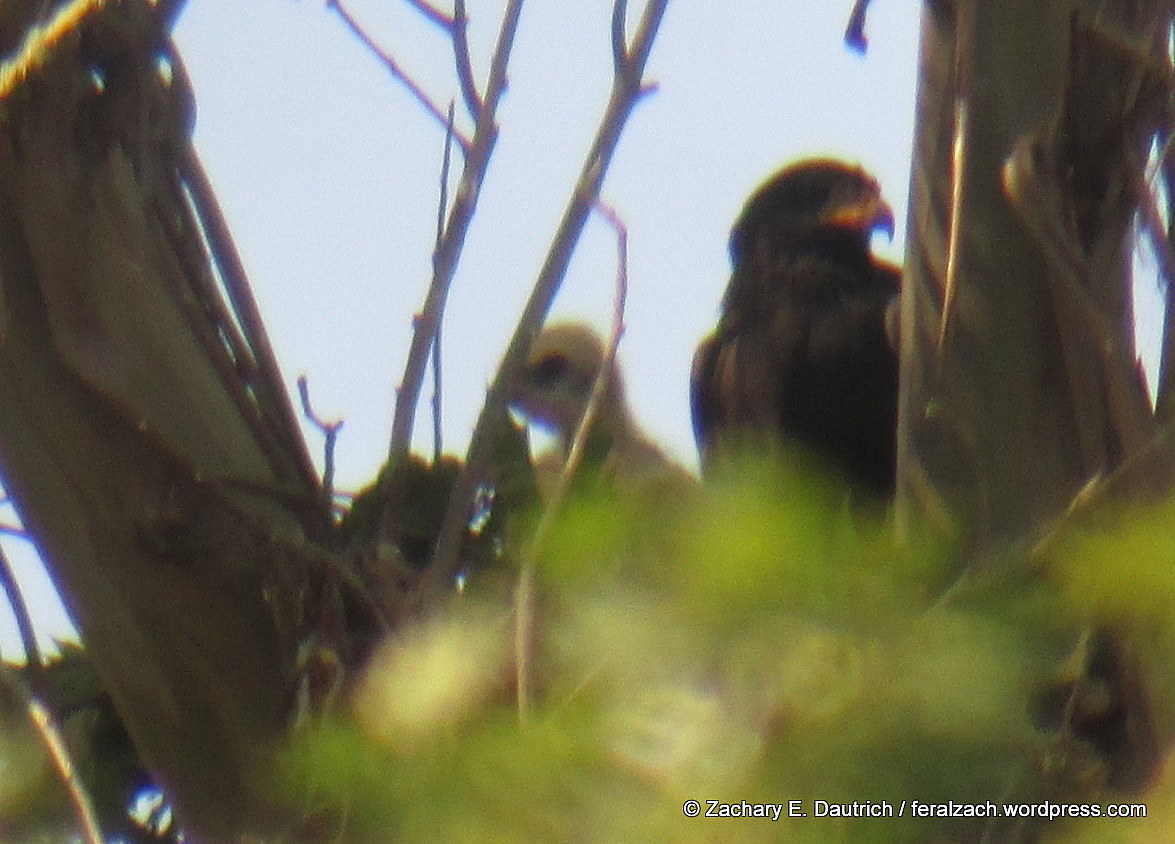
black hawk and eyas / Sonoma County, CA
I had heard that this same couple, the black hawk and the red-shouldered hawk, had young last year. I felt lucky to get to see it with my own eyes. What will this little creature grow up to look like? Time will tell, and I hope to have updates soon as the little one grows and starts to get its first set of feathers.
I never saw the red-shoulder on Sunday, likely because I was there during the hottest part of the day when there is little animal activity (they are smarter than me, evidently). The pictures were digi-scoped, so they aren’t the best quality, but it allowed me to capture this exciting occasion.
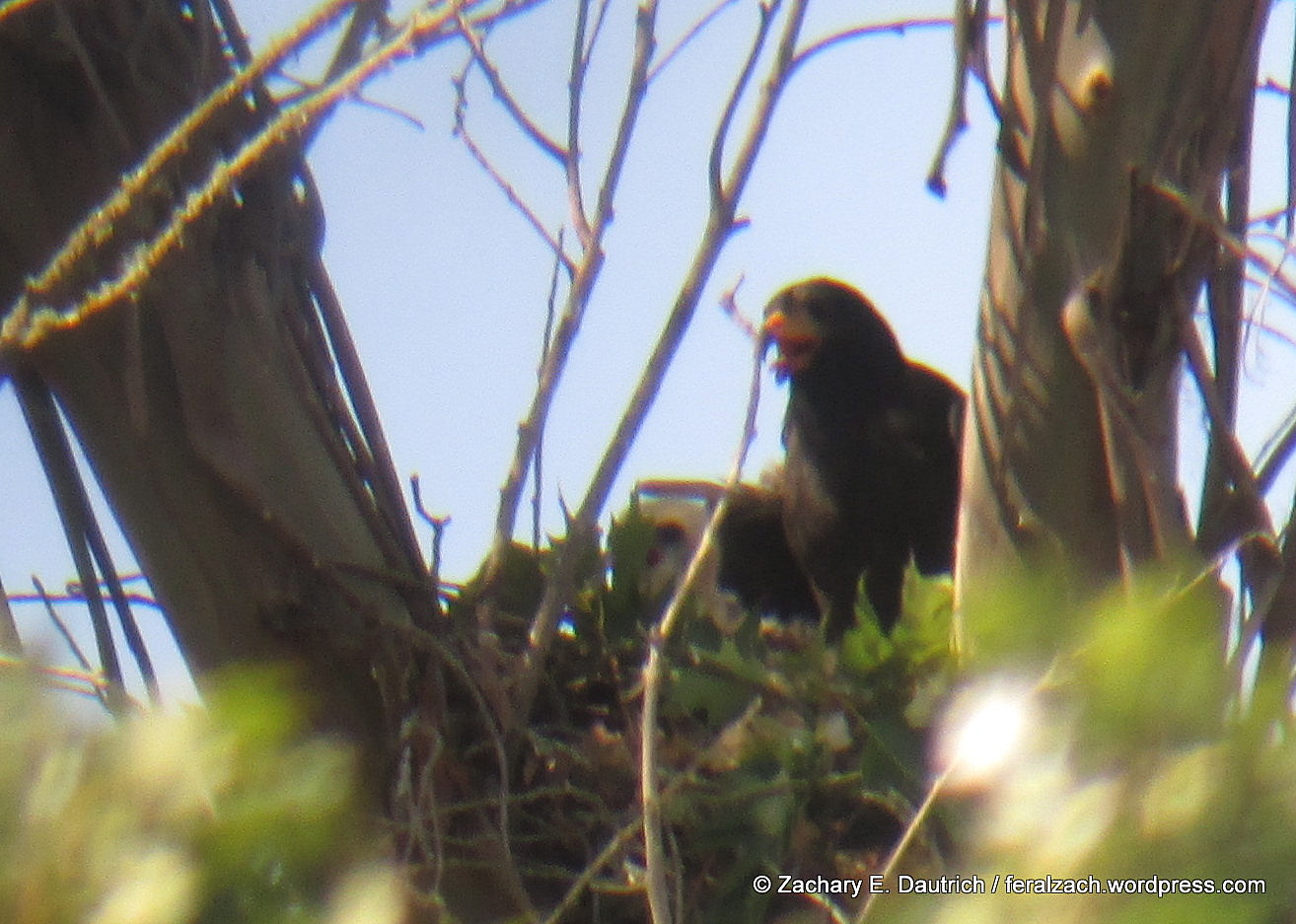
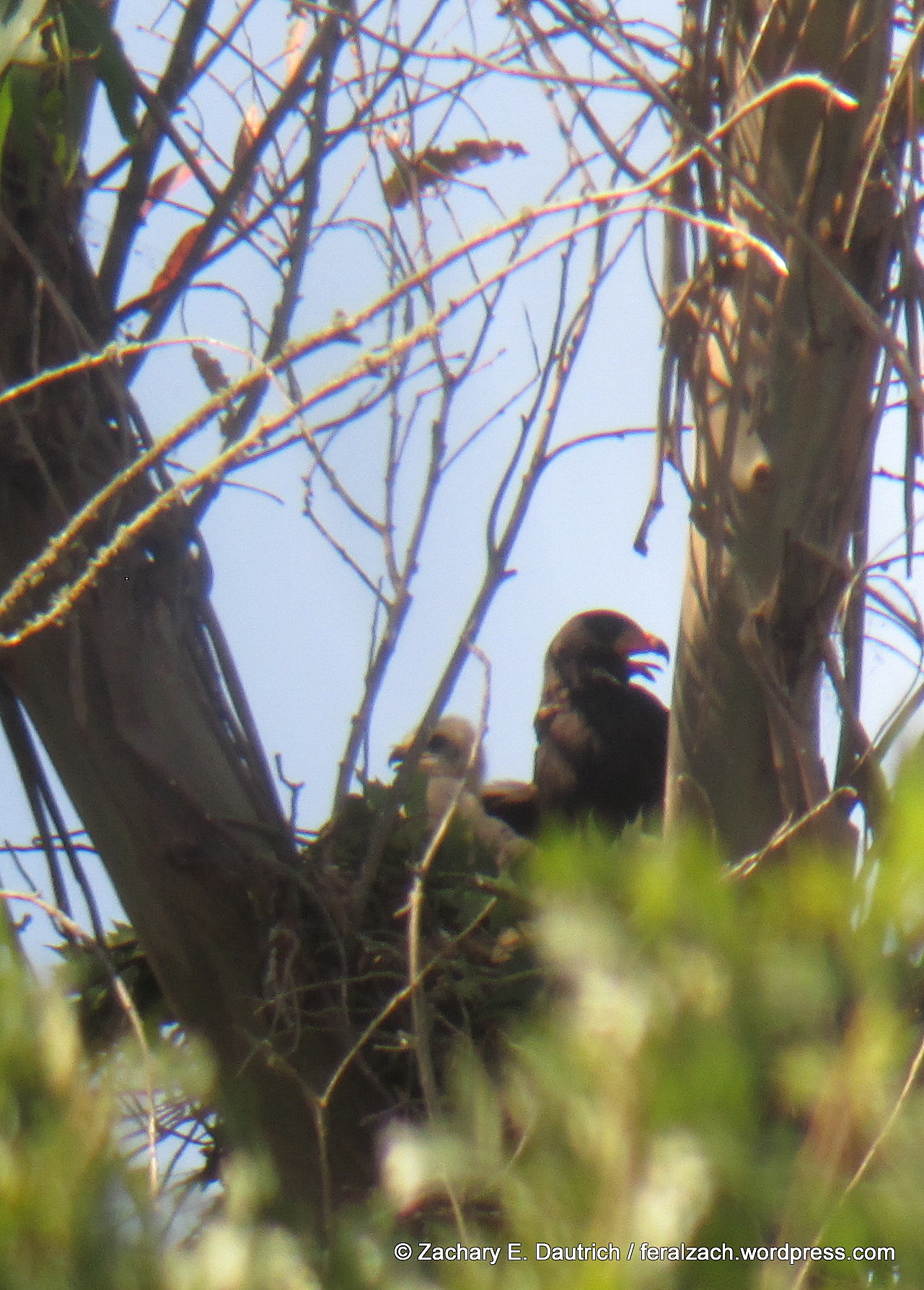
Thanks to Larry Broderick and Yvonne Motherwell for sharing the location of the nest and supporting efforts to document and spend time witnessing these amazing animals.
goatsucker!

common poorwill
I saw this little one a few weeks ago in the mountains east of San Jose – it landed on a dirt road in front of us as we were slowly driving back to camp – with headlights and an additional LED flashlight, I was able to get this picture. It is a common poorwill, part of the nightjar family of birds, which are nocturnal birds of prey. I don’t often see them, but it’s actually the second time I’ve photographed one in the wild! See my earlier blog post from last January (2013).
They were know as “goatsuckers” due to folk tales that they sucked the blood of goats during the night. So far, there has been no evidence of this – but they do eat a lot of insects.
soar
i could watch the eagles and red-tailed hawks soar all day
everyday

adult golden eagle
[Grant Park, Santa Clara County CA]
rain wanderings and newt attacks
I couldn’t help but smile in the dwindling light tonight, as my footfalls fell softly on the soft wet ground to a chorus of water drips falling from the leaves around me. It hasn’t been often this year to feel the rain drops on my face – hopefully we continue to get some more before the usual rainy season ends in a month or so.
As I reached the high ground on my short wander in Wildcat Canyon, the winds started to pick up and the rain became heavier. I gave a couple of hoots at a spot where I usually see one of the pairs of owls, and after a few steps I saw one of them perched out on a branch in his “transition” spot where he goes just before heading out to hunt. He was hunkered down in the direction of the wind and rain to the west, leaning over to allow the gusts to flow around his feathery coat. But after a few moments, he seemed to think it a better idea to go back to bed, and he returned into the deeper woods of Monterey Pine and Douglas Fir where he took a few moments to give a few hoots.

great-horned owl
As I hopped down the side of the hill, I noticed a number of newts were also out enjoying the rain. Towards the bottom near the parking area, I found one of them enjoying some breakfast – an earth worm!
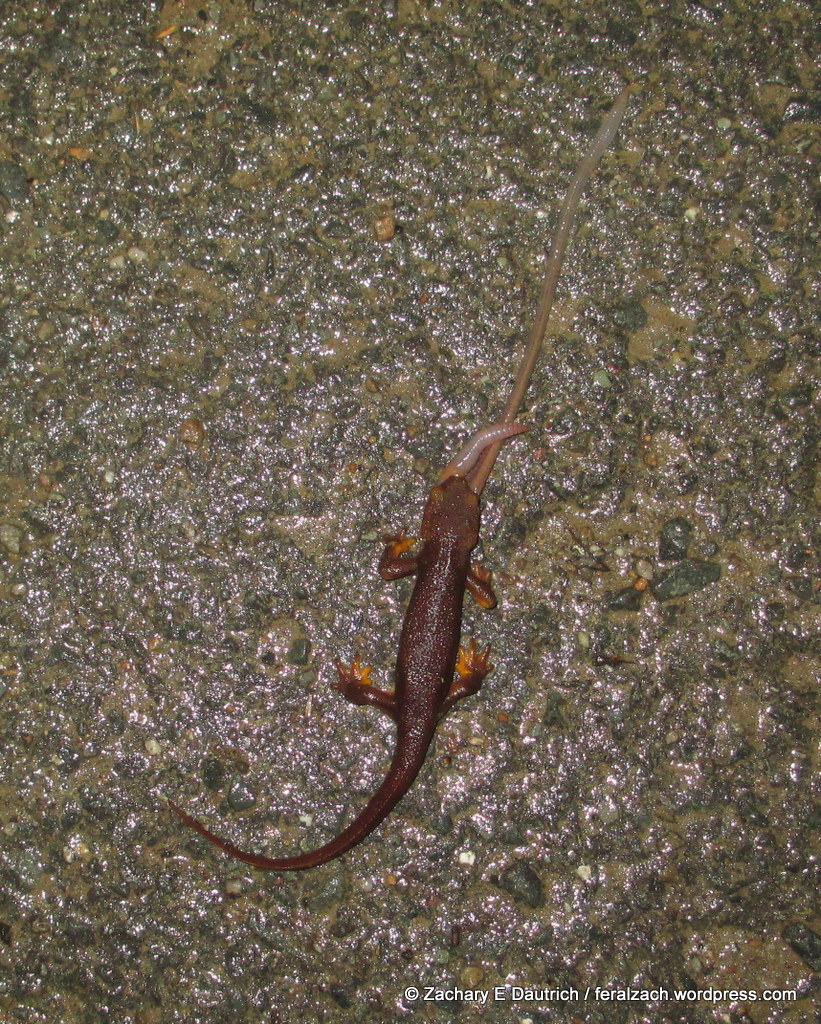
newt eating earthworm
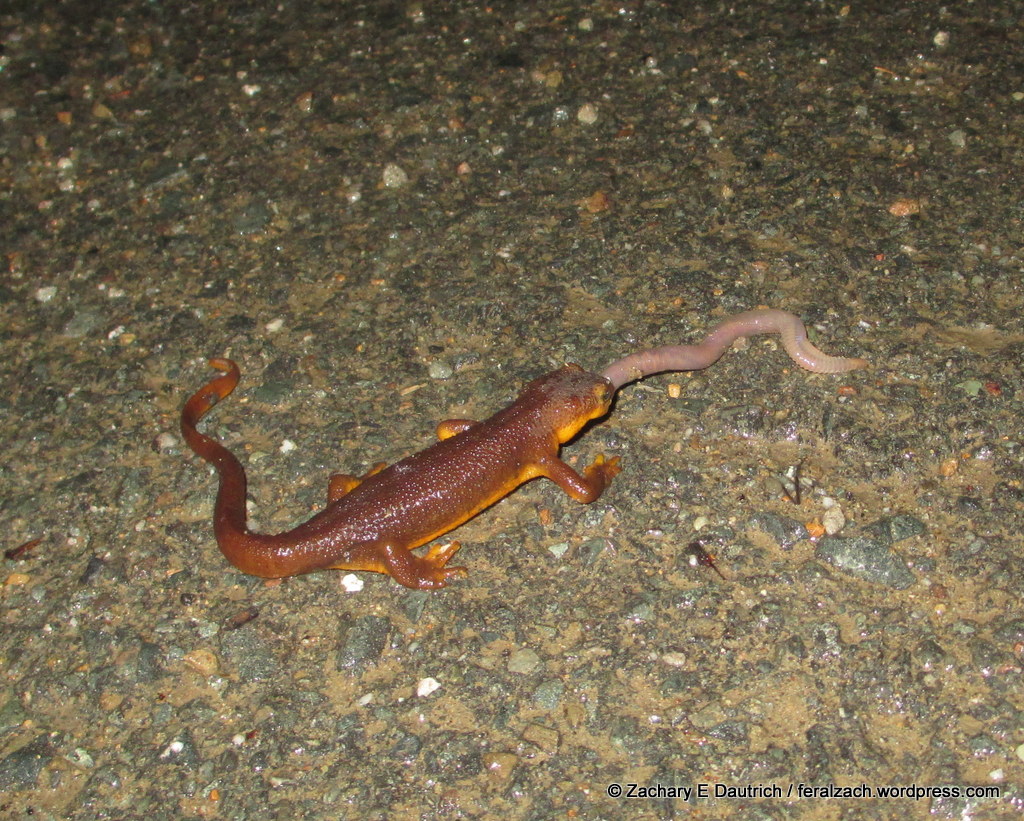
newt eating earthworm
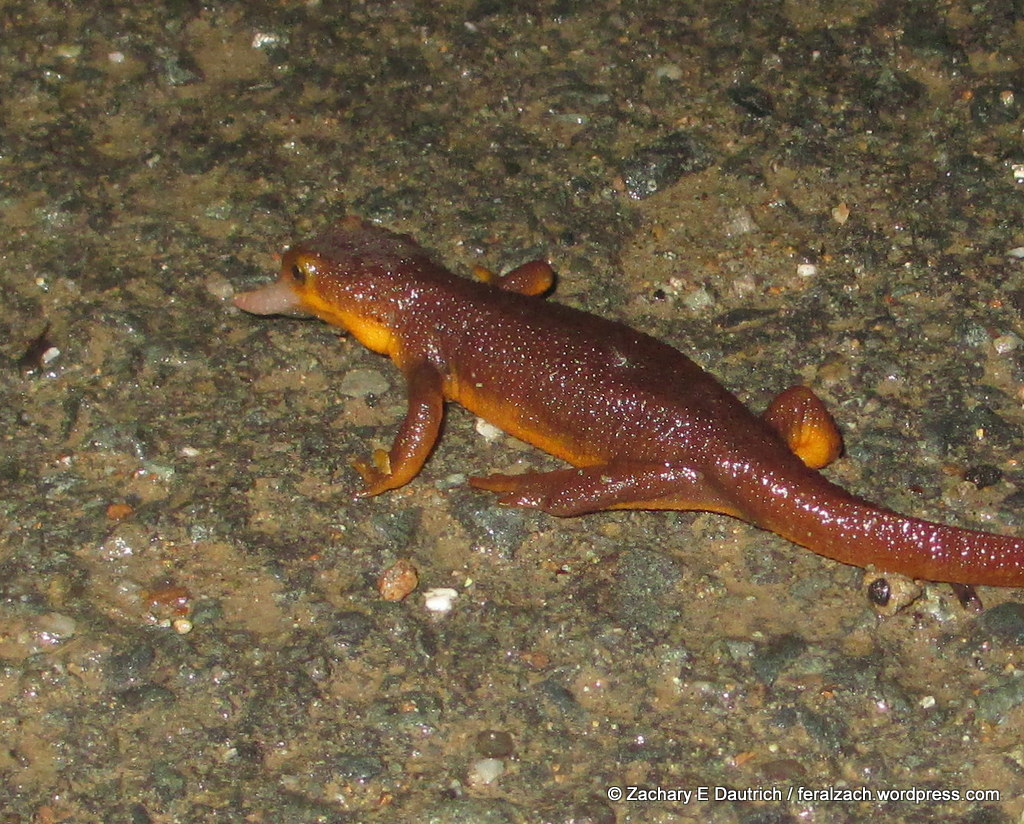
almost done …
It only took the newt about a minute or two to finish the worm, which didn’t seem to struggle all that much. After it was done, it walked off into the canopy of some milk thistle on the side of the path.
I love newt feet.
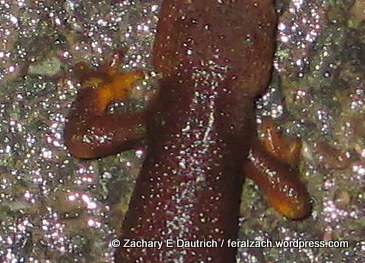
newt front feet

newt rear feet
The newts I saw tonight are likely the California Newt, Taricha torosa – hard to differentiate from the rough-skinned newt (Taricha granilosa) which is also found in this area.
Let it rain!
chasing mountain lions blog to resume soon …
I’m excited to report that I am helping with a new puma project in the Bay Area, my other blog chasing mountain lions will be updated with a new chapter soon …
Here are pictures of tracks of two of the cats that we are tracking and trying to capture right now in the mountains East of San Jose near Mount Hamilton:
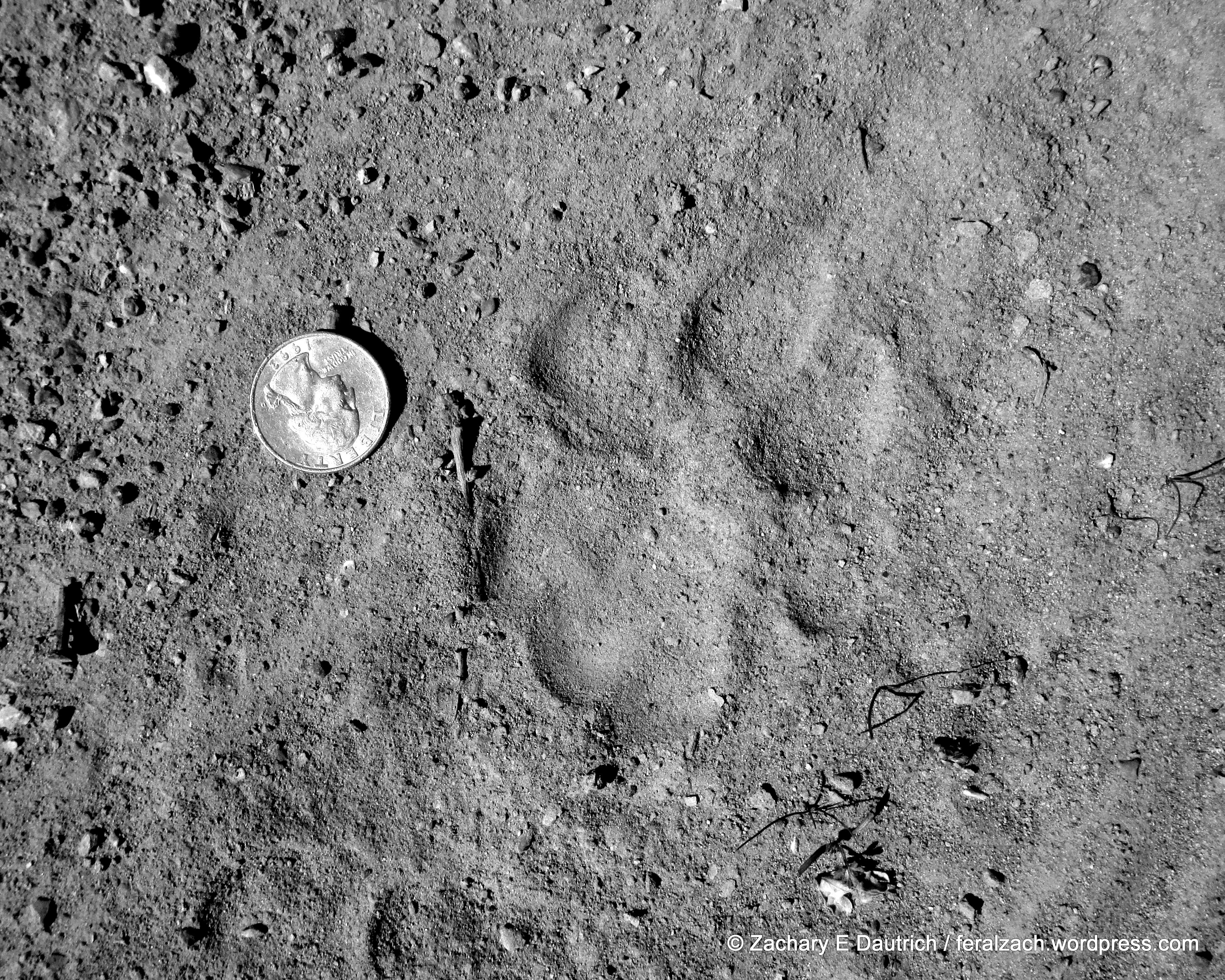
male puma track

female puma track
And here are a few of the residents where we are tracking the lions for capture (to outfit them with GPS collars) …
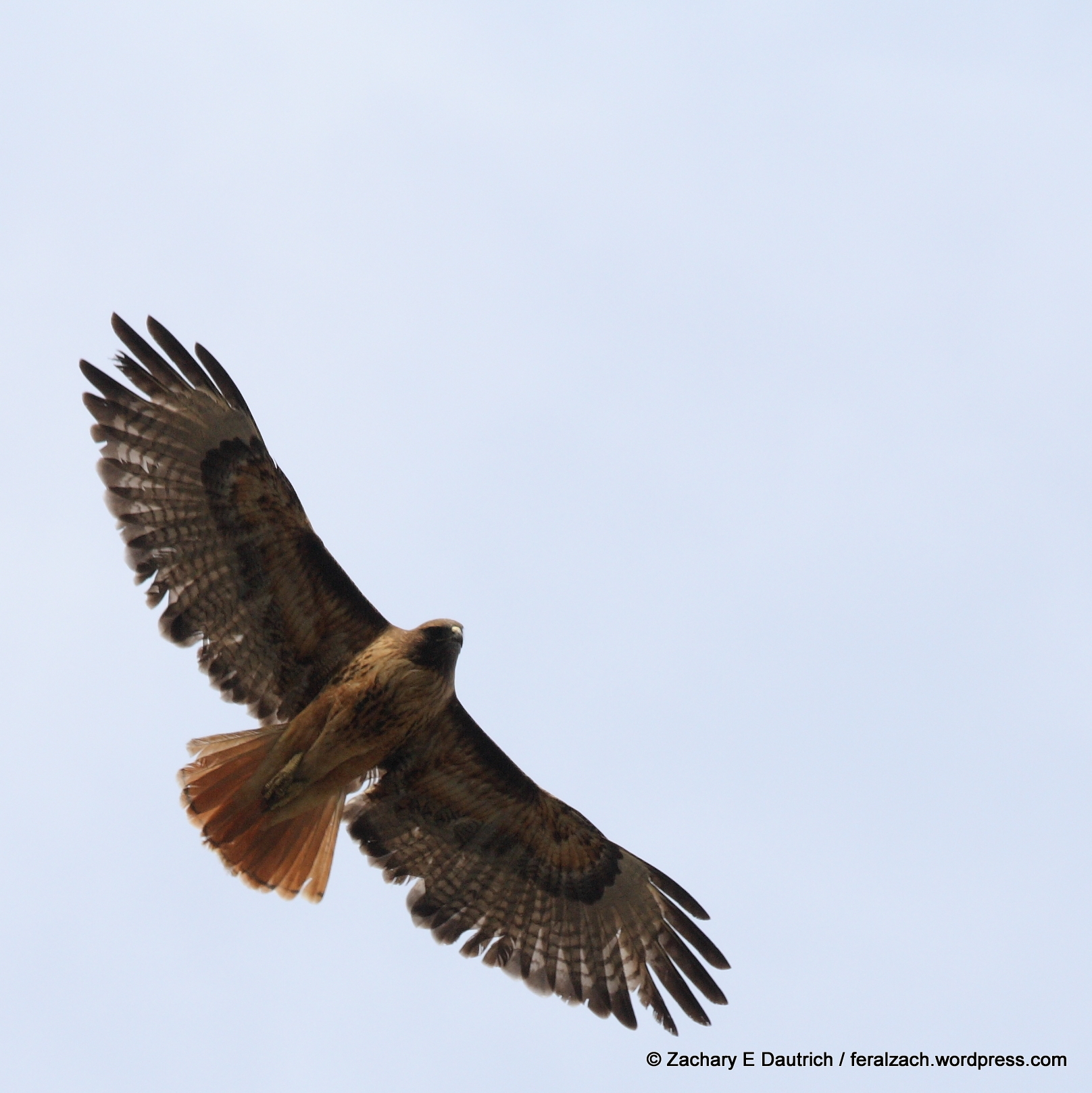
red-tailed hawk
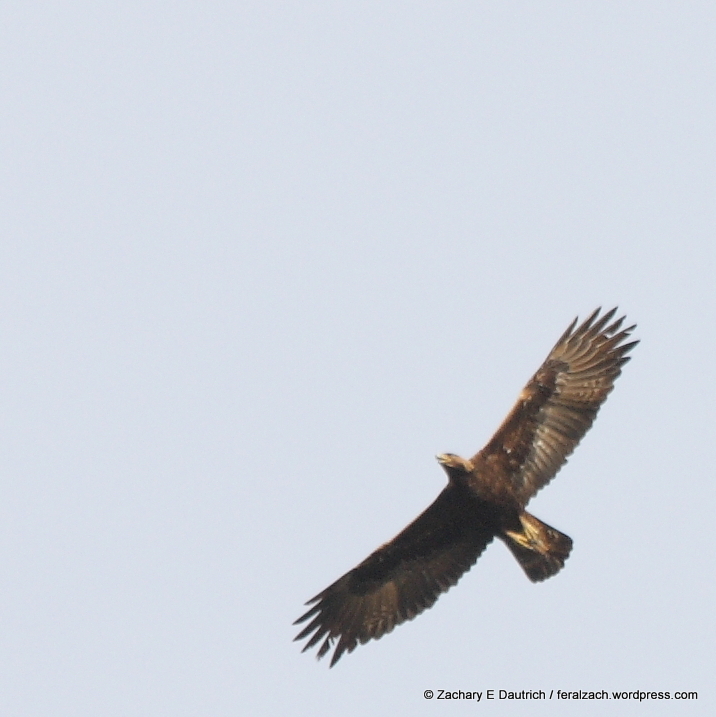
adult golden eagle
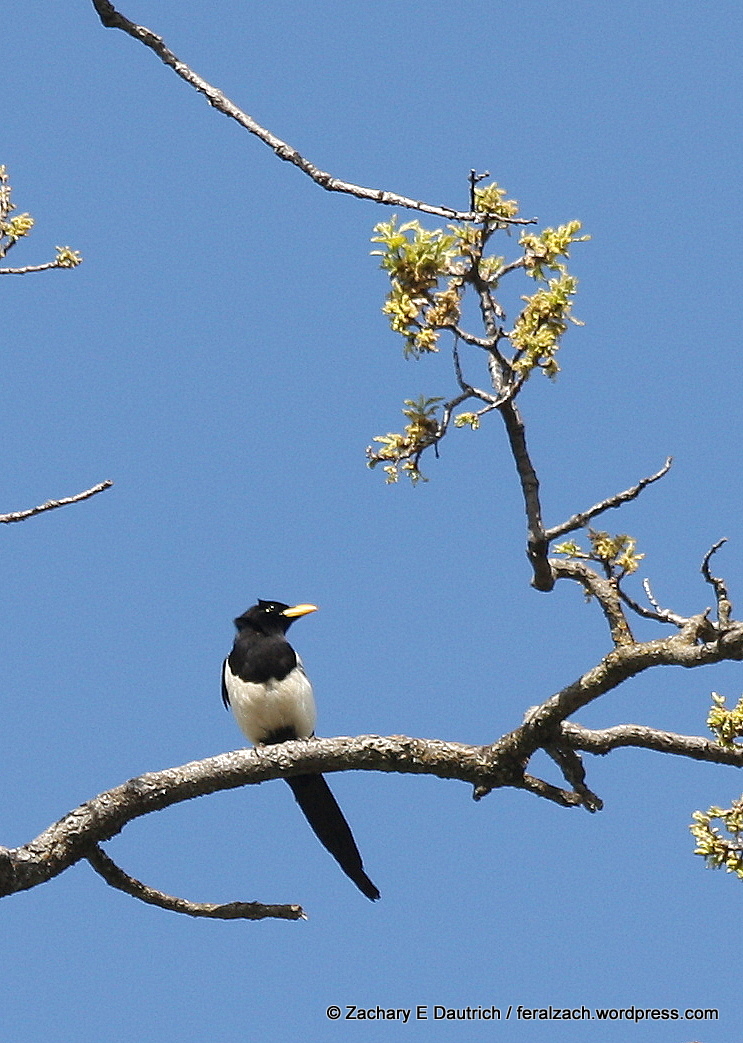
magpie

white oak “monster”

great-horned owl

the amazing pooping bobcat

60 second old bobcat scat!!
More to come soon …
dark morph red-tailed hawk
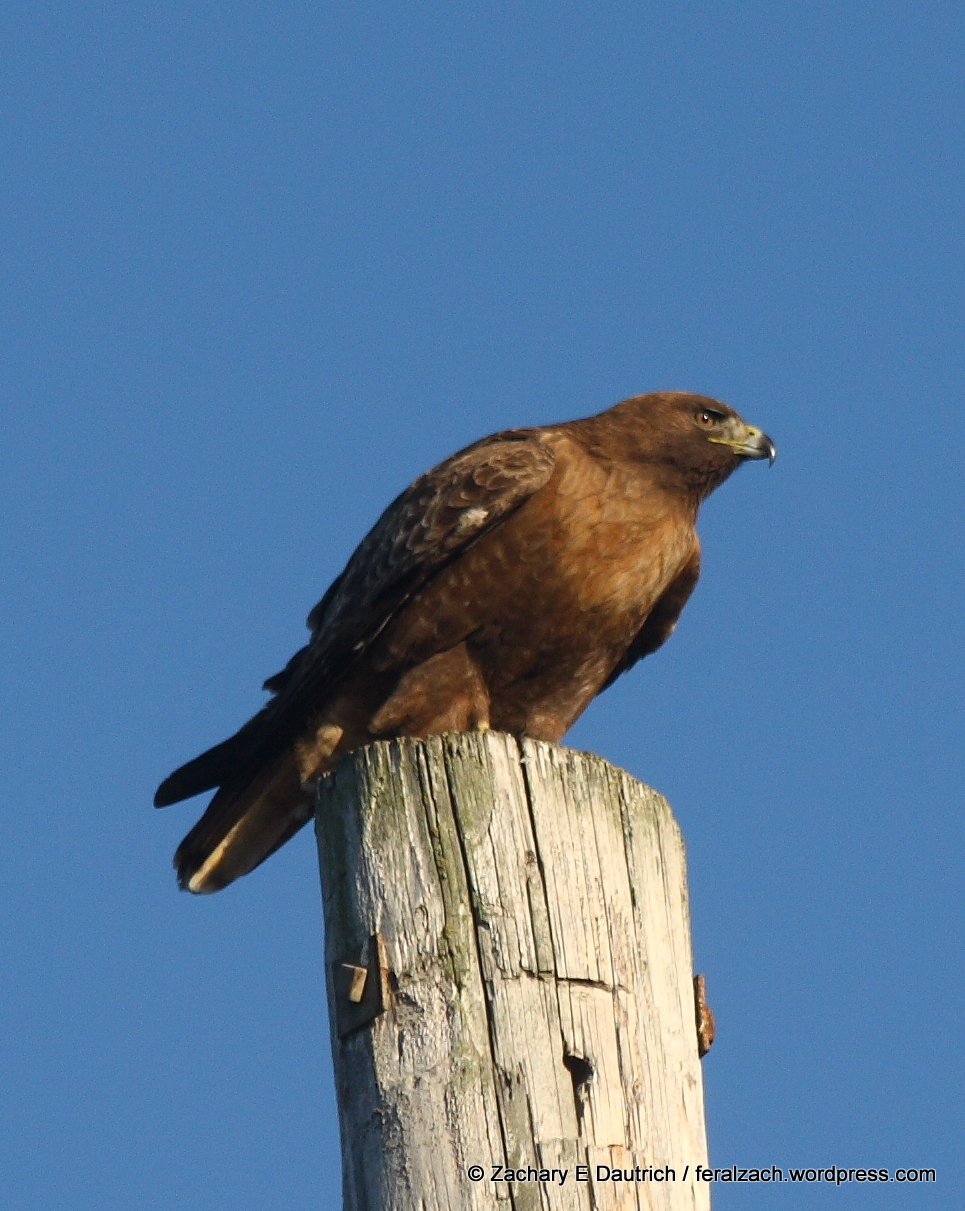
i ran into another old friend on friday … a dark morph (or rufous/intermediate morph) red-tailed hawk that has spent the last few winters in berkeley. it’s fun when i get to know an individual animal, and this one has been around for a few years but i just saw her for the first time this season about a week ago. i was happy to see her again.
when i first saw her we gave each other a little wave (ha!)

right about the time that i saw her, a huge flock of crows was moving through the area and it didn’t take long for some of them to spot her too. crows love to harass red-tails, and today was no different. first one or two took up the chase, and soon there was a flock of close to 50 crows escorting her out of the area.

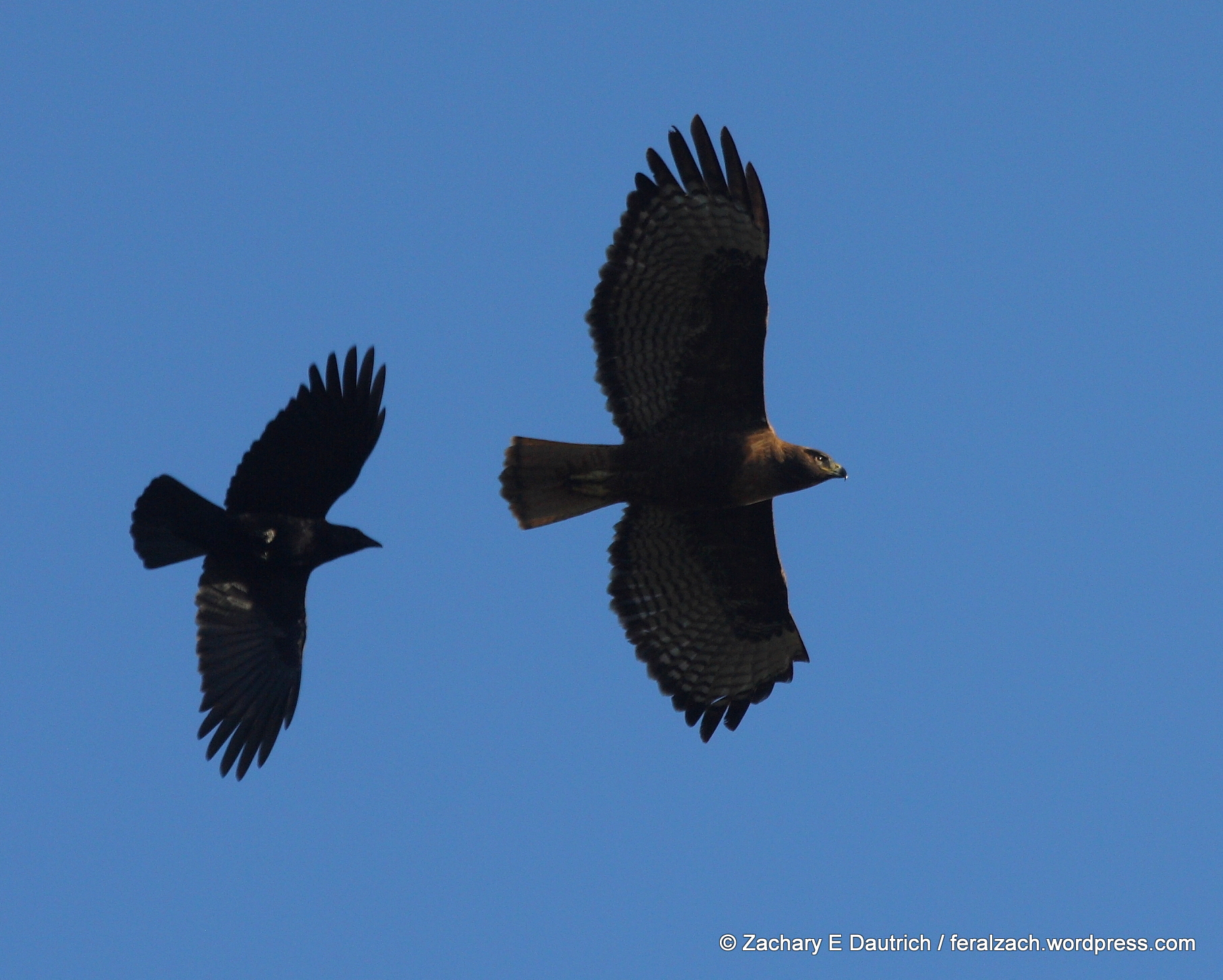

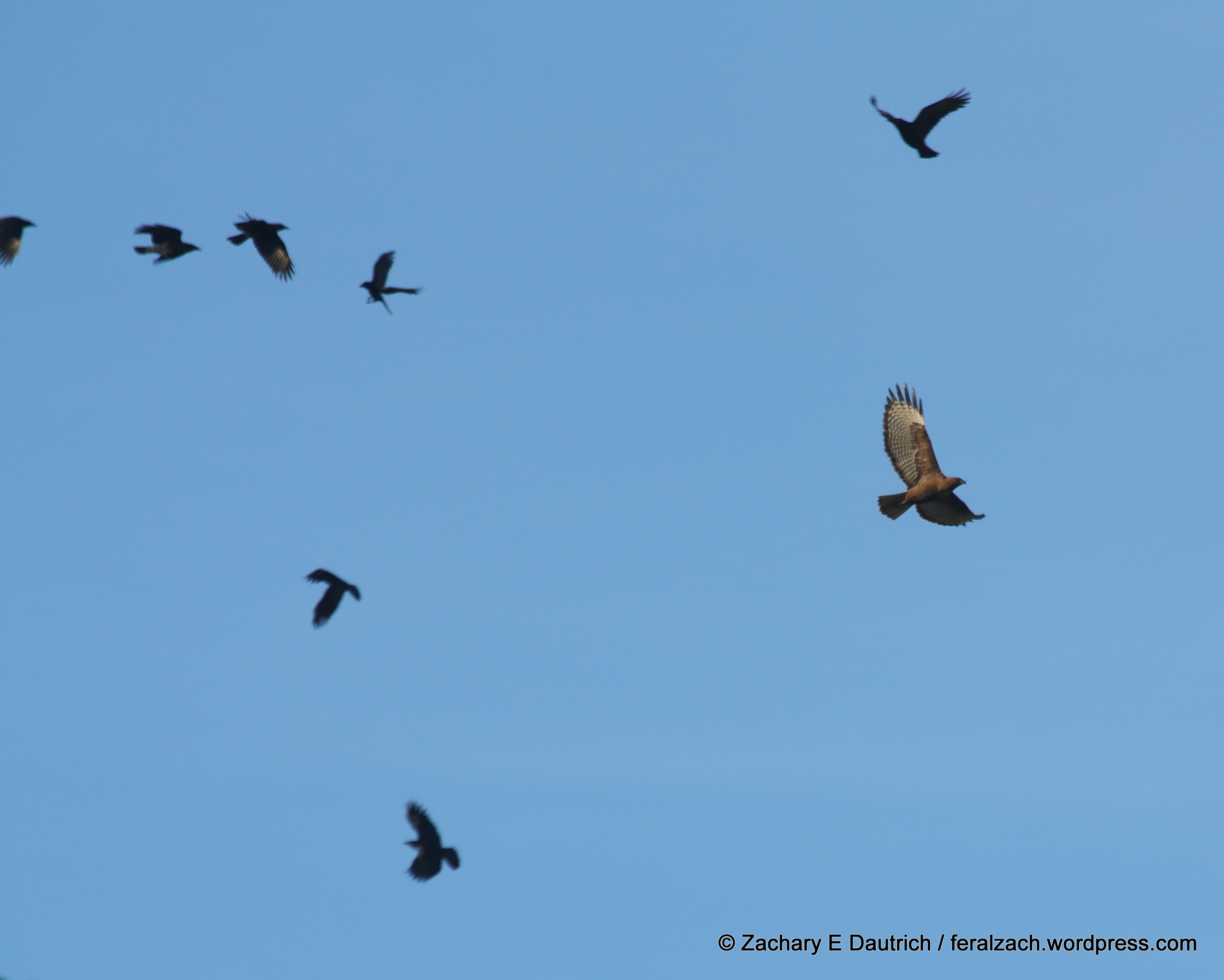
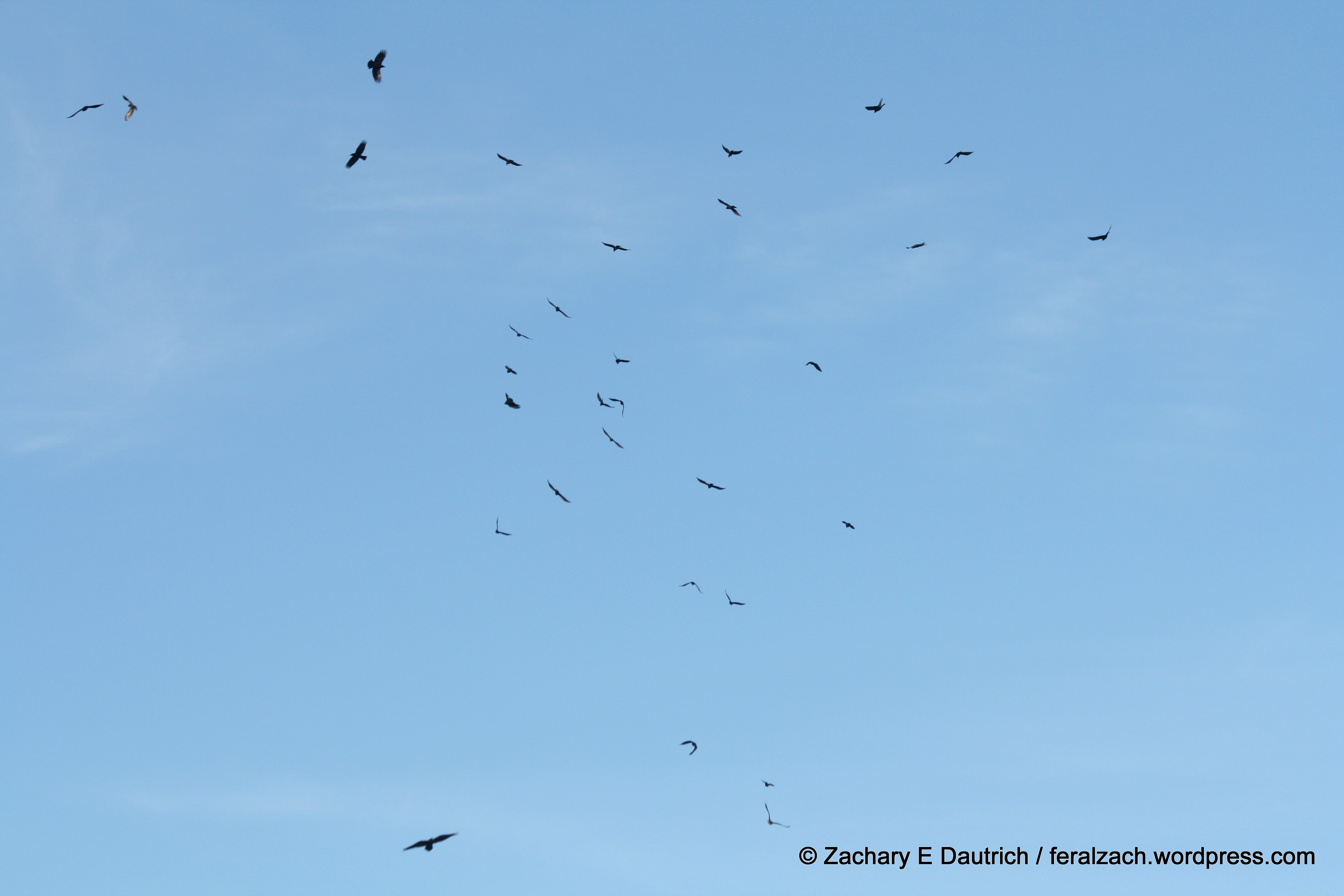
the mob goes wild
i’ve mentioned this before, but there are some corvid researchers (i can’t remember who) who say that this mobbing behavior could be a corvid “right of passage” – which makes some sense to me because there is very little reason that i can think of for the birds to do it other than fun or to establish social ranking.
fruitvale falcons
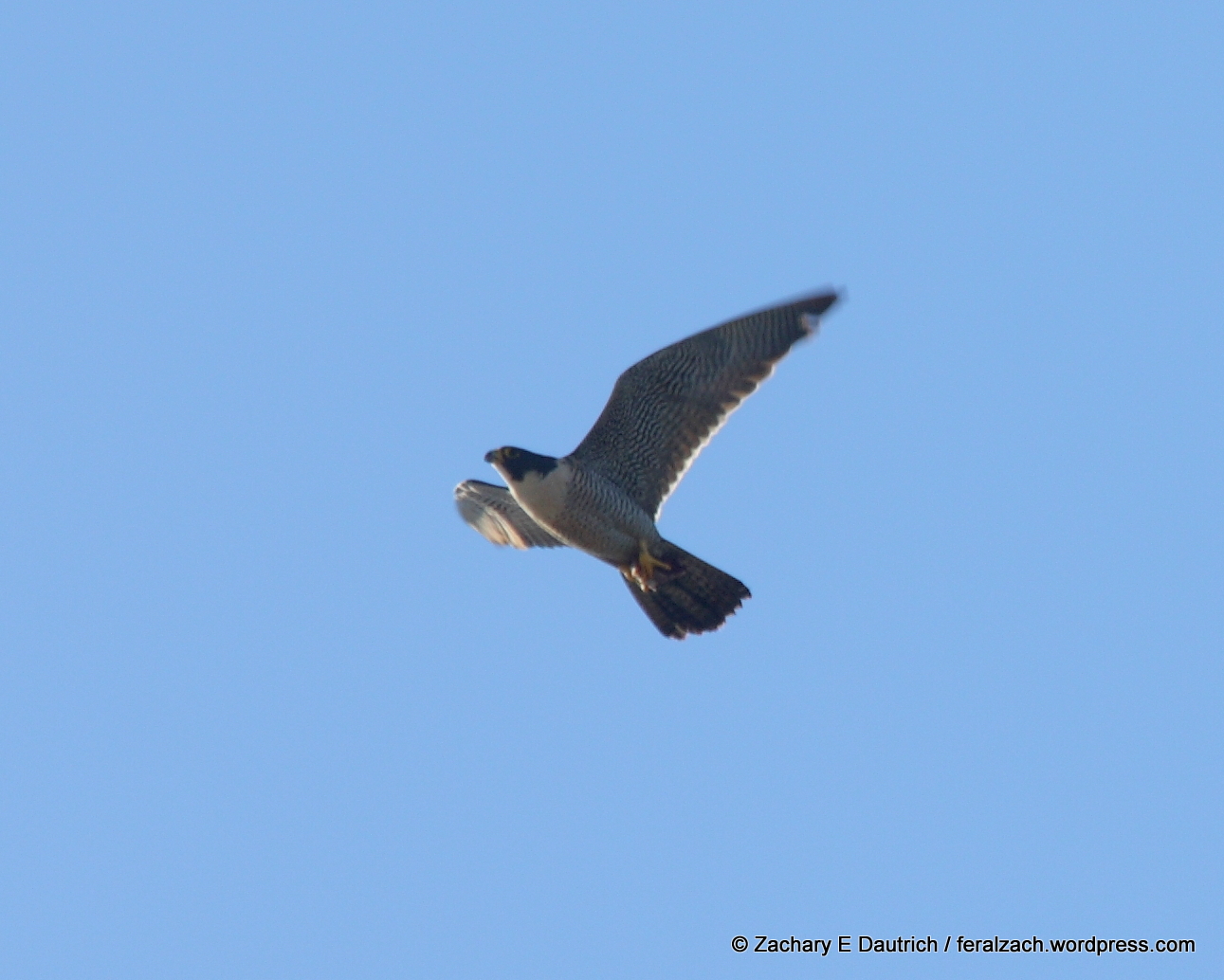
On this beautiful Spring-like (?!) morning, I had the privilege to see my old Falcon friends on the Fruitvale Bridge in Oakland/Alameda. Just after I arrived, Hiko, the tiercel (male falcon), came in to land on the Oakland tower with breakfast – which this morning appeared to be a Eurasian collared dove. Doing his part to remove invasive species today, I guess. Unfortunately my vantage point had the sun back-lighting my photos and I was pretty far away, but it was fun to watch as he really went to work on this bird, de-feathering it as we watched. Feathers floated down like a snow storm beneath him, he was working furiously to get at that meat!
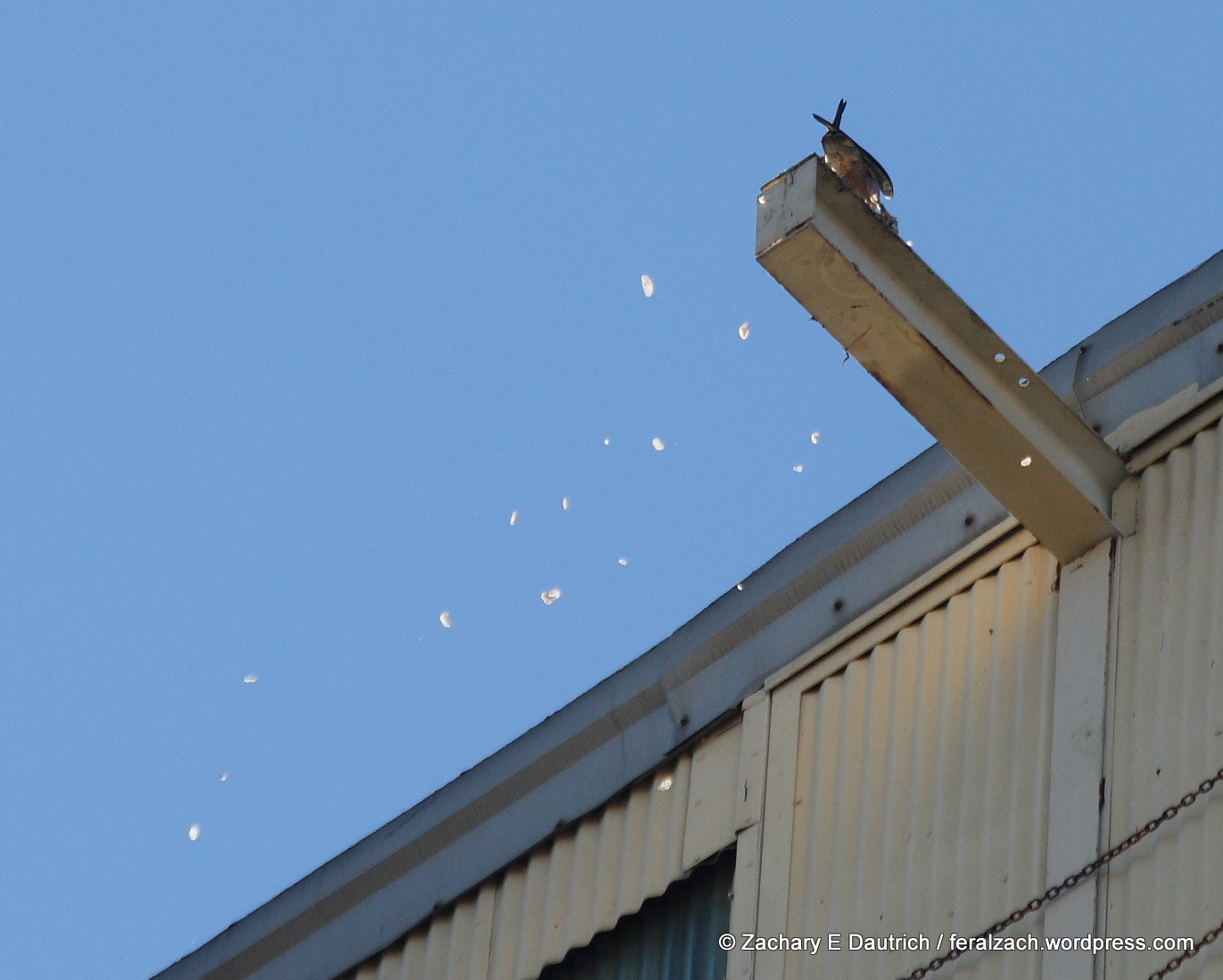
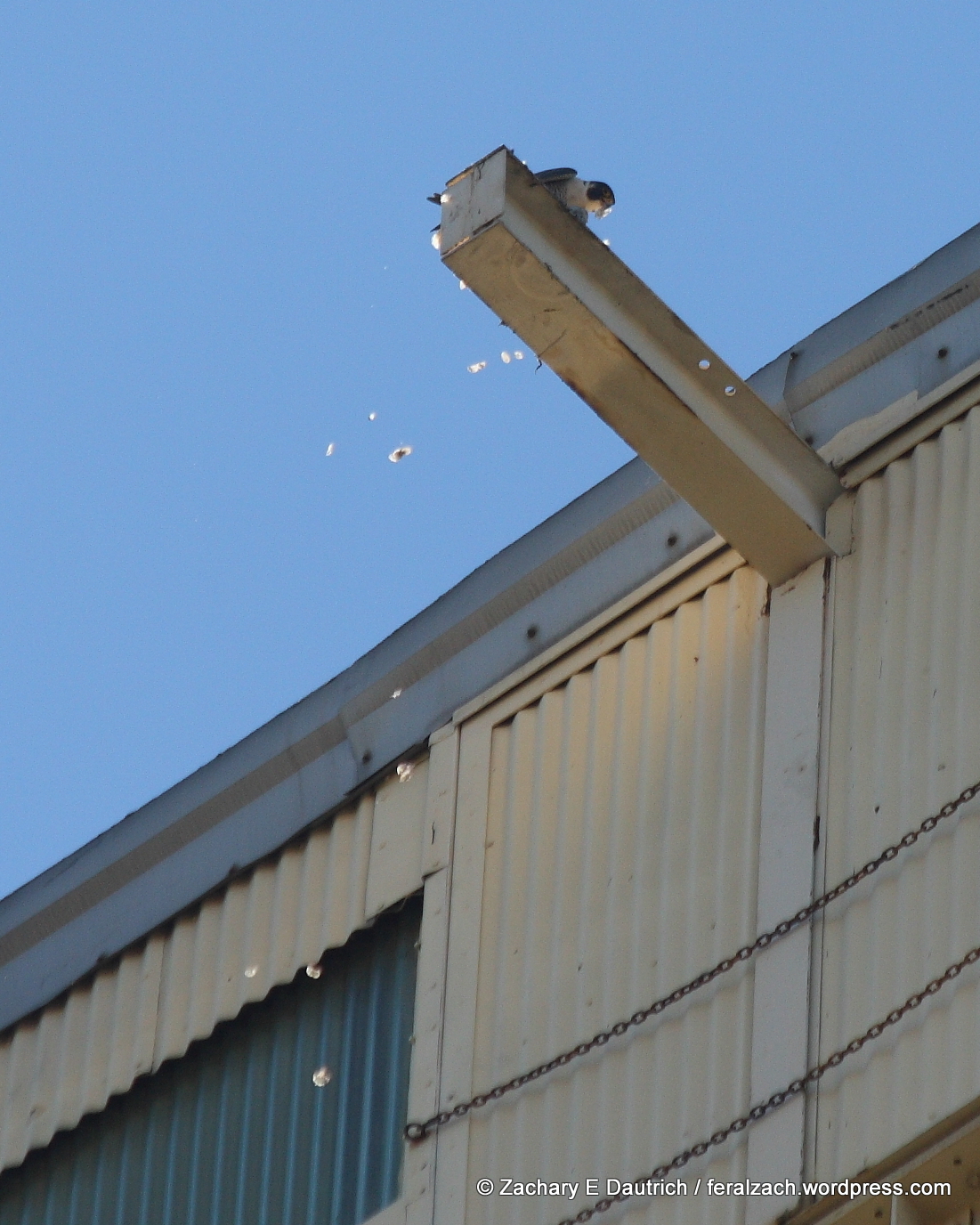

After a little while, his mate came flying in from the northwest over the waterway, and she didn’t seem to see him as she landed on the other tower. She started to e-chup (vocalize), and he let her know he was there with a few response calls. Usually this time of year, the fella would be offering meals to his mate as part of the courtship process, but he seemed intent on keeping this meal to himself at that moment. It is just the beginning of the courtship and mating process, so maybe he’s just not feeling the love quite yet.

the female falcon, Tremaine
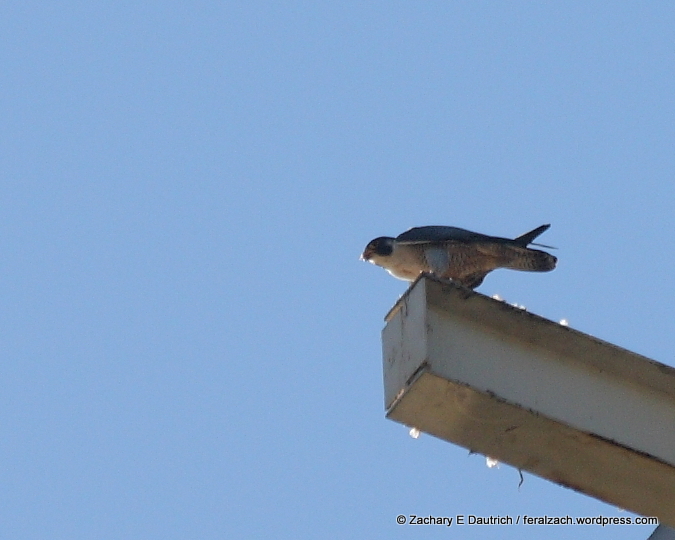
Hiko, finishing up his portion of breakfast
As Hiko was finishing his meal, Tremaine took off from her perch to investigate a little more into what Hiko was doing.
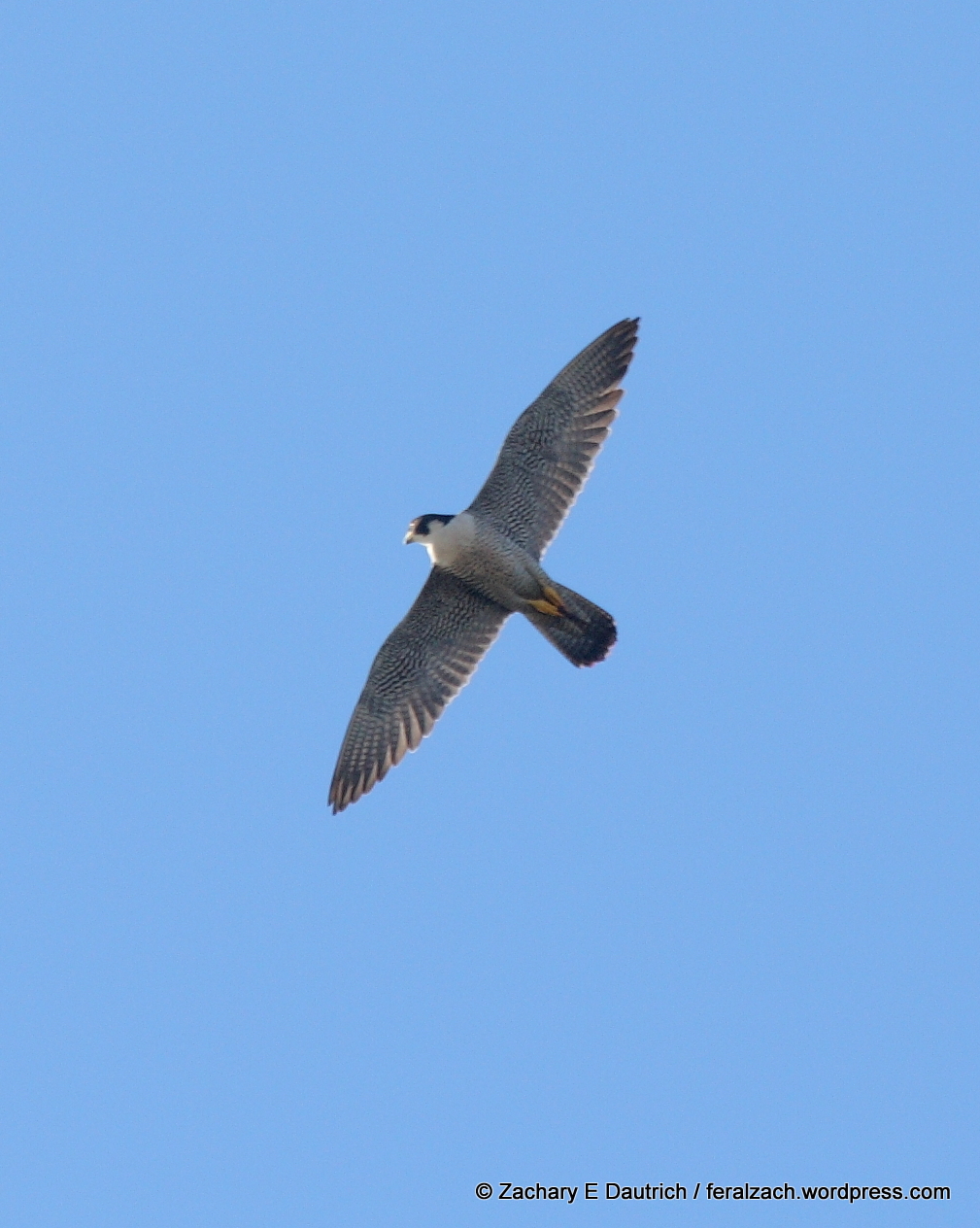
Tremaine landed back on the Alameda tower, and finally Hiko seemed moved to share his breakfast with her after being discovered hoarding his food. He took off with a portion of what was left and flew to her on the other tower. Typically, the tiercel would drop-off the food for the falcon as part of the courtship process, but at the last minute he had second thoughts about sharing and he veered away! Or perhaps he was flirting, falcon style. She immediately took off after him, and within seconds had “commandeered” her portion from Hiko in mid-air over the bridge! Good stuff.
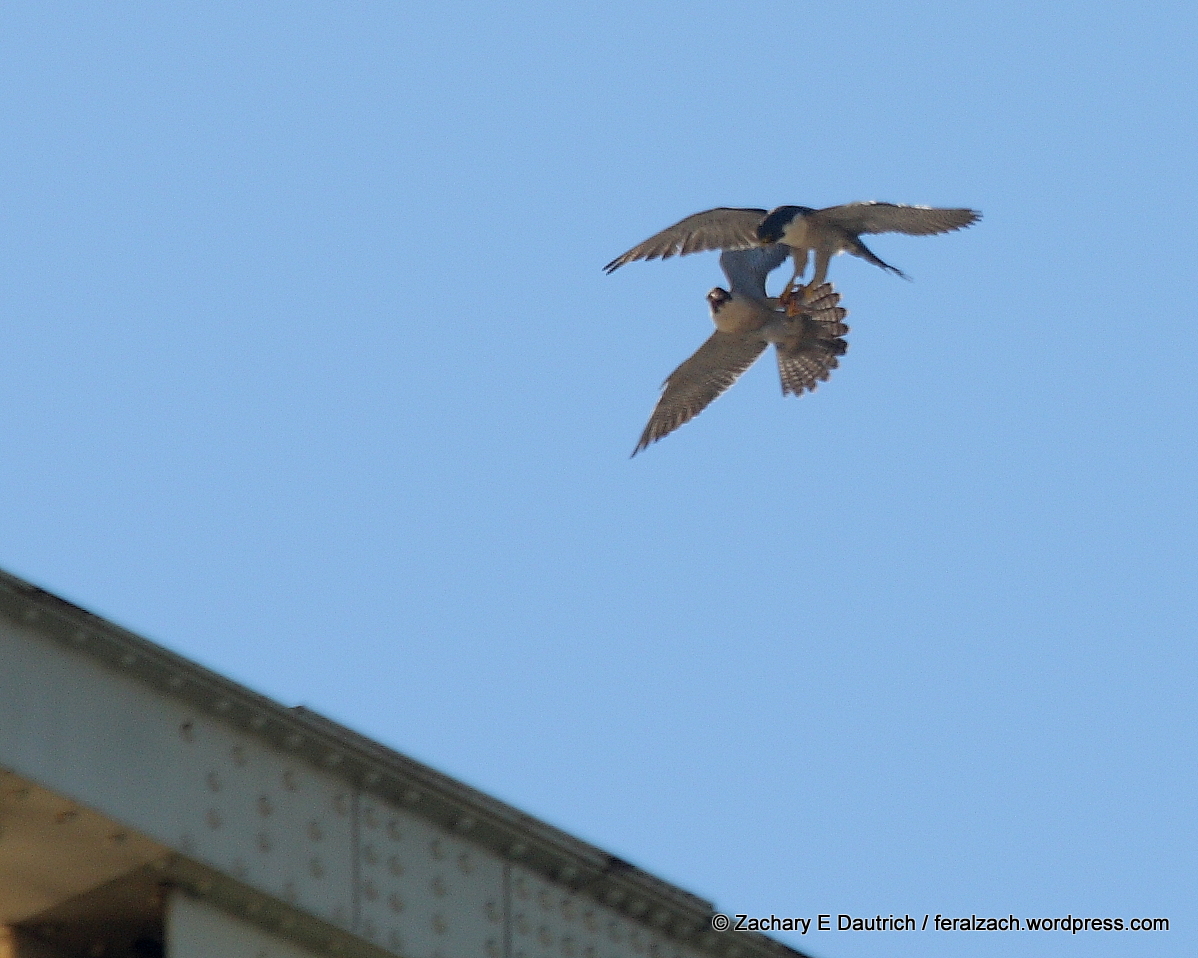
She took the small portion of the dove that he had and did a lap around the towers with it, then headed back to the Alameda tower to eat.
Tremaine with prey remains
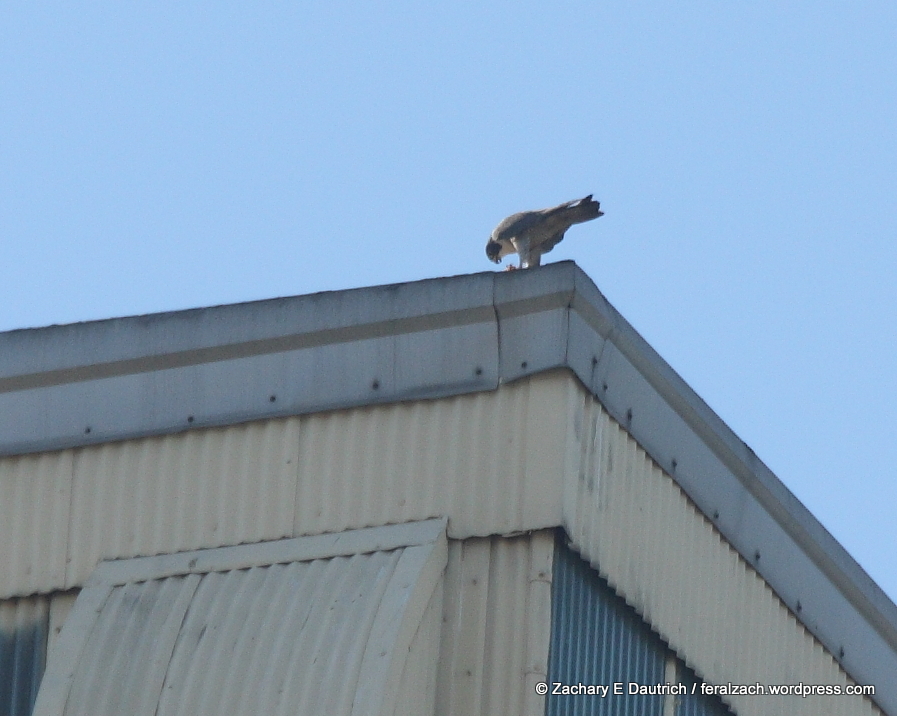
Tremaine eating
Hiko then did a little survey flight around the area and settled in near Tremaine on the Alameda tower to do some preening after his crop-busting breakfast.

Hiko
After Tremaine finished her portion, she flew over to the Oakland tower (interestingly the OPPOSITE tower that Hiko was on – I don’t think he won any extra points with his sharing “efforts”). The two settled into a mid-day lull as they digested their food and preened, and I left them to enjoy the sunny day.
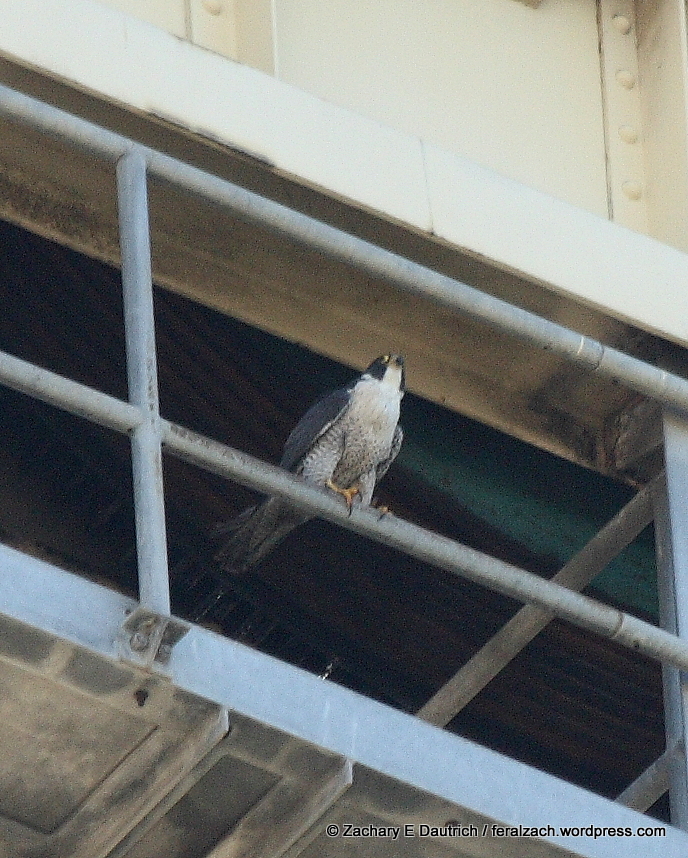
Tremaine
This is a shot of Tremaine when she was eating that I took with my camera phone through a friend’s scope (digiscoping, it is called). Not great quality but quite a zoom. You can see Tremaine has a full crop, she must have eaten something on her own before getting this “gift” from Hiko.

These birds are so beautiful, watching them fly, with such quickness and grace, never gets old.
another adventure at the lagoon

red-tailed Hawk (intermediate morph)
Sunday was a warm and clear day on the coast, strange weather for January – it felt like summer (well, summer anywhere besides the coast and the Bay area). We started the day by witnessing some interesting behavior by a couple of deer that caught our attention. The deer, which appeared to be doe and a yearling (nearly the same size), were standing with heads raised and their focus on something in the chaparral to the north of us. The yearling took off trotting, then bounding, right towards the path we were on, seemingly unconcerned with our presence. It then stopped and turned around, bounding back to its mother. The two of them then started a slow walk in the direction of the threat, with the mother in the lead. Shifting our position back down the trail, we were able to see what was causing the concern …


I was only able to catch the tail-end of the bobcat as he disappeared into a coyote bush (for the moment now a bobcat bush) – a large male that uses this particular territory who’ve we’ve tracked and seen around here before. Although I think it’s rare for bobcats to take down full grown deer in this area, fawns are fair game. This particular young one is probably big enough to be safe, but given the respect that the deer on this day showed towards him, and on another occasion when I witnessed his presence disturb them, I’d say he is still viewed as a threat. He seems to be a large bobcat based on his tracks and scat.
The most interesting part of this whole interaction was when the deer started to FOLLOW the bobcat – the doe literally walked right to where the cat had disappeared, and she seemed to be chasing HIM out of the area! Good stuff.
On the way in to the lagoons, I spotted an American bittern in a small pond along the pathway – I’ve seen one on the far shores of the larger lagoon, but never one so out in the open here. It was shaping up to be another good day, with lots of live animal sightings. Later in the day on the return trip it was still there and posed for some pictures in the beautiful light.
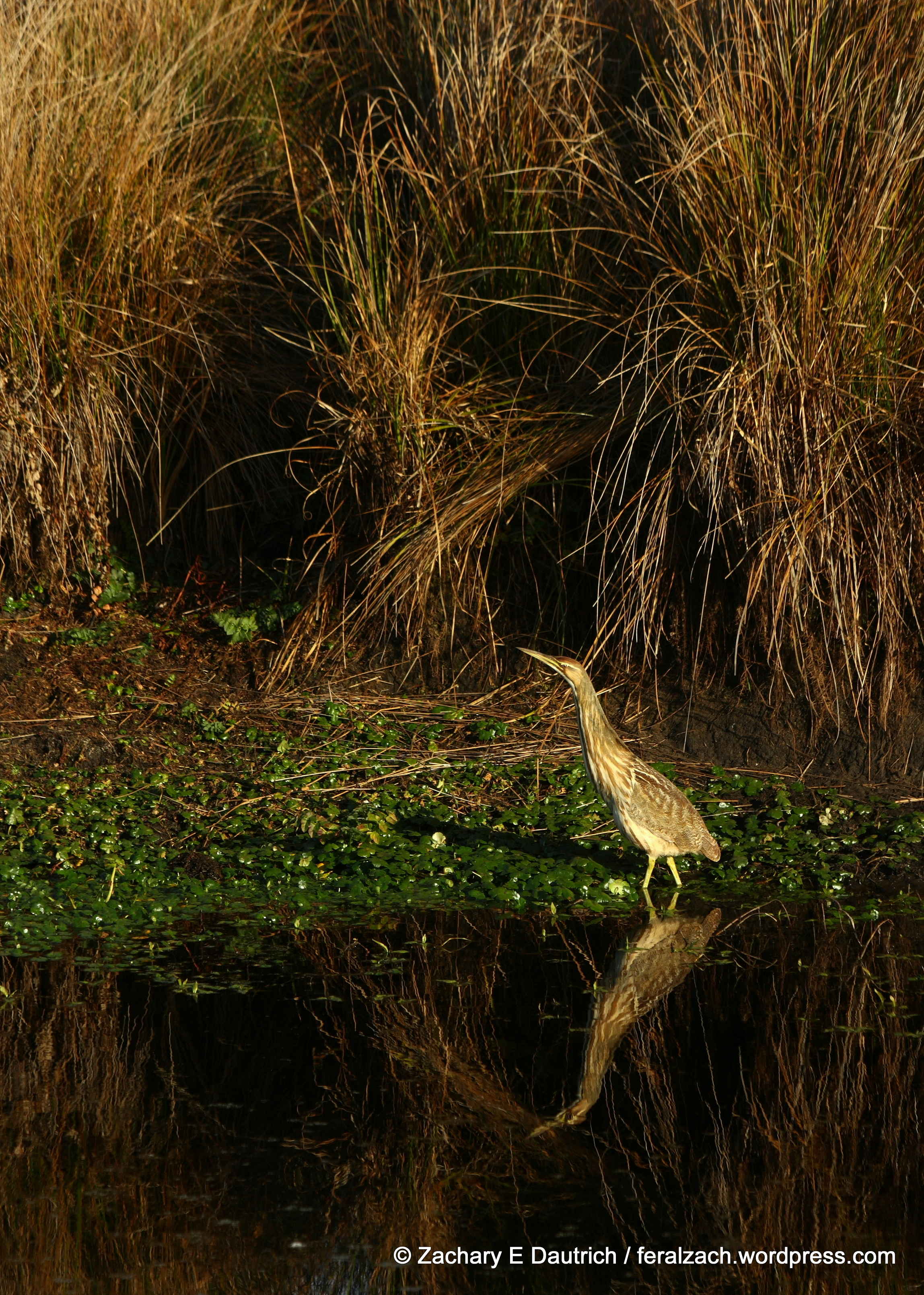
American bittern

American bittern
As we approached the lagoon, a resident great-blue heron was hunting in the shallows.

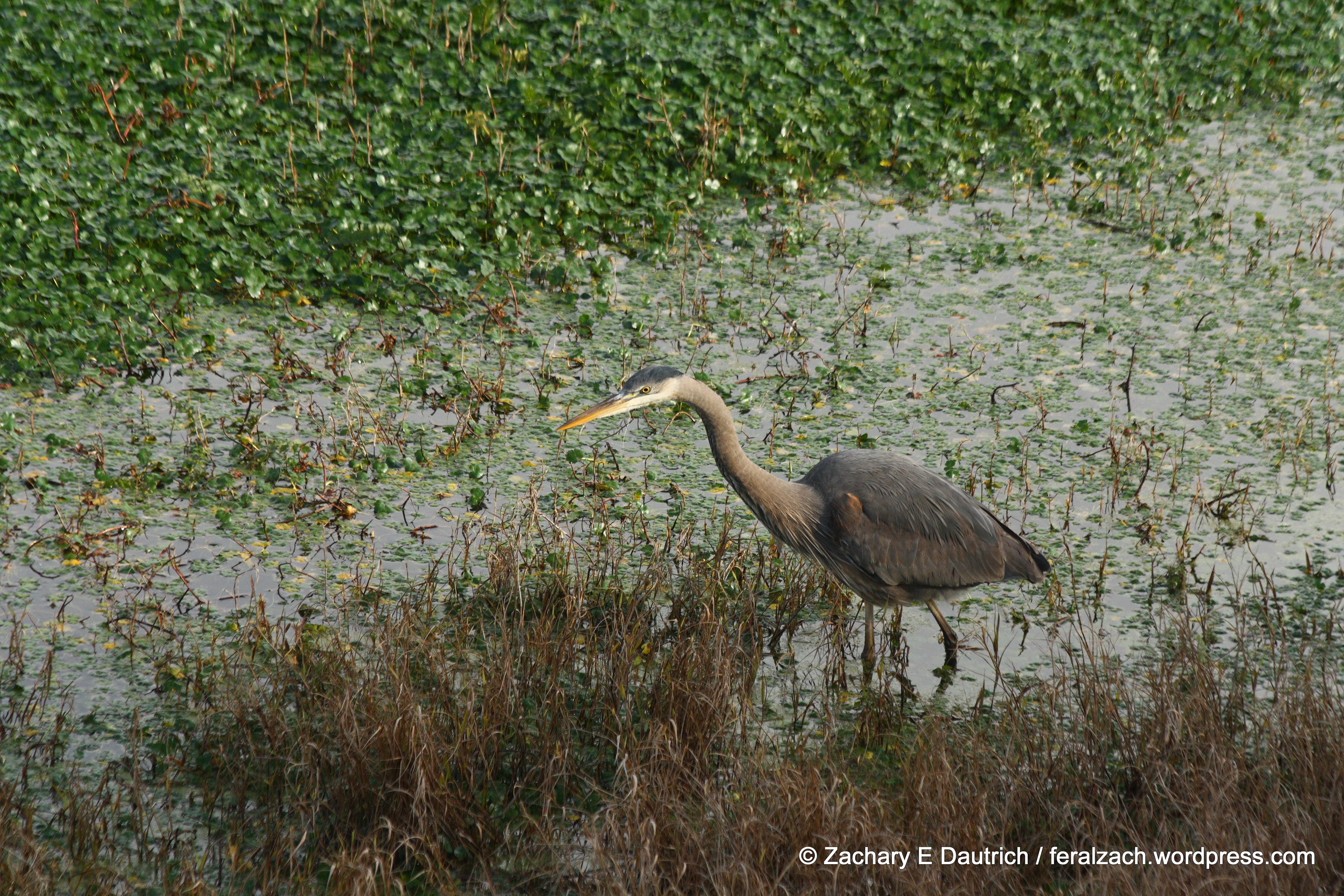
There were quite a few sets of trails and tracks on the dunes, but the striped skunks were most prevalent. This is their mating season, during which they really seem to be wandering around outside of their normal areas with higher frequency – sadly it is also marked by the large number of road kill skunks at this time of year. Notably absent was the female bobcat that usually patrols this area. It is also breeding season for the cats, so her daily patterns are likely interrupted by the breeding impulse. I also spotted at least one golden eagle soaring above the hills, only the second time I’ve seen one in this particular area. Along with a ferruginous hawk sighting (a somewhat rare winter visitor in this area) and the great view of an intermediate morph red-tailed hawk, we had some great raptor and other bird sightings. During the day at various times the family of otters was visible on the upper lagoon, but I never really was close enough for any pictures. Just their presence is a joy, watching them even from afar is so fun.
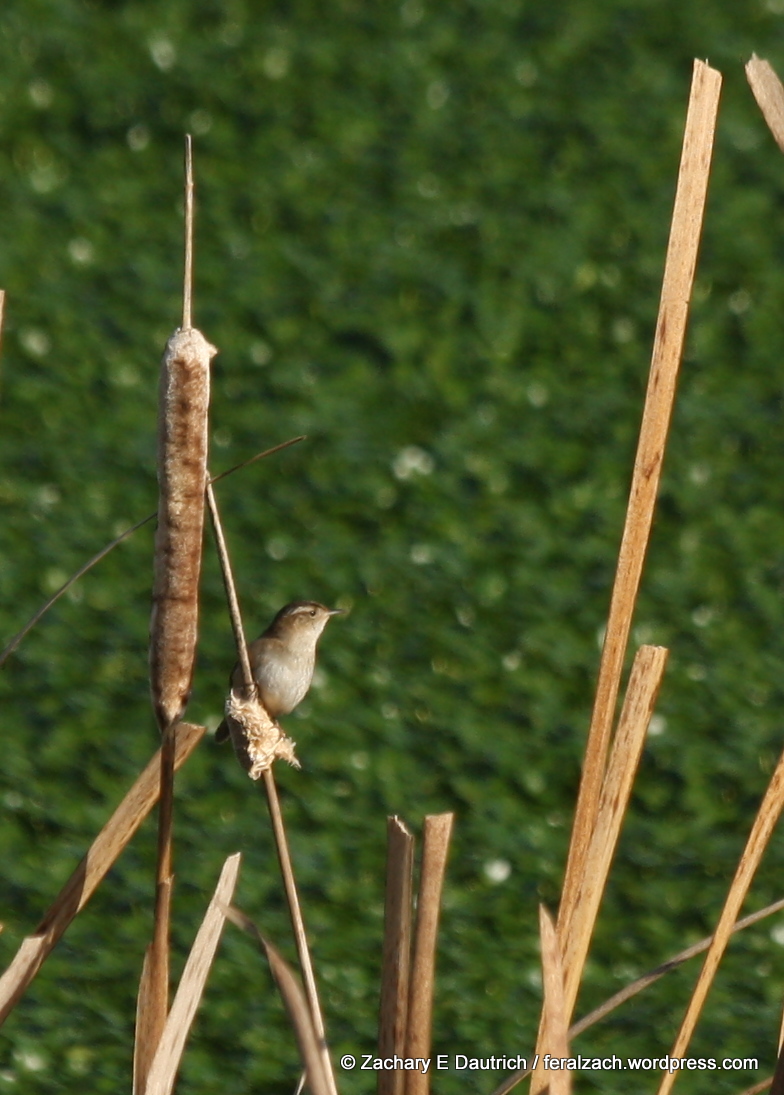
marsh wren

ferruginous hawk
As we were resting by the lagoon, a pie-billed grebe made it’s way out of the shallows by the cattails with quite a prize – after straining to identify what it was, we realized it was a small bass! The grebe paddled around with the fish in its beak for at least five minutes, occasionally shaking it and twice losing it in the water, but diving down and quickly recapturing it. Finally, after almost ten minutes, it downed the fish whole!!
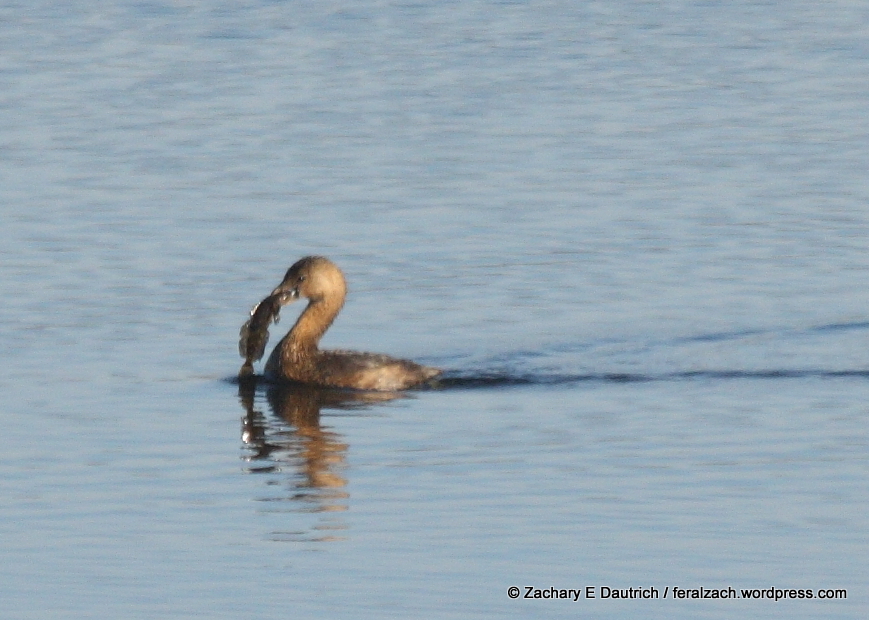

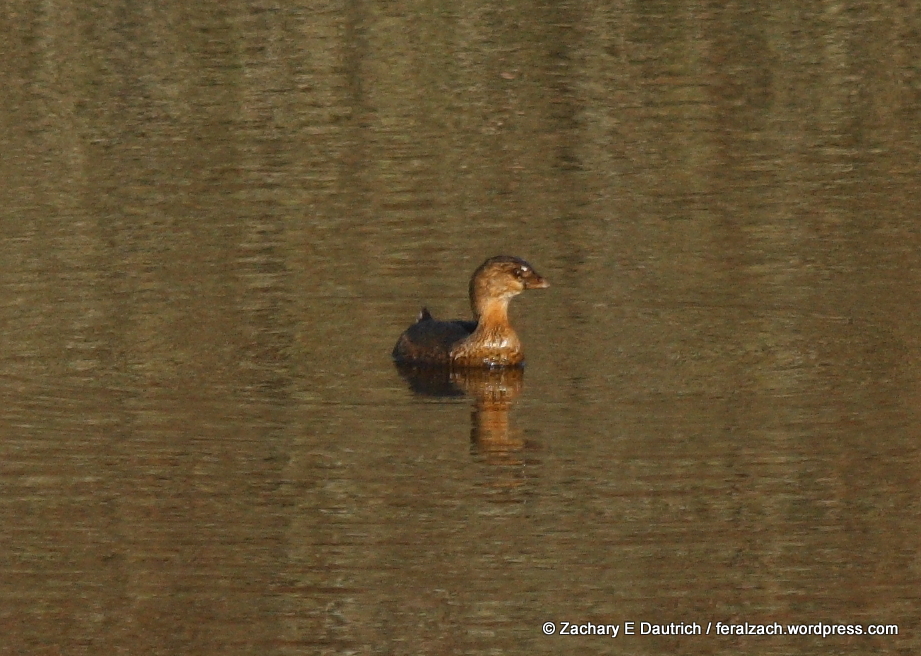
Impressive.
Another great day out there, I’m so thankful for that place and to be able to wander in it. Thanks also to Richard Vacha and everyone who participated in this Marin Tracking Club excursion for making it a fun and educational day.
teaser
There are too many photos and stories from yesterday to rush this tale, which I don’t have time at the moment to honor properly – but here are a few teaser photos until I do. Honestly, books could be written about what is found in any few square feet of space in places like Abbott’s Lagoon. The richness and density and variety of life in this area, along with many friendly substrates that record so much of it to see afterward, is just such a gift.

The above picture is of a Great-Horned Owl landing spot in sand – you can see where it landed, and in the foreground is the imprint of its wing feathers in the sand. You can also see the trail of it walking away, out of the frame to the top left of the picture … a trail of about 15 feet, where it took to the air again.

Black-Tailed Mule Deer Buck
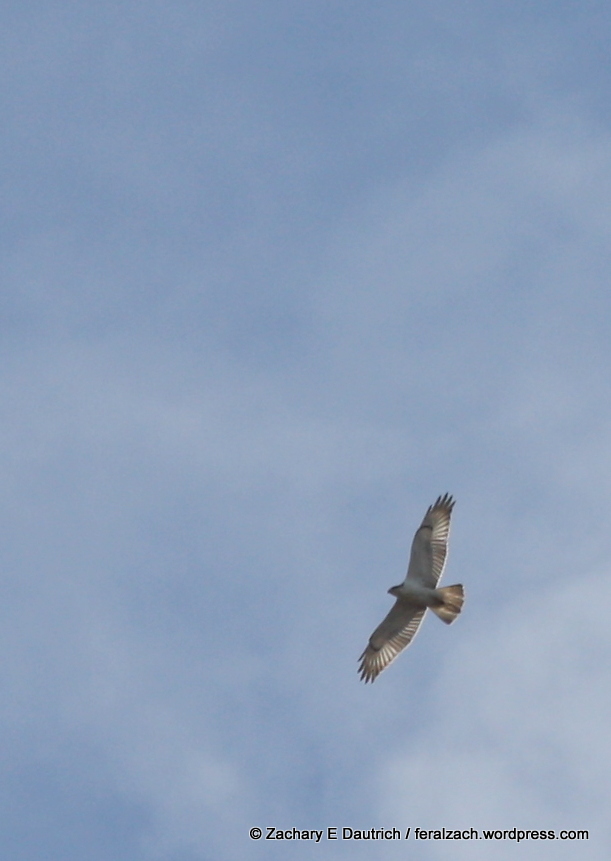
Ferruginous Hawk
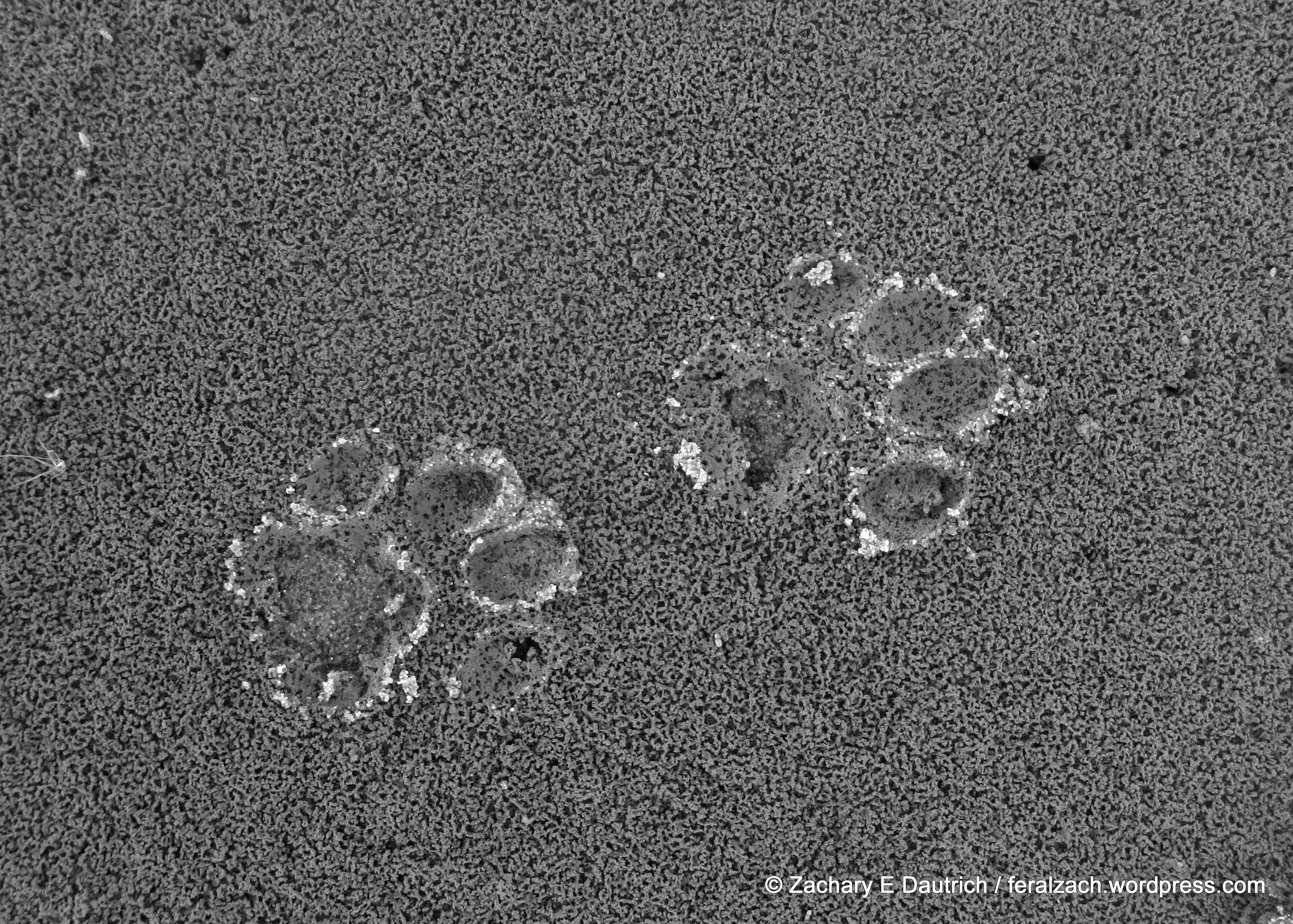
Bobcat tracks in algae/sediment
petroglyphs in my backyard [+ new species of human ID’d!]

petroglyph rock IN MY YARD(?!)
I’m always fascinated to see evidence of people from the past – to hold an arrow head in your hand is a direct connection to the person who made it, a physical and energetic connection to another time. We tend to think of these past times and people as having occupied a space that is very removed from our present reality, and in some ways that is true. It’s hard for our minds to grasp this, as to many of us the early 1900’s seems as long ago as when the pharaohs ruled Egypt (OK maybe that’s a bit of an exaggeration, but maybe not – both are just abstractions in our minds if we haven’t lived it). But when you consider the brief amount of time that each of our lives is here in this incarnation, it’s possible to feel how close we actually are to our ancestors despite our mind’s perception.
And of course this is especially true when we see direct evidence of our primitive past living out in our congress and politicians today!
[Perhaps there actually is another species of human that survived to present day, and merits a new branch on our family tree – hiding in plain site, somewhere between Neanderthals and Cro Magnon man – he/she looks like modern day humans and has survived in our midst despite retaining the brain size and primitive behaviors of long gone primate species … I hereby propose the addition of “Homo politico ineffectus!!!”]
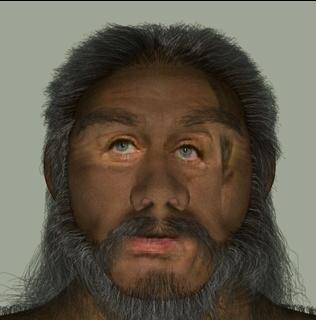
Homo politico ineffectus
(photo meld courtesy of Smithsonian’s MEanderthal app – evidently the MEanderthal app is considered critical and not subject to government shutdown)
Enough of that though, I am getting off topic.
The other day a woman was combing through the neighborhood where I live looking for ancient petroglyphs – rock art. That’s right, looking for rock art in the metropolitan area of the East Bay of San Francisco. Evidently petroglyph sites have been found all along coastal California and into Oregon that are attributed to people who lived here anywhere from 8000 to 3000 year BP (Before Present)! Amazing when it is thought that humans only occupied this land at most 12,000 years BP. It is suspected that these are the predecessors (and possible ancestors) to the Native People who live here now and have been living here for many centuries prior to contact with Europeans. This woman was excited to reveal that one of the rocks in our yard very likely holds some of this ancient art.

Pecked Curvilinear Nucleated shapes (PCN’s)
What prompted her search, besides a peculiar calling and possibly that she already did her annual tree burl assessment for the area, is the fact that there is a site not far from where I live (approx 1/2 mile) that is a park, and within that park a playground was built around some rocks. Turns out those rocks hold a large number of petroglyphs. Fortunately someone finally realized the significance of the markings on those rocks and now they are protected (Canyon Trail Park in El Cerrito). This is one of less than a dozen sites that has been found though, so it is remarkable. But all throughout the neighborhoods of the East Bay are many rocks that protrude out of the earth into people’s yards – some as big as passenger vans or larger. Many palettes for the prehistoric-artist.
According to research and analysis regarding this topic (which is scant, at best), a type of rock art was all the rage in those times composed of shapes now called “pecked curvilinear nucleated” petroglyphs (PCN’s). They generally consist of a circle inscribed in the rock, which then allows the center to stand out in relief. Sometimes there are variations to this theme, and sometimes they are accompanied by cupules (small cups ground into the rock). Not only that, they have almost always been found carved on blue/green chlorite schist rock and often near a water source. The chlorite schist only occurs in fault zone areas, so it is found in isolated regions especially in California.
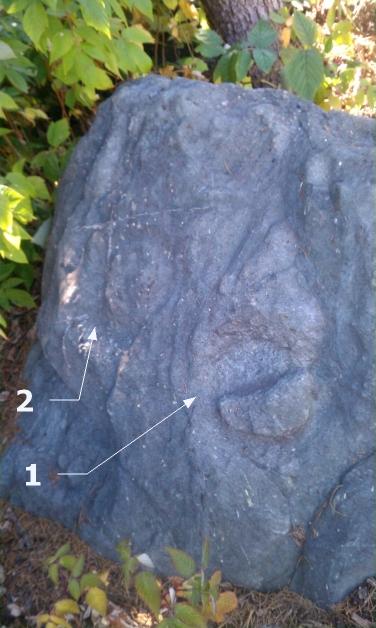
close-up of PCN’s

close-up of PCN
Who carved these? And why? And when? Evidently those exact details are a bit of a mystery, but it is theorized that they are related to fertility or weather rituals by the people I mentioned above, sometime between 8000 and 3000 BP (though not to be confused with some petroglyphs created later, in the same areas, by Pomo People for fertility rites – or mortar stones for grinding acorns by other various Native Peoples – see pictures below).
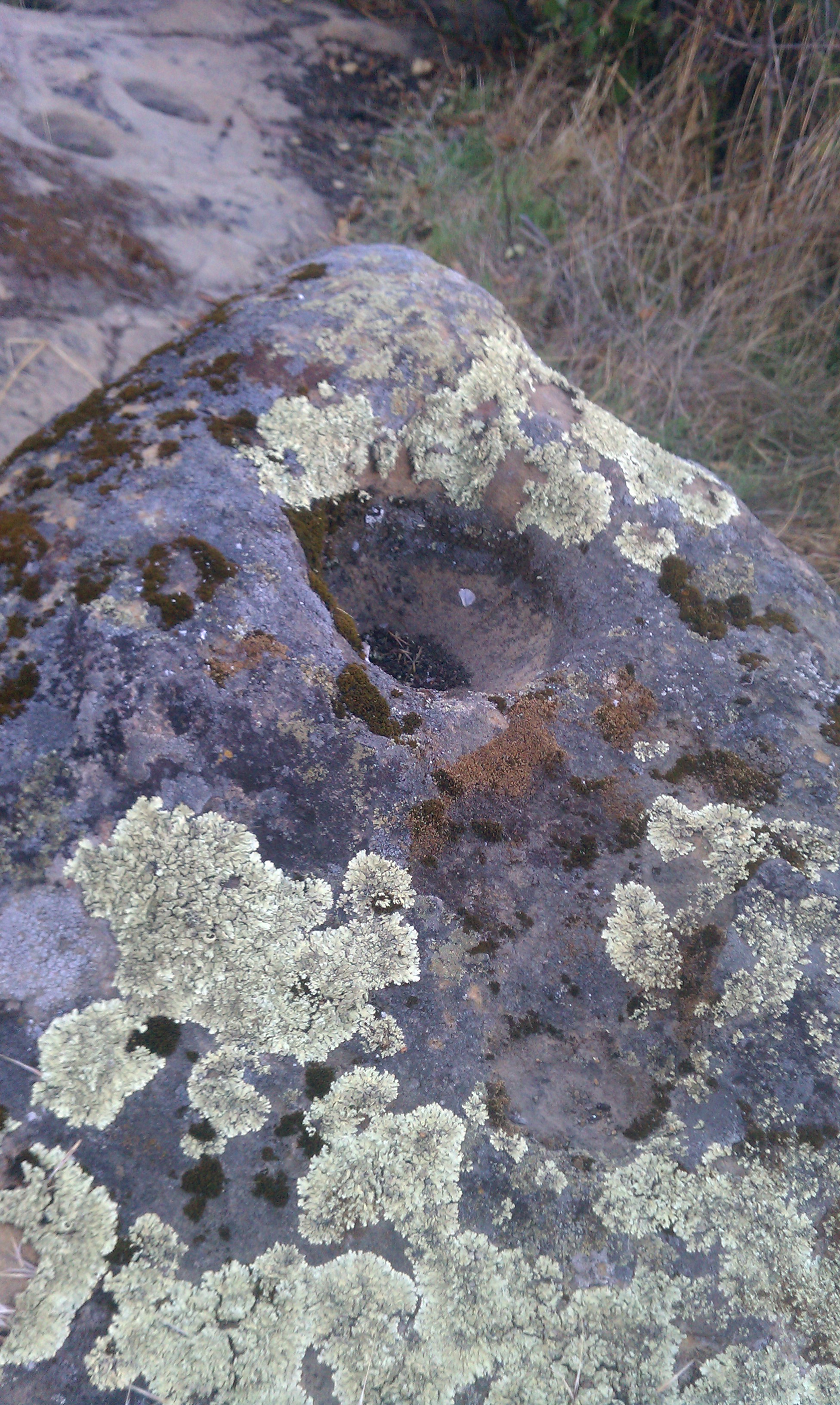
mortar rock hole (hole diameter approx 8″) / Solano County

mortar rock with multiple mortar holes / Solano County
Really an amazing treasure to be living by such a piece of history – it will be exciting to see if anyone analyzes the rock further (and if there are more petroglyphs buried under ground level).
Another site that is open for viewing to the public in addition to Canyon Trail Park in El Cerrito is Ring Mountain in Marin County. There are other sites, but many of them are on private land or are not publicized.
Luckily for all of you, I have decided to open a roadside museum to display this new find in my yard – look for me in full steam punk regalia with a bullhorn, standing on a soapbox by what will appear to the observer to be a modified child’s lemonade stand. I’ll also be selling my special tonics that are guaranteed to cure all.
===================
References (and for more information) check out these links:
1) Cultural Markings on the Landscape: The PCN Pecked Curvilinear Nucleated Tradition in the Northern Coastal Ranges of California – Dissertation by Donna Lee Gillette http://www.escholarship.org/uc/item/1nh3898b#page-4
2) American Rock Art Research Association website http://www.arara.org/
3) Canyon Trail Park petroglyphs – http://www.arara.org/documents/LP-30-1.pdf
4) CA petroglyphs – http://www.arara.org/Background_RockArt_Calif.pdf
passersby in the night

raccoon and gray fox tracks in mud silt

gray fox track in mud silt
Both tracks look like front left for each animal, which is pretty cool. Amazing detail in the fox track, you can see the hair impressions in the mud silt – also, it’s not often that the claws register (gray foxes have semi-retractable claws and are able to climb trees).
falcon fledge time
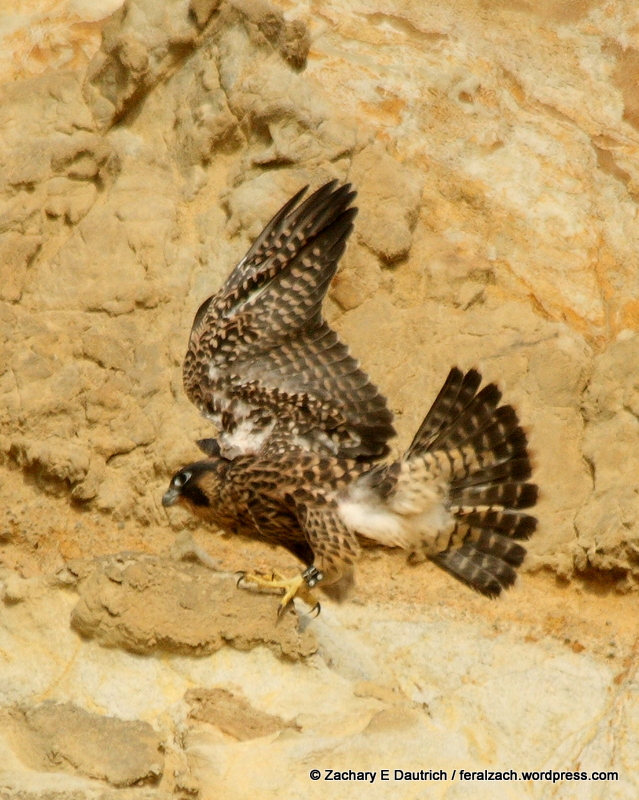
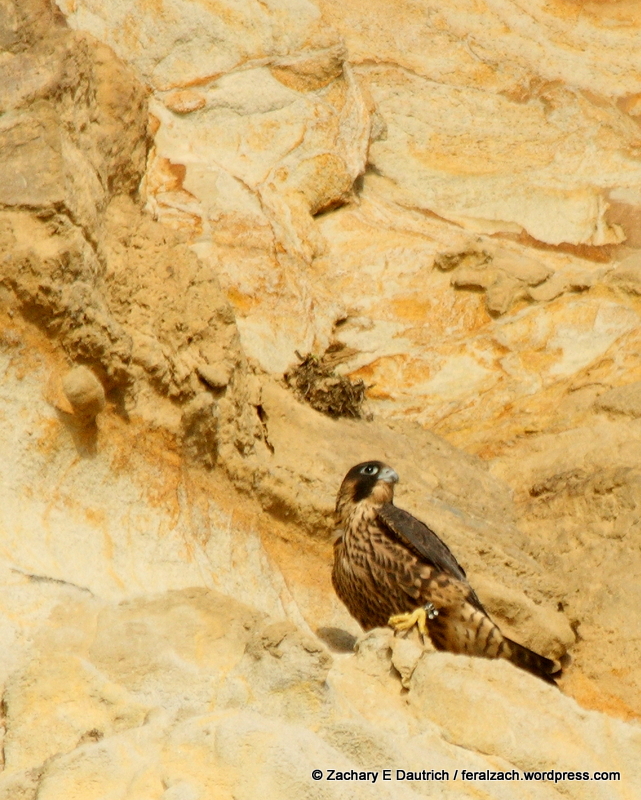
male peregrine falcon fledgling (Falco peregrinus)
All across the Bay area baby birds are taking flight, and many of the peregrine falcon nests in the region are already empty. Last week, the three peregrine falcon nestlings that are in a cliff side nest a few hours north of San Francisco were practicing their flapping when we stopped by. Tightly gripping the left-over sticks from the old raven nest that makes up their eyrie high on the cliff, they they pumped their wings as if ready to fly into the sun.
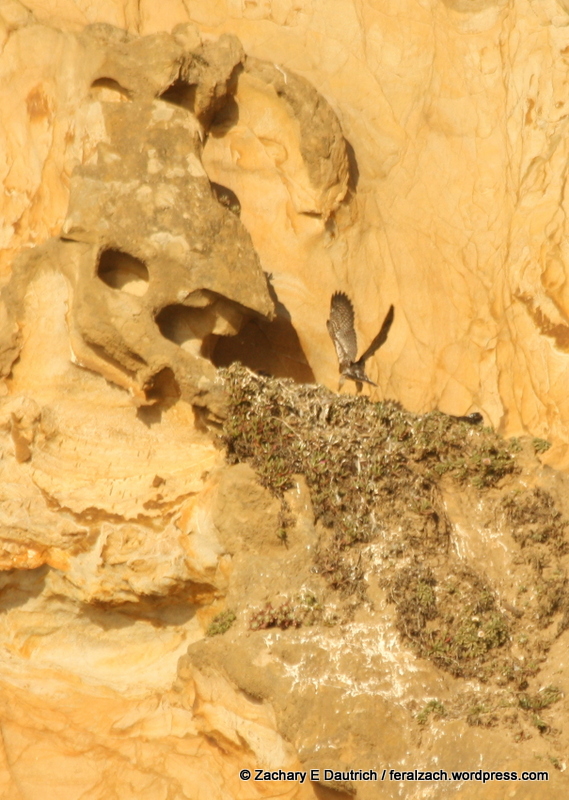
I always find it to be such a profound metaphor of our own developmental processes in life. In what ways are we flapping our wings but still clinging to the nest, afraid to let go and fly? To use our wings for their true purpose, to allow us to fly in whatever way is appropriate for the unique feathers that we each wear?
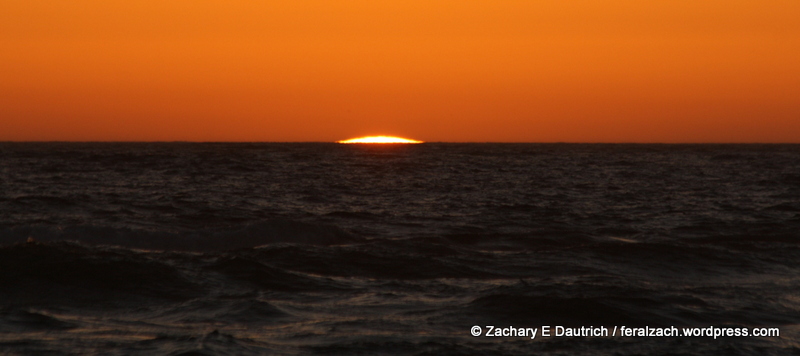
The winds were blowing hard, as they often do in that area by the ocean, but the fog was attending to its business far out at sea so we were treated to a rare sunset right into the waters as we sat with the birds and the thousands of small sand hoppers that had erupted to take over the tidal zone of the beach.
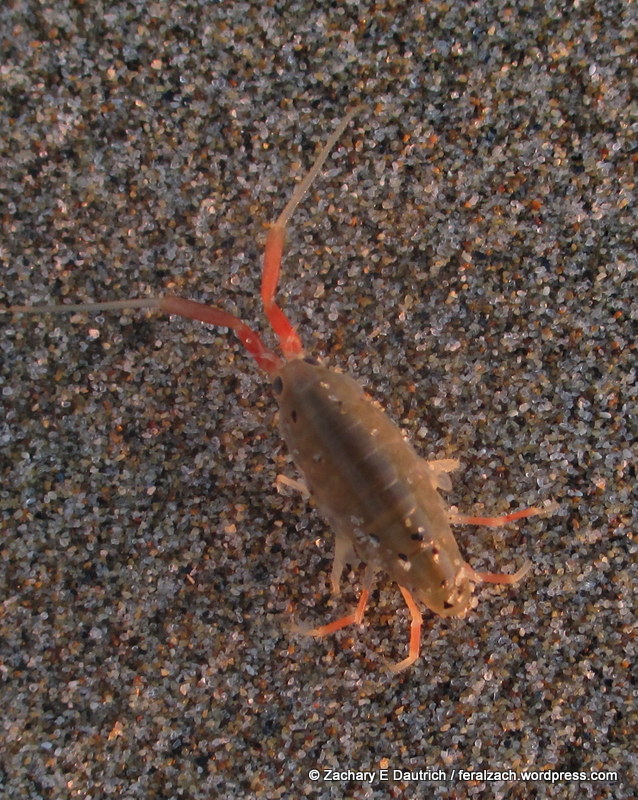
sand hopper (Talitrus saltator)
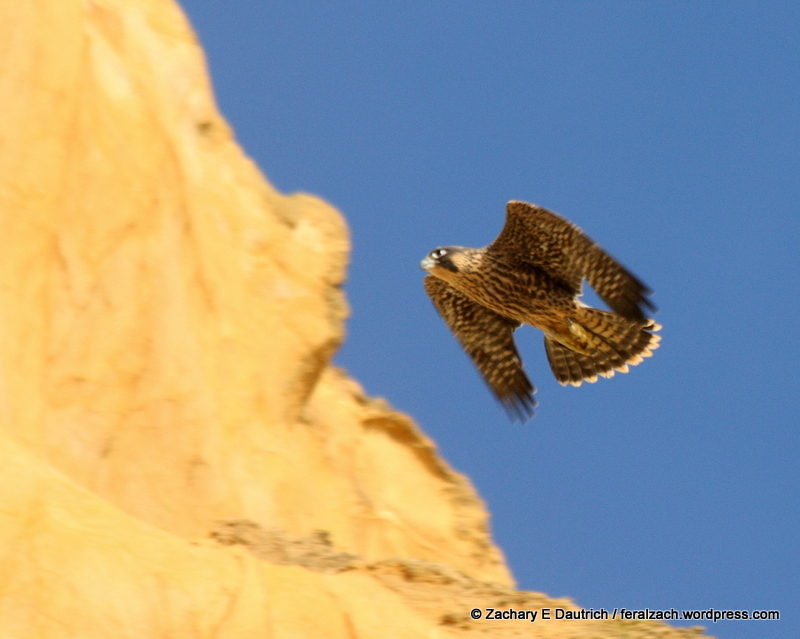
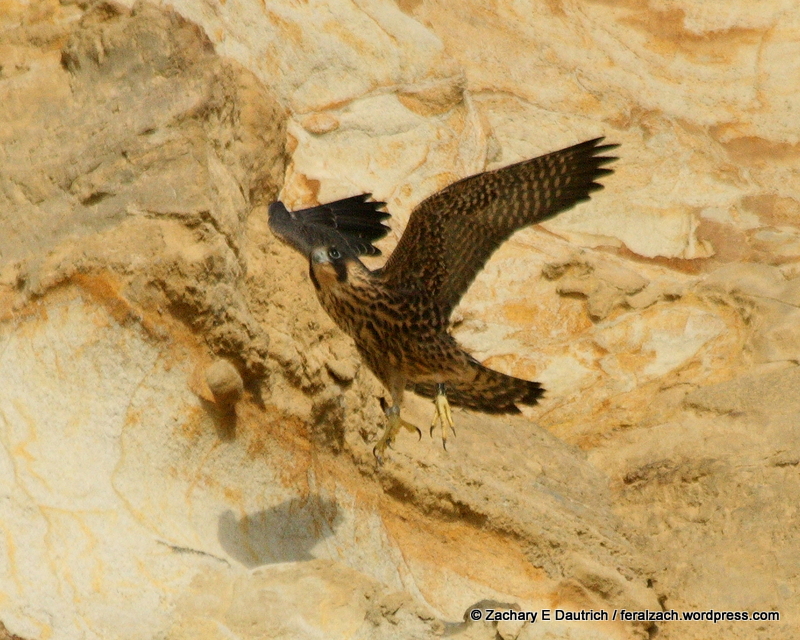
Saturday when I stopped by, one of them had fledged. I learned later that it was the male (based on his bands, the birds had been banded earlier to help track them – there is one male and two females). He had positioned himself on a nearby ridge to the north, but when the female brought food into the nest, he had a strong incentive to battle the high winds and make his way back. It’s an endearing sight to see the perseverance of this little being who is still trying to figure out how to work his own body, and I find myself cheering him on as he awkwardly makes the short journey in little flights and hops from one ridge to the next, then up the cliff face. It’s comical at times, because they are like toddlers learning to walk – and with the strong winds, it made the effort that much more challenging.
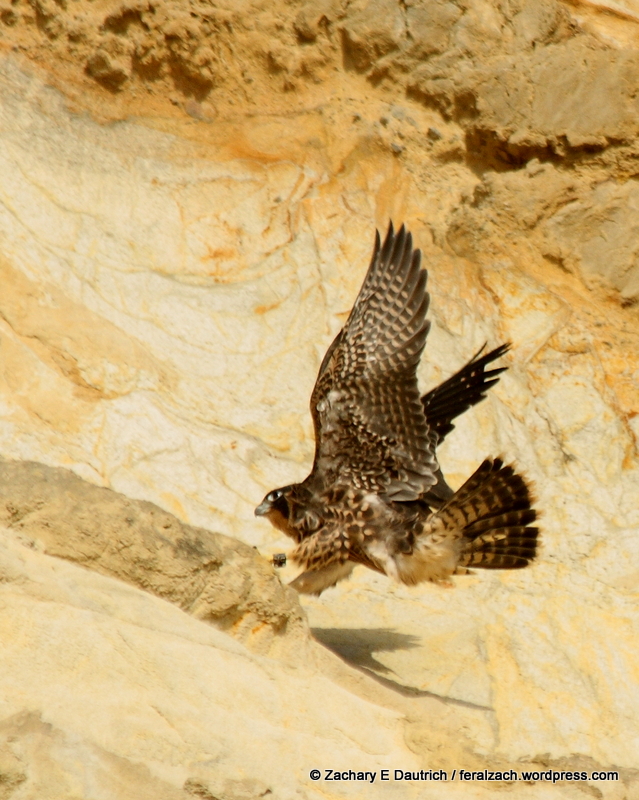
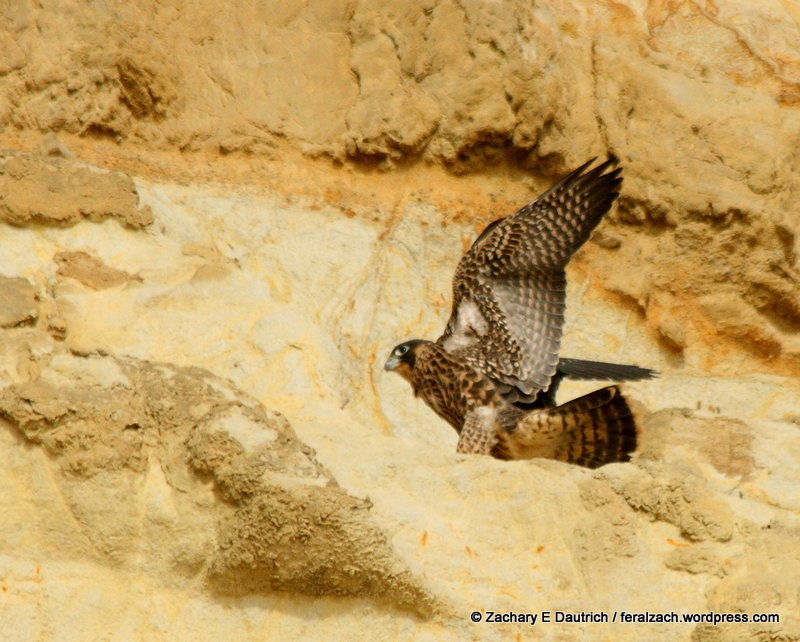
After a few stops and breaks, he finally made one last noble attempt, leaving the safety of the cliff side and doing a few circles in the air to gain some altitude to get into the nest for his final meal of the day. Just before he took off though, he seemed to gather himself in a dignified manner and assume a regal pose just before he leaped. Again, I was struck by the analogy to moments in our own lives, when we gather ourselves closely around that light inside us and recognize having the strength, courage, and belief in ourselves to make that leap. I was grateful to bear witness and share that moment with him.
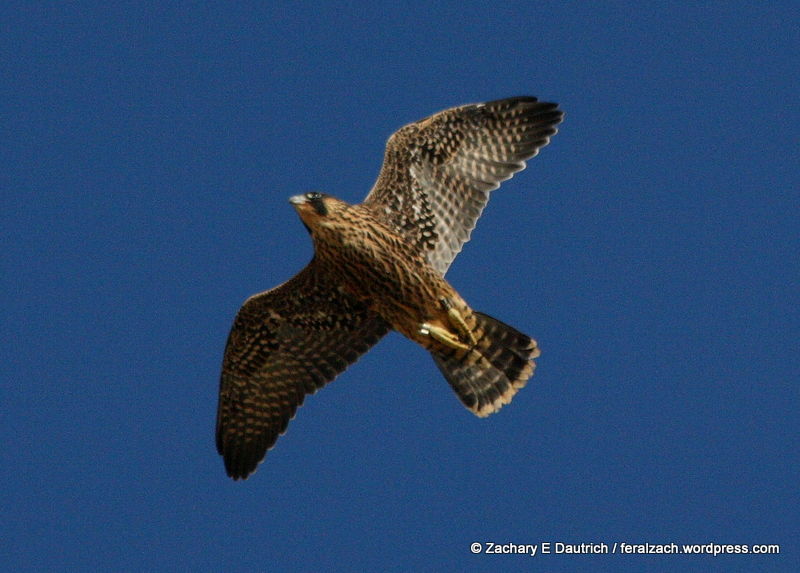
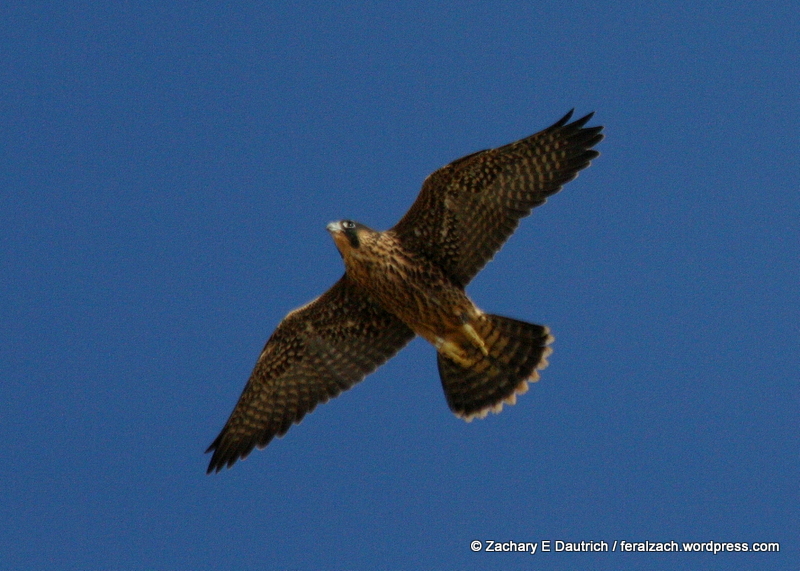
One of the adults, it looked like the female, came into the scrape to join them for dinner as I was leaving for the evening.
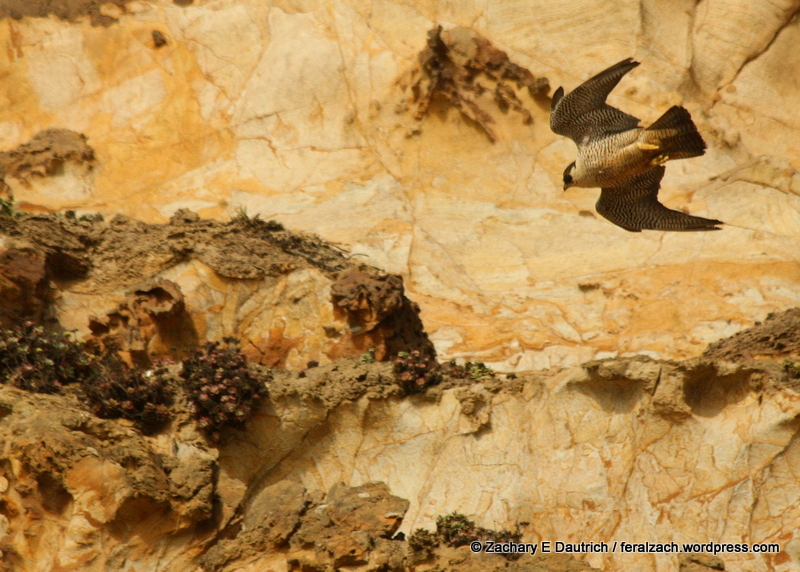
adult peregrine falcon
It’s quite a privilege and a gift to get to witness this, and to photograph it and share it is an honor.



sonoma coast northern harriers

male Northern harrier / Sonoma Coast CA
On this picture you can see the owl-like facial disk that Northern harriers wear:

male Northern harrier / Sonoma Coast CA

female Northern harrier / Sonoma Coast CA
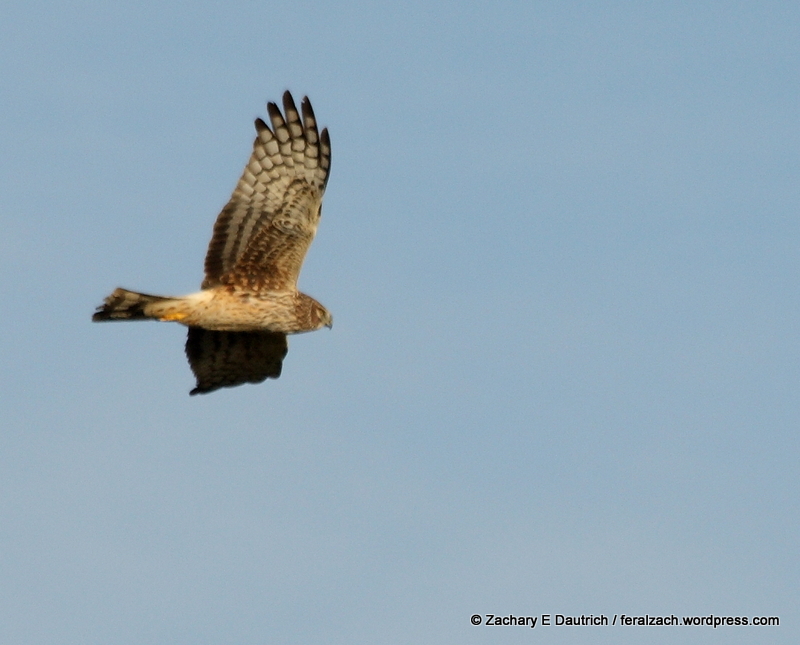
female Northern harrier / Sonoma Coast CA
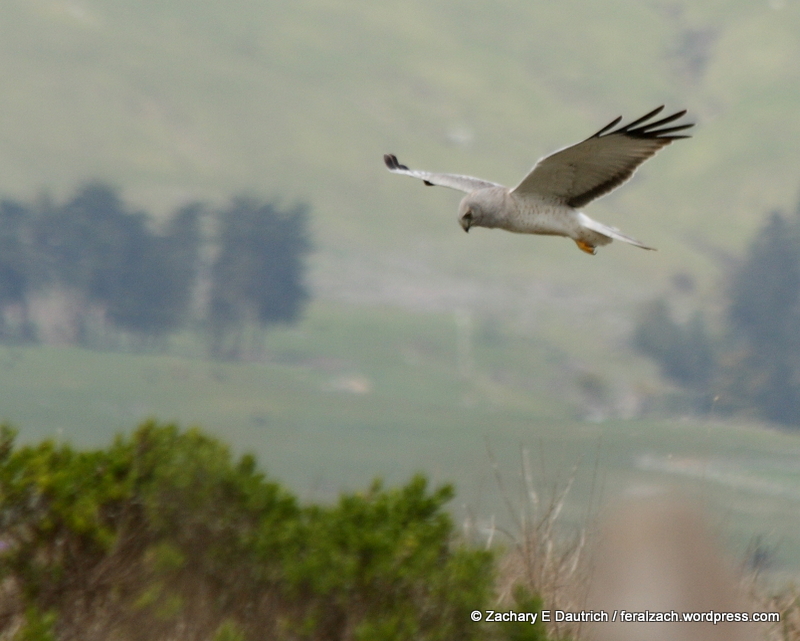
male Northern harrier / Sonoma Coast CA

male Northern harrier / Sonoma Coast CA
Northern harriers are found in open grass and marsh lands (historically called the “marsh hawk”), and they tend to fly low over the landscape in search of small mammals, insects and lizards which are one of their main sources of prey. They have a small facial disk, similar to owls, and it is believed they use this to use focus sound when hunting in the same way that it is said that owls do.
Males and females are sexually dimorphic, meaning in this case that they have very different adult plummages. Males are white and gray with black on the wingtips of the primary feathers, while females (and sub-adults) are dark brown overall with a cinnamon or pumpkin coloring on their underside (sub-adults tend to have more of a cinnamon coloring). One of their features that is helpful for in-flight ID is their white rump patch, seen on all of them. They also tend to hold their wings in a slight dihedral (v-shape), while gliding low over the ground.
Interesting, these birds nest on the ground.
They are fun to watch, as they glide over the landscape almost like butterflies teetering in the wind.
a morning of birds on the russian river

killdeer / Russian River Sonoma County CA
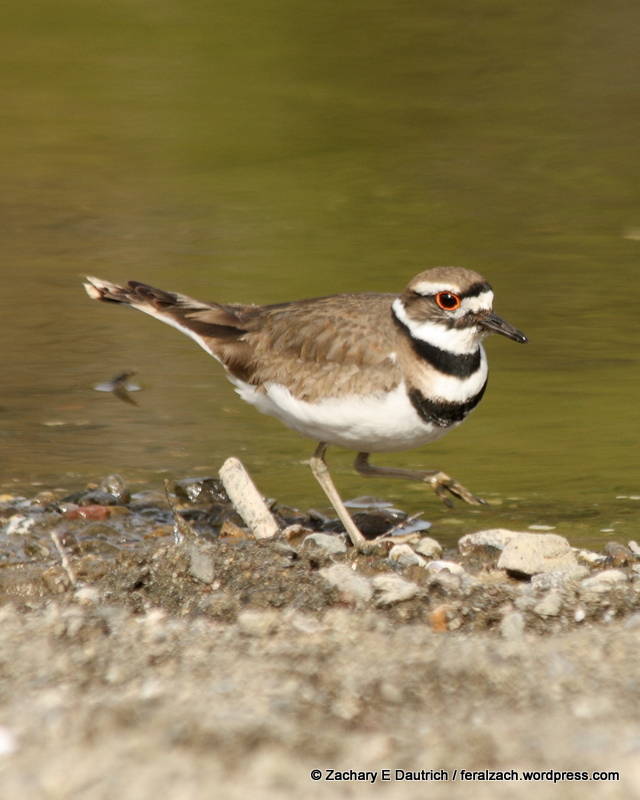
killdeer / Russian River Sonoma County CA
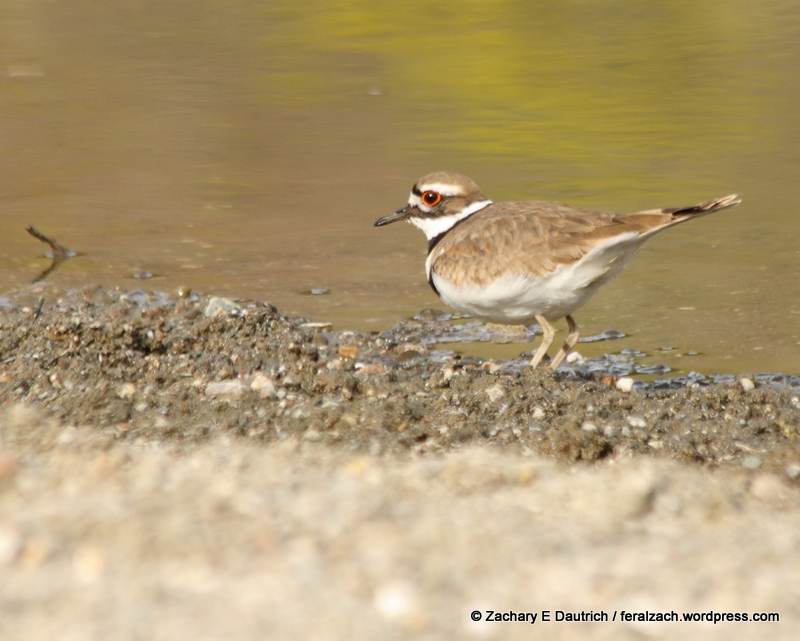
killdeer / Russian River Sonoma County CA
Want to get better at shooting birds in flight? Try practicing on tree swallows flying over a river catching insects … in poor light. Everything else becomes much easier, let me tell you! Just to remain standing and not spun around and on my face in the sand or river was a minor success.
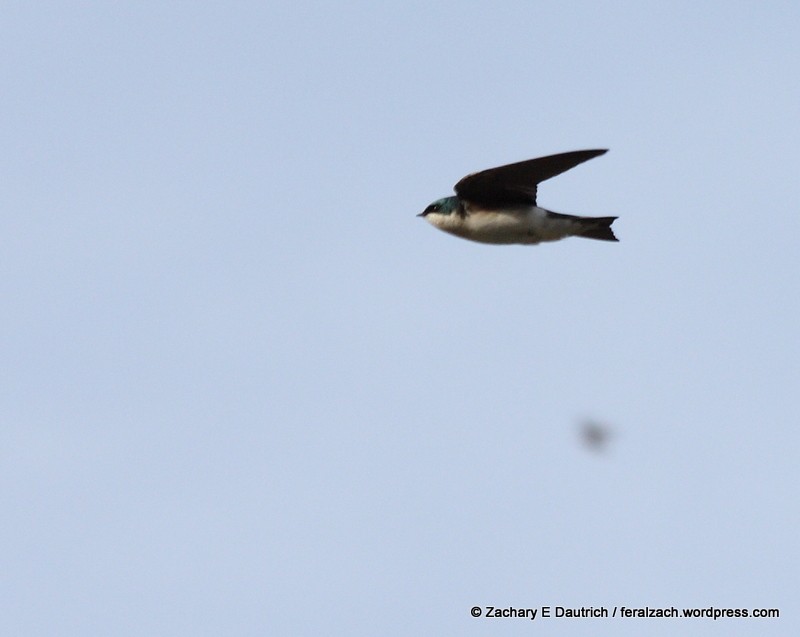
tree swallow / Russian River Sonoma County CA

tree swallow / Russian River Sonoma County CA
The osprey were out and about as well, with two or three pairs fishing and perched in the area. There are many nests around the river and out towards the coast in Sonoma County, always amazing to see these birds in action. They seemed as interested in me as I was in them …

osprey / Russian River Sonoma County CA

Watching it all unfold was a tree full of vultures, trying to warm up on a chilly and foggy West County morning on the river.

vulture roost / Russian River Sonoma County CA

turkey vulture / Russian River Sonoma County CA
hatched!
Earlier this week we saw a little beak protruding up from the Anna’s hummingbird nest that I shared a couple of weeks ago …
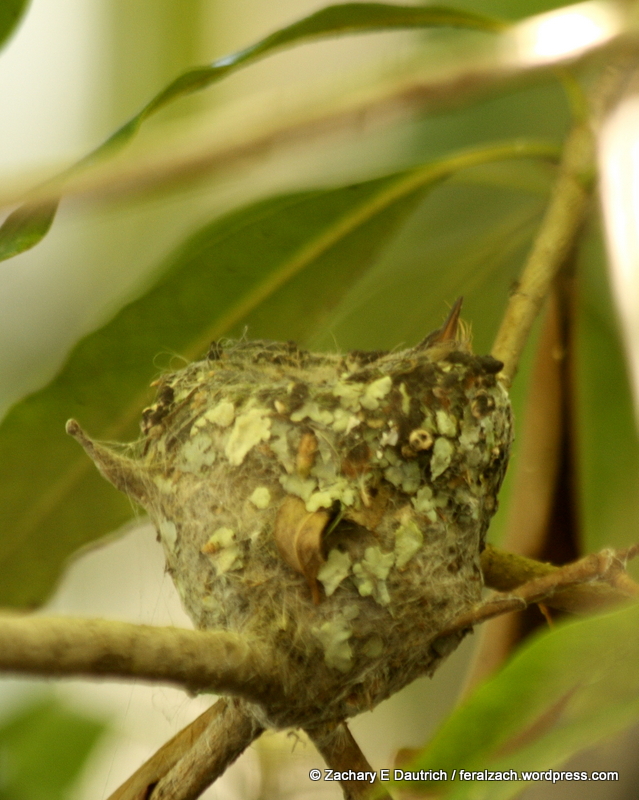
Anna’s hummingbird nest and hatchling
This lone hatchling seems strong and is getting big quickly – they only stay in the nest for 20 days!
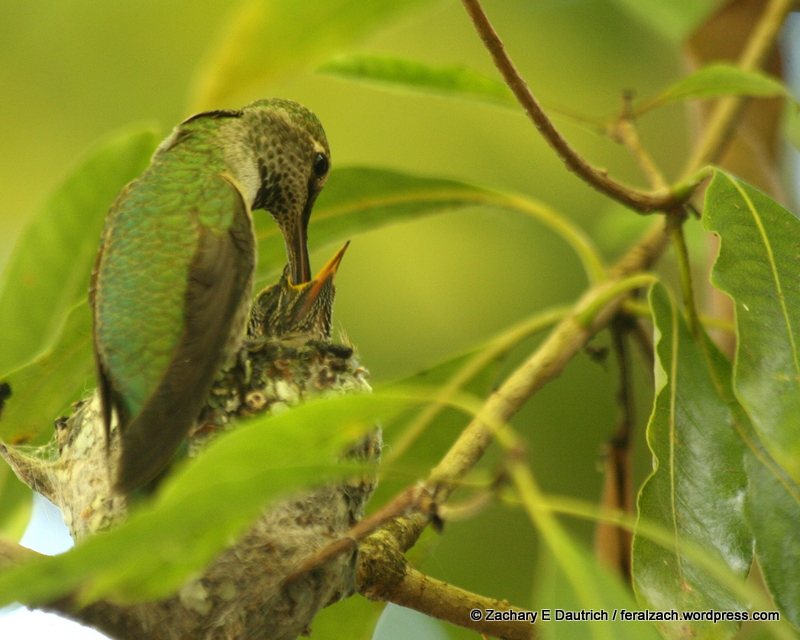
feeding time / Anna’s hummingbirds
 feralzach