
hawk hill today / juv peregrine shenanigans!
Exciting day at Hawk Hill today by the Golden Gate Bridge, one of the great spots for seeing large numbers of migrating raptors. The Accipiters are coming through in high volume right now, and I was able to get out for a bit to watch. The fog started to roll in just as I got there, but we still had a good number of birds coming through (and visible, despite the low fog bank).
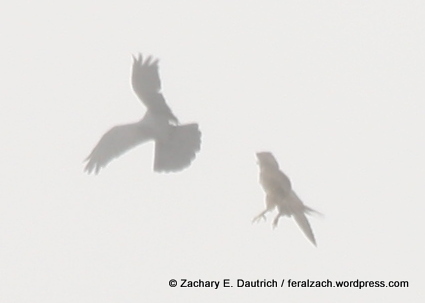
In addition to many sharp-shinned hawks and a few cooper’s hawks, we were treated to a few peregrine falcons that flew by. But not only did the juvenile peregrine fly by – it stayed a while to perform some antagonizing aerials on resident ravens, migrating sharp-shinned hawks, and one lone harrier! It’s hard to tell if it was hunting, just playing, or something in between. The ravens seemed to be having fun playing with it. The small sharpies … definitely not so much!
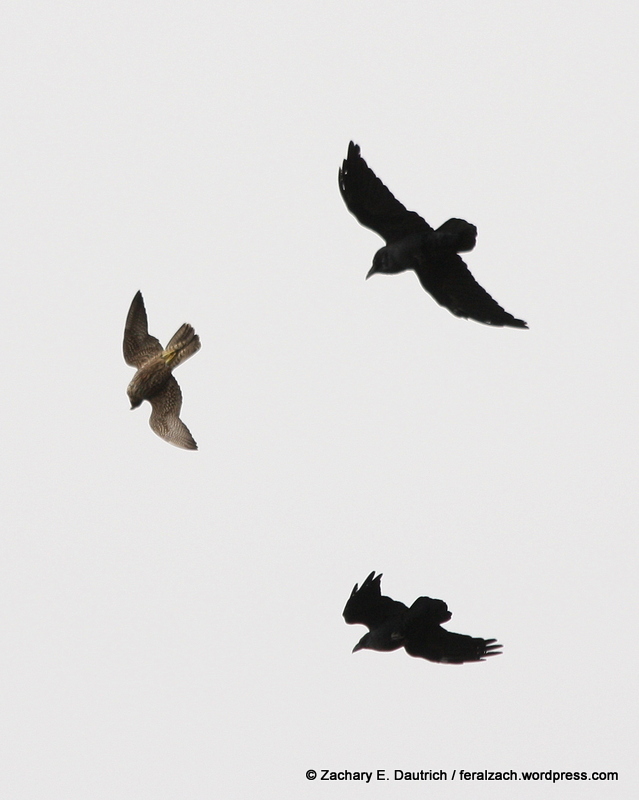
juvenile peregrine falcon “playing” with two ravens / Hawk Hill GGRO Marin Headlands CA
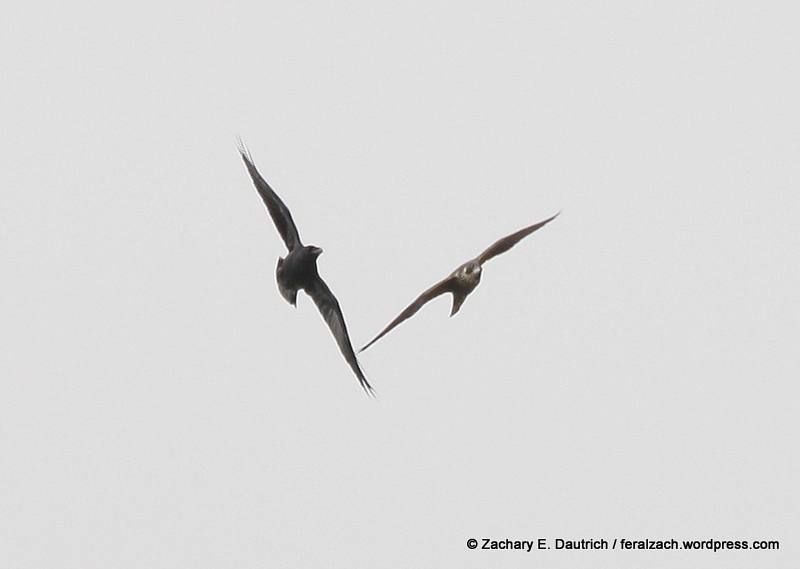
juvenile peregrine falcon and raven

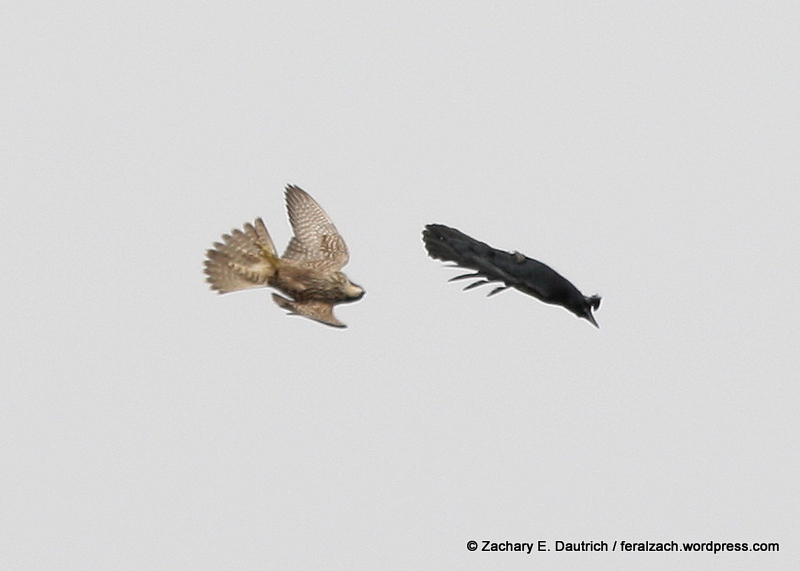
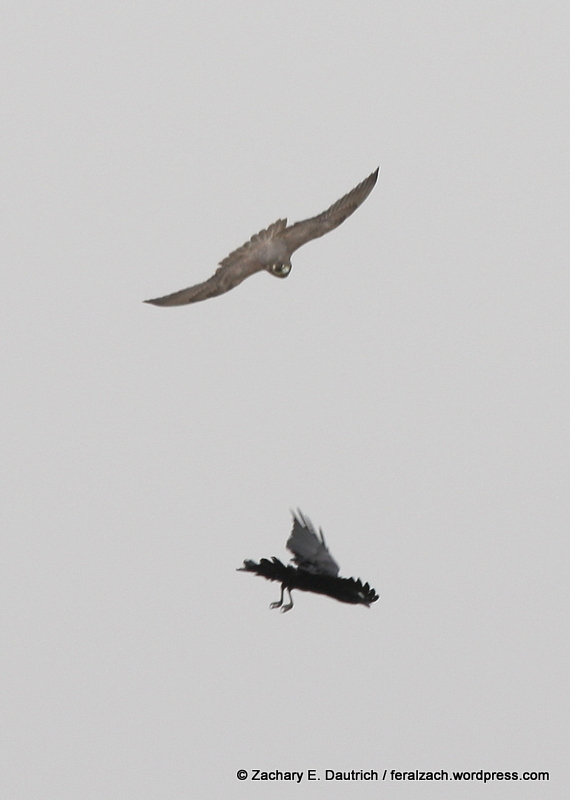

juvenile peregrine falcon / Hawk Hill GGRO Marin Headlands CA

turkey vulture / Hawk Hill GGRO Marin Headlands CA

sharp-shinned hawk / Hawk Hill GGRO Marin Headlands CA

juvenile sharp-shinned hawk / Hawk Hill GGRO Marin Headlands CA
an evening in a great-horned owl’s dining room
One of the areas that I spend a lot of time is absolutely saturated with great-horned owls. And coyotes, for that matter. I would conservatively estimate that within one area of about two miles by a half mile (as observed routinely for the past year), there are five or six pairs of great-horned owls that make their home there. I routinely hear them and see them, and it has become one of my great pleasures to spend time watching them. My sentiment is likely not the same for many other animals in the area, including skunks, gophers, voles, mice, screech owls, barn owls, domestic cats, and any other animal under 20 pounds that makes its living at night, whether by foot or by wing. And actually, young red-tailed hawks too, are at risk – three of which, I suspect, from a nearby nest this season, met their doom by owl talon.
Last night after a nice run, I decided to extend my stay in the park with a wander up around some of the more remote areas (“remote” being a very relative term in the Bay Area! Yet, still surprisingly true to the word … one of the reasons that this area is able to be inhabited by feral Zachs). I started off flowing over some cattle trails, also used by deer and coyotes and turkeys, until I got to some small wooded canyons. I have a number of ways to cross most of them, as they are densely wooded and steep in sections, but sometimes depending on the amount of light it can get confusing. Especially when I get distracted by things – which I inevitably do. As I ducked down under the boughs of the bay laurel trees standing guard at the edge of the first ravine, I almost immediately saw some feathers that I hadn’t seen the night before.
Owl feathers.
Small ones. They looked like they were from a Western Screech Owl, one of the smaller owls that inhabit this area. It’s seldom that I hear them in this area, and if I do, it’s usually further down slope towards the more densely wooded areas. With so many great-horned owls around, they don’t make it long if they leave the safety of those areas. Such was the fate of this one who perhaps flew to far up into the more open oak woodlands and grazing lands.
As my eyes adjusted to the dim light under the oaks and bay laurels, I started seeing more and more feathers. This was no molt, for sure. This small owl was predated. And judging by the feathers, it was taken by another bird. Almost certainly a great-horned owl. Owl on owl! Great-horned owls are a top tier predator, and they are incredibly successful and adaptive hunters. Hide your babies (that’s a joke).
As a side-note, the previous night when I had passed through the same area, there was a very intense smell of skunk spray right where I was seeing the owl feathers. I didn’t spend a lot of time looking around then, but I noted it. This night, the smell was still very strong. As I followed the trail of owl feathers like bread crumbs to the ginger bread house, the skunk smell got stronger. Strange.
Finally I got to a spot where it appeared the great-horned owl had plucked a majority of the feathers from the screech owl. The skunk smell was almost unbearable, as if it had just let go nearby recently. Yet I knew it was at least 24 hours old. As my eyes found a more concentrated area of feathers, I walked over to check them out. And right by the feathers I found a skull! It looked like a young skunk skull!


I kept looking around in the leaves, and soon I found one of the biggest great-horned owl pellets that I’d ever seen! It looked like majority skunk hair (dissecting to occur soon) …
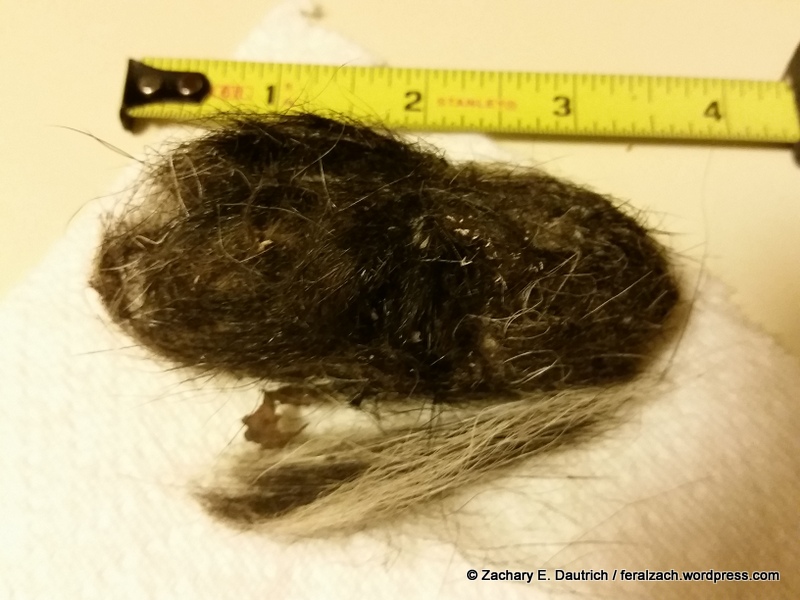
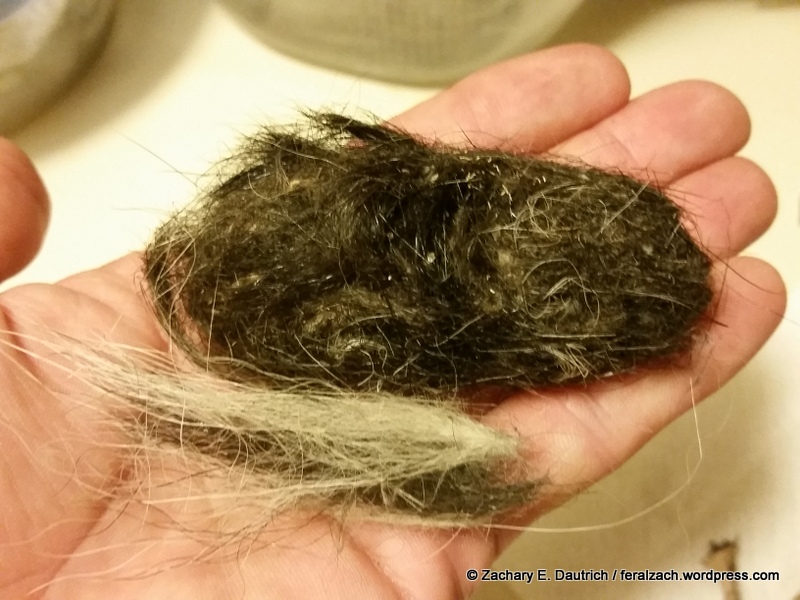
An owl not only ate that when it was also flesh, but puked that pellet up!! Amazing.
Above me was a slight clearing in the canopy, and covering some of the stars, silhouetted in the twilight, was an old dead oak tree. The perfect perch for an owl. As I looked around more, there was a lot of owl slice (owl poop), and other remnants of dead things. I think I had stumbled on a great-horned owl’s dining room!
It was well past dark at this point, so I decided to move on. I went through another canyon, in which the night before I had heard a great-horned owl – but tonight I heard nothing. I kept walking, and soon I got to a tree line that was just on one side of a clearing, of which on the other side, was the perch of two of the local owls. As I walked past the last trees in this first tree line, I saw an owl. Interesting, it was in a spot I’d never seen one before.
I walked across the clearing / meadow, and got to the next tree line where the locals were, and sure enough there was the silhouette of another owl in an oak tree right by where I’d expect one. As I approached, the owl didn’t move. It didn’t even seem to notice me! Again, very strange. As I got closer, my path went right by it, but the owl hardly looked at me. It was intensely staring in the direction of the first owl that I saw. Suddenly I got a glimpse of another owl take off from nearby, flying away from the owl I was underneath. I walked right by the owl in the tree, probably at 25 feet, and the owl just continued to stare across the meadow at what I was now guessing to be a new owl intruder (the first owl sighted). I continued around this line of trees, and made my way towards the exit of the park.
About 500 meters later though, I felt something to my right and looked up and realized that the owl that I had seen take flight was now in a coyote bush just 15 feet from me. It also seemed unconcerned with my presence, and was looking back in the direction of the other owls.
I’m guessing that a new owl had moved into the area, and these two residents were ready to battle to keep it at bay. I’m not sure about the migration of owls, but certainly at this time of year hatch year owls could be dispersing trying to find territories of their own (though it actually seems early for that). Could this be a migrant from the north looking to overwinter? A second year bird that is looking for a territory? I need to do some research.
When I finally got home, about ten minutes later I realized I had to put my shoes outside because the skunk smell had gotten on them and it was really intense. It is said that great-horned owls have no sense of smell … so combined with their incredible power, it makes for one of the few predators of the striped skunk!
equinox, shifting patterns of autumn … and blog #200!

Sunset by Mount Tam over San Pablo Bay, as viewed from Wildcat Canyon Regional Park CA
What an amazing time of year this is – the shift from the summer cycles to autumn is in full effect. I love this time of year. The buckeye trees have long ago lost their leaves, the first harbingers of the impending autumn here – and the days are growing shorter as the light turns to a beautiful golden red. Here in the Bay Area, it means we actually have some summer weather! Infrequent wind, less fog, and some beautiful sunshine and warm weather … and warm nights. The long winter of summer is over, and all of life is shifting, moving … while still waiting for some rain. The bird migration is flowing south, the trickle of birds flowing in the updrafts of the coastal mountains now turning into more of a flood. The Accipiters were the predominant raptor today at Hawk Hill at the Marin Headlands, and in my backyard, and all around, I hear new birds adding their voices to the choir as they move through or come here to spend the winter moons.
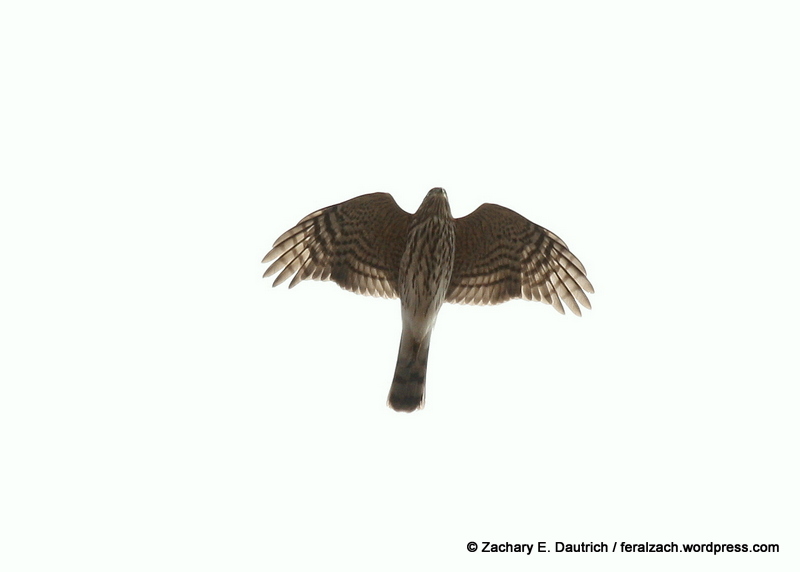
juvenile Sharp-Shinned Hawk / Hawk Hill Marin Headlands, CA
The black-tailed mule deer bucks are chasing does, and more than a few willow trees are marred with the fresh marking of the bucks’ antlers. The smell of the new scarring on the trees is delicious. Ripe acorns are falling, and the acorn woodpeckers, squirrels and jays are busy adding to their own little collections. The poison oak is a beautiful red color (and hey, an extra warning to the careless one who treads without heed!), and the unusually still air in the evening makes space for the sound of crickets and all sorts of insect life.
You can hear life moving all around you in the hours after sunset in the absence of the wind.
As I walk, the smell of dry bay leaves follows my footfalls under the canopy of trees, while in the fields of introduced grasses that predominate the Bay Area, the sweet smell of tar weed dominates. They are two of the first smells I remember from when I moved to the area at this time of year nine years ago, and both bring with them nice memories.

deer rub on willow tree / Wildcat Canyon Regional Park CA
Last night, the equinox, I had a great wander in Wildcat Canyon. Because of the lack of wind and extremely dry conditions, anything that is moving makes noise. Listen carefully enough, and you can start to discern the different animals by their footfalls and movements. I still am amazed at how quiet a deer can be even in these conditions though – an animal that big can be so silent. Sometimes I feel something watching me, and adjusting my eyes in the dark, I see one of them nearby staring at me. But sometimes it’s the other way around too! After many months of seeing mostly just bucks in the drier areas, I’m now seeing females make their way back after spending the dry months more in the human habitation areas (more food, more water, protection for their fawns aka less mountain lions!). During the rut they are less shy, and almost every night that I wander I see bucks and does interacting – and not as concerned about my presence.
As I was finishing my hike last night, I heard a very slight rustling in the oak trees to my left. I paused, and listened. The sound stopped. Hmmmm. Usually a skunk or raccoon will continue on their business, not too concerned with my passing. I flashed a small LED light over in the direction, and about 20 feet away sat a grey fox. Watching me. With one eye! I turned my light off and just stood there, feeling its gaze. Two great-horned owls were hooting to each other in some trees about 200 yards away, and the only other sound was from the crickets in the still night air. Many moments went by, and I flashed my light over towards it again. Still there! We watched each other for a little while longer, until finally it made its way quietly into the night, and I could here it foraging around for what I presumed to be “first” breakfast.

great-horned owl / Wildcat Canyon Regional Park CA
turkey vulture sea food
turkey vulture eating gull
Mendocino Coast, CA
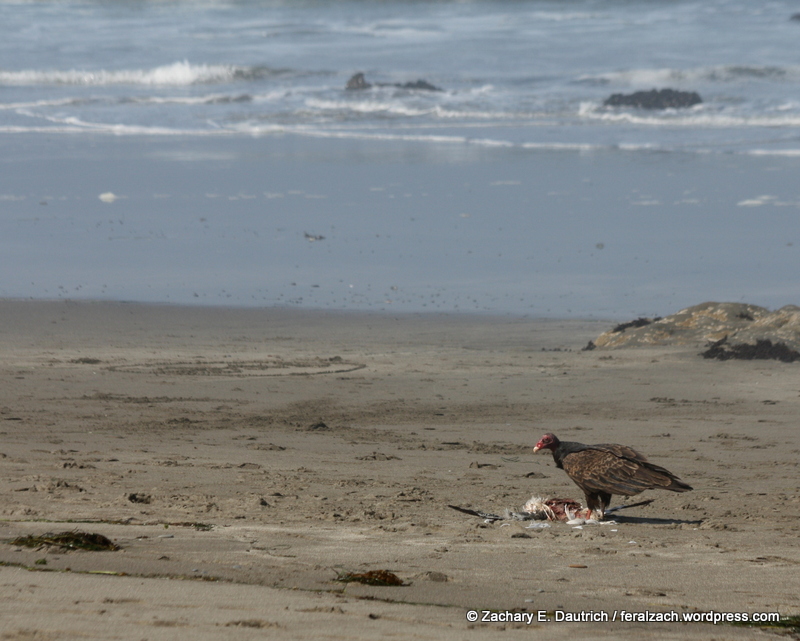
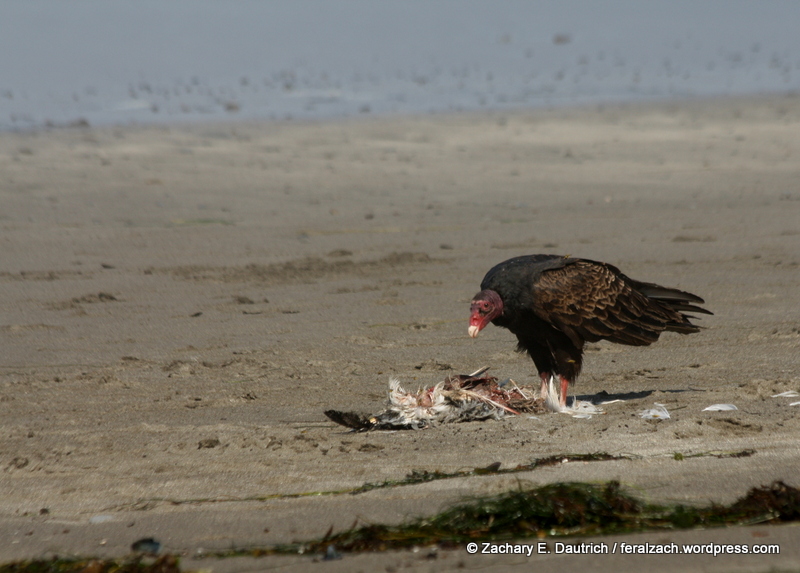


turkey vulture tracks in wet sand
baby raccoon
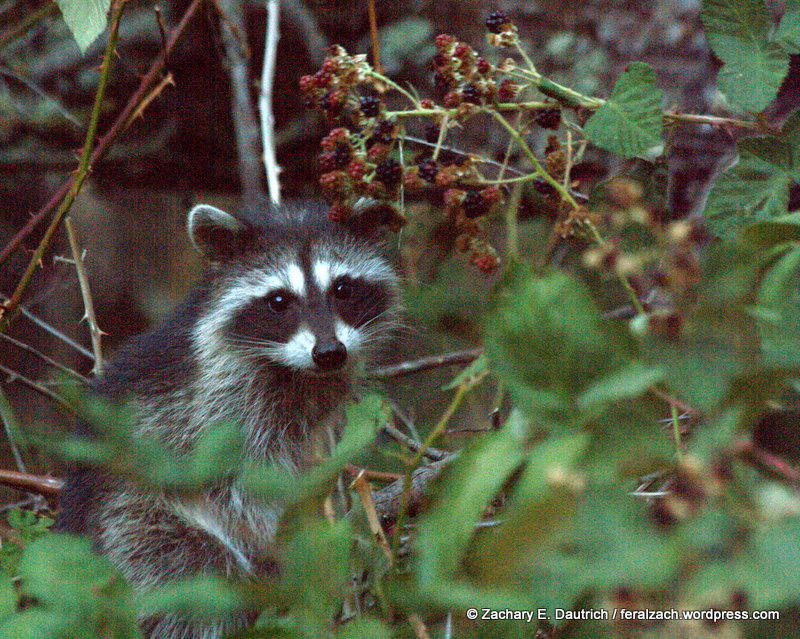
dusk at Mount Diablo State Park – i walked up on a mom and this baby Raccoon having some black berries for breakfast. this one was tiny! they were on top of the bramble, and first I saw mom until she quietly made an exit – then this little one popped up and was about to eat some black berries until he saw me – we stared into each other’s eyes from about 10 feet for about 10 seconds at my eye level, then he silently disappeared down a willow branch into the thicket.
a moon and two planets
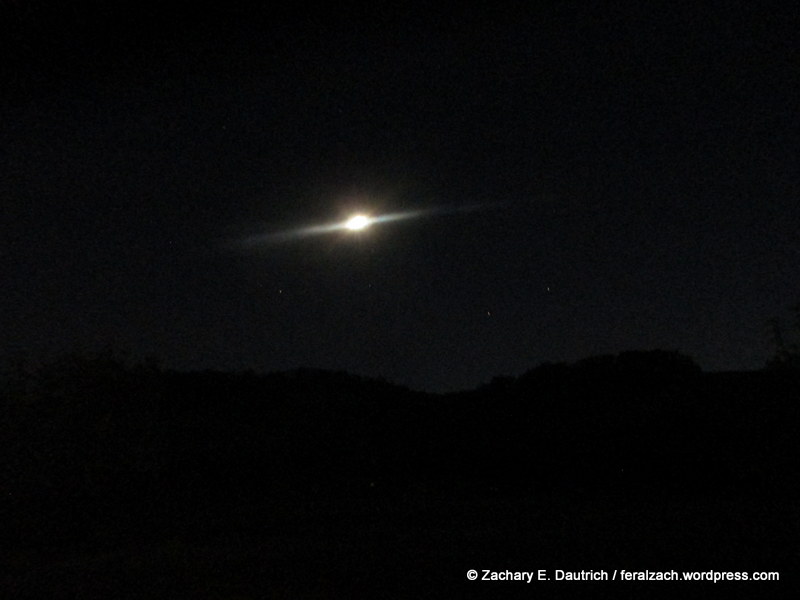
the night sky after dusk on this hot day revealed our Earth’s Moon waxing at first quarter, with Saturn and Mars to the lower right of it. the constellation of Scorpio is just under the Moon, with the “left arm” of the scorpion reaching up to the moon, and Antares, the bright red star in that constellation, shining brightly to the lower left of the Moon.


Antares is a supergiant star, and said to be 883 times the radius of our sun!
goat rock fog line

Amazing to see the color of the water drastically different on each side below the line of fog that held just off shore. Gray/brown under the fog, vibrant blue in the sun.
time of the new owls (and the meaning of life)
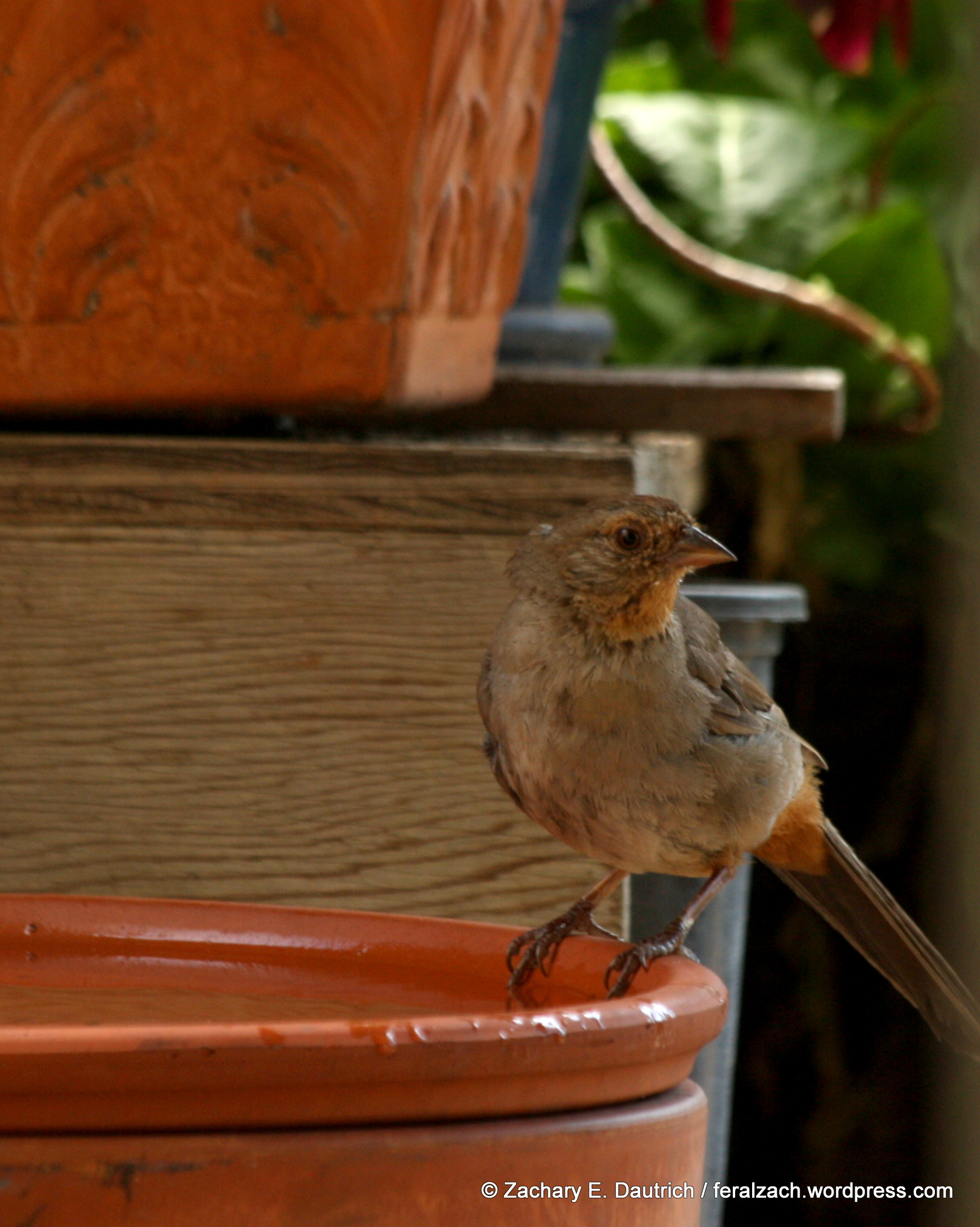
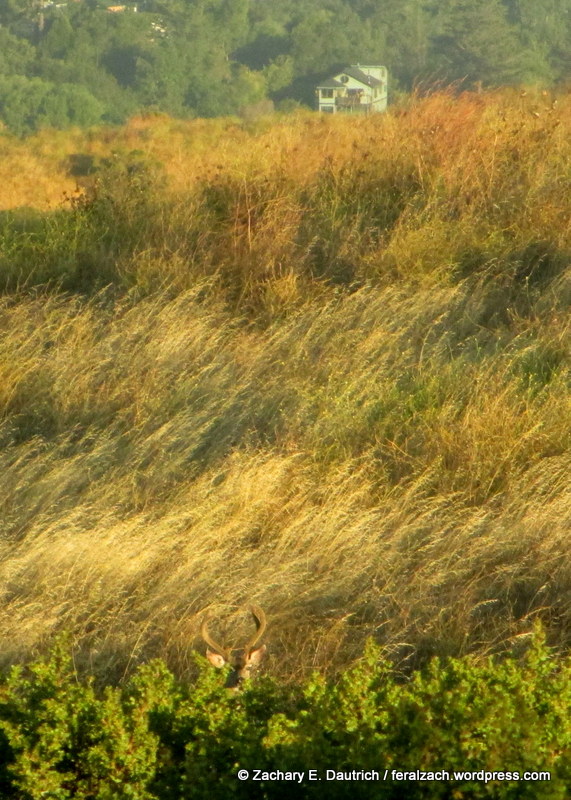
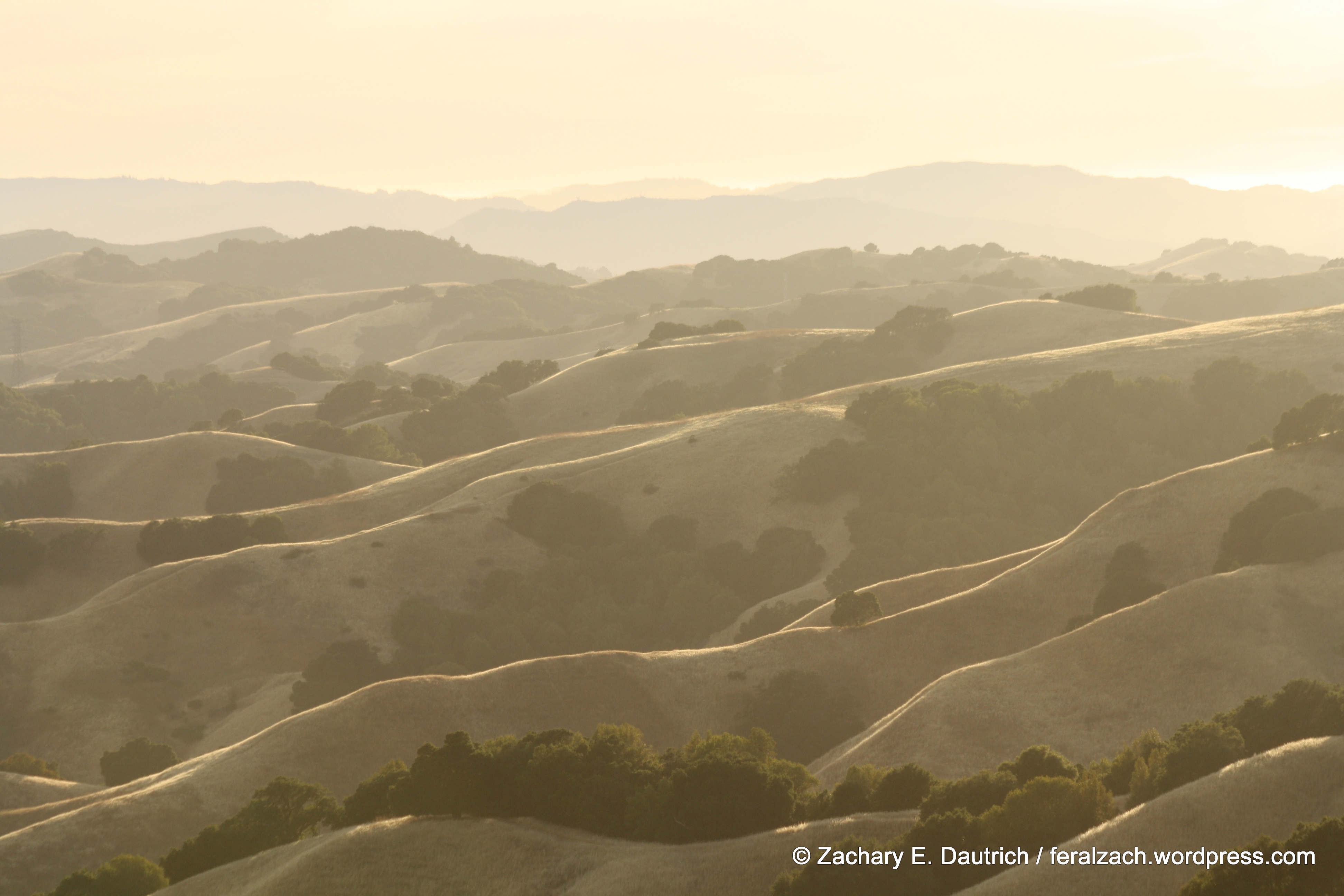
Almost everywhere I go wandering now, right around sunset, I start to hear their calls. It is an unmistakable sound – a loud, short, ascending, piercing/shrieking “what the hell is that?” call that cuts through the falling night and thick air – a whining, desperate, yet strong sound – definitely recognizable to even the untrained ear as the sound of a begging youngster. The young great-horned owls are now out of their nests and flying around, but still dependent on their parents for the bulk of their food. And they don’t let them forget it.
Sunday night, I took a wander at sunset to see the last light of day before the arrival of the so-called “super moon.” Most media sources have exaggerated the size of the moon on these occasions – regardless, it is certainly slightly brighter and bigger during these times when the full moon and perigee coincide (perigee is when the moon is closest to the earth during its elliptical orbit around us).
Just after the sun set, as I was sprinting down the mountain side that was my sunset perch, I spotted a coyote already starting its rounds …

I followed it, and we stayed on the same path for at least a mile until a second coyote came into view. The moon was not yet visible from behind the low-hanging clouds to the east, but this valley was already alive with the creatures of the night. As the coyotes darted around in the open field marking their territory and investigating the ground squirrel holes, the baby owls had started their begging calls in the treeline to the south. By ear, it sounded like three of these young ones.
I watched one coyote mark an area up the side of the valley, then disappear over the ridge. It’s mate walked over to the area that had seemed to captivate the male, then disappeared in the other direction. Of course I went to see what they had been checking out.
Just as I reached that area up the hillside opposite the sound of the young owls, the female coyote that had just been there re-appeared back on the trail where I had just been – she had looped around and was now watching me. In this light (or lack thereof), it takes a careful eye to see them even when they’re moving, their camouflage is so amazing. As I looked at the area they had been checking out, she checked out the area that I had just been. Our gazes met briefly as we acknowledged one another and then returned to what was before us. She backtracked where I and the first coyote had come from, until finally cutting up a ravine in the general direction that her mate had gone.
The owls were now making so much noise I had to go over to check it out. There was very little light left in the sky, but as I approached the treeline I was able to make out two juvenile great-horned owls perched up in the oaks. Occasionally they would hop to another branch, or dislodge one another in turn from their perches in what seemed like youthful play, and perhaps inpatient anticipation of their first meal of the “day.”
There were three young ones, and the two adults were there in the general area as well, hooting amid the youngsters’ begging. Five owls making a lot of noise. In addition to the hooting, the adults made some other sounds – ones that they seem to use when greeting each other at the beginning of the night when they reunite from their daytime roosts. It’s an intimate and endearing sound, almost a cooing noise mixed with a cluck.
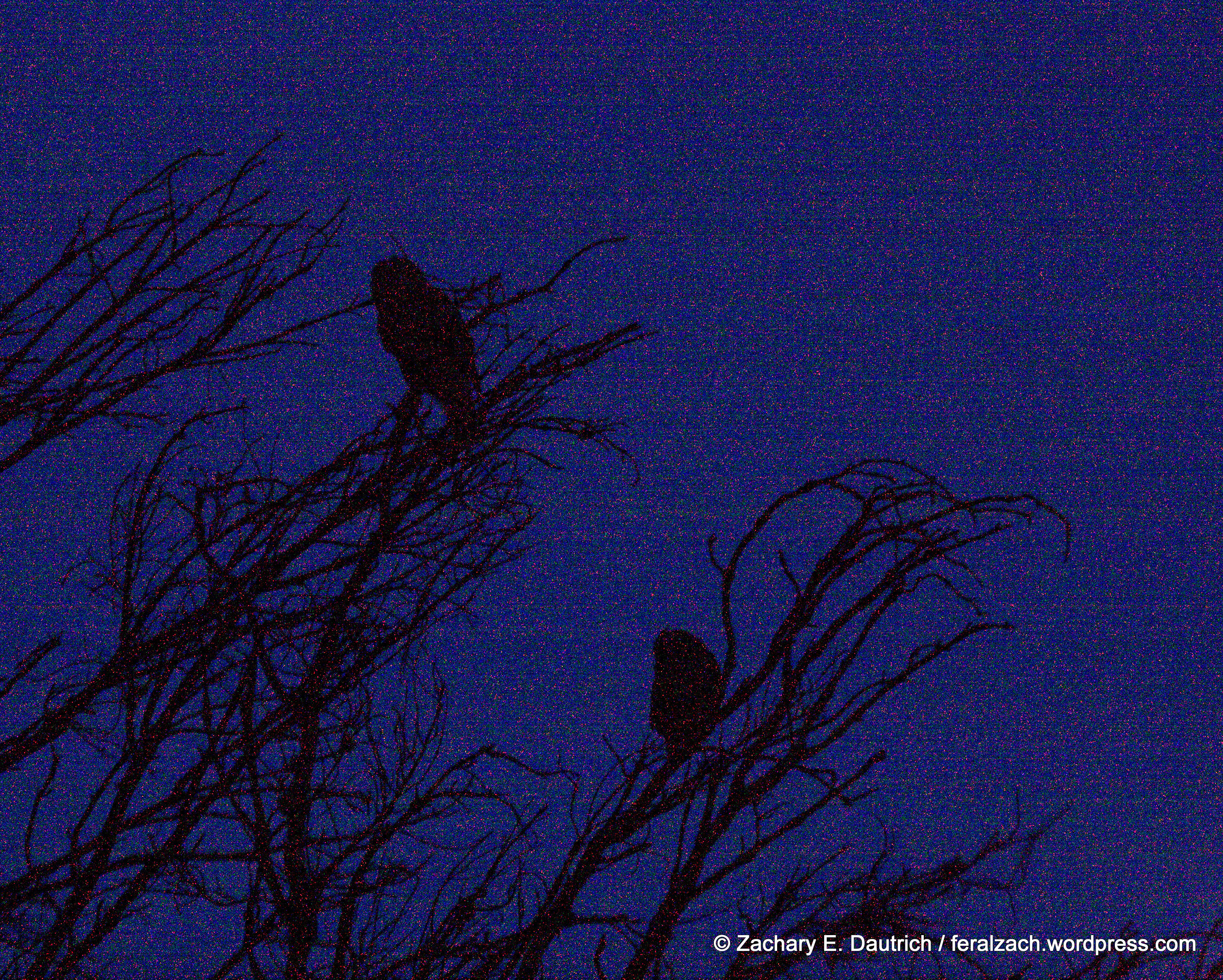
I watched for about ten minutes until they finally dispersed into the night – likely the young ones followed the adults as they set out to hunt, making their job of getting food that much more difficult!
It was just about then that the moon rose above the clouds – what a sight indeed. The air was still and warm, and with the sudden light of the moon the entire valley lit up with a blue light that illuminated everything.
True tranquility.
As I wandered slowly back towards my vehicle, a buck and a skunk escorted me out.
+ + +
The next night, I went for a run at one of my favorite spots nearby where I live, just before sunset. As I paused at a spot to stretch and do some pull-ups, I heard those familiar calls. This time it was from a nearby valley. After about five minutes, the calls came closer, and I realized that one of this other set of young great-horned owls was just above me in a coyote bush at the top of a hill. I crept up the opposite side of the hill until I was behind another coyote bush, about 20 feet from this young owl who was now at eye level with me. It peered over to look in my direction just as I looked out from behind the bush …
Then it started begging, right at me! It’s mouth opened so wide, it looked like I could peer directly down into its belly! And the sound! It was incredibly loud, coming right in my direction. I didn’t move. Finally it swiveled its head around to face the valley before us, in the direction of its two siblings, and continued to cry – occasionally looking around and back at me, spreading its cries in every direction in hopes of a meal soon. We spent a few minutes together, and it was only the approach of an oblivious hiker who came within about 100 yards that ushered it to take flight.
I cherish these moments.
juvenile bald eagles
a few weeks ago, i had the pleasure to accompany some friends and dedicated raptor-enthusiasts to see a bald eagle nest in alameda county that had two newly fledged juveniles. bald eagles have been slow to return to the Bay Area, and there are only about 16 nests currently in the vicinity from Monterey up to Mendocino County. a good sign to see them coming back.
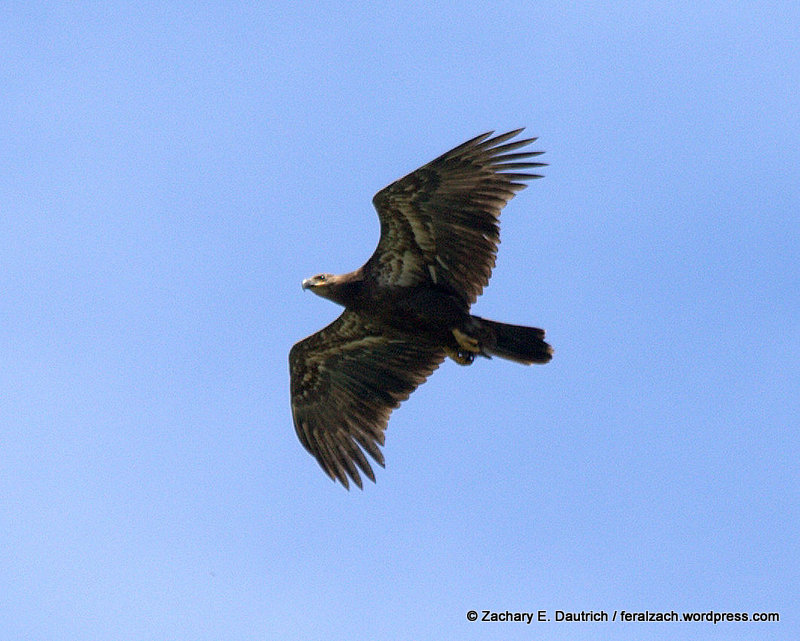
juvenile bald eagle / alameda county CA
they were comical to watch – flying was fairly easy, but the landing part was still a challenge. they would put their feet down 100 meters before their intended perch, and often overshoot it and have to fly around for a second attempt or find another spot.
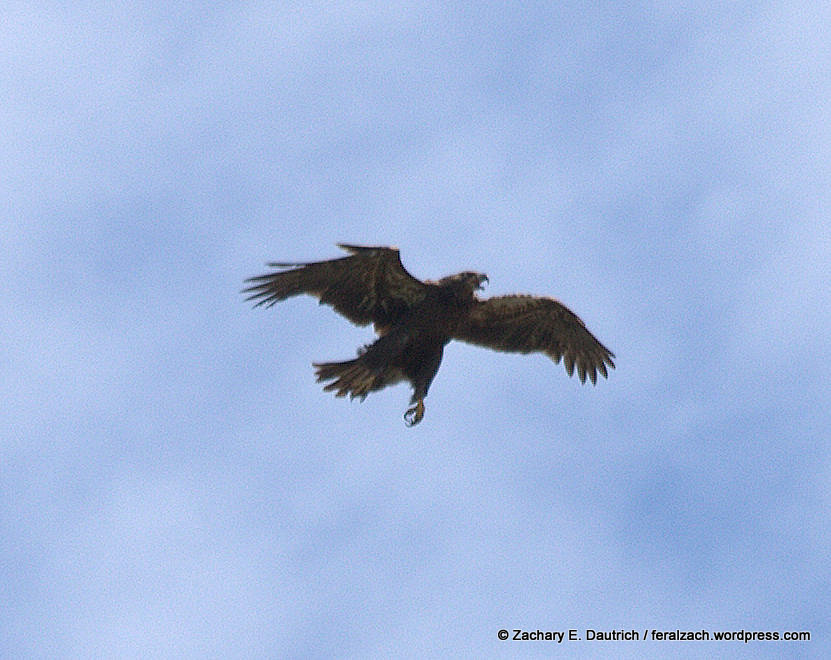
they were begging for food from their parents – pa was about a mile away (out of ear shot, likely, from the incessant begging), and ma seemed un-phased by their constant calls, looking regal on her perch as she preened ignored their calls.
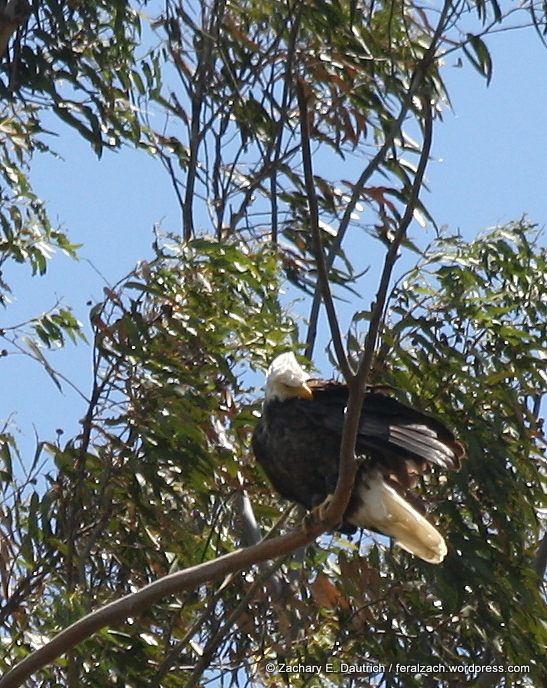
adult female aka ma bald eagle / alameda county CA
she did make one or two half-hearted attempts at a fish in front of us in our boat, but it was a leisurely sunday morning for all involved overall.
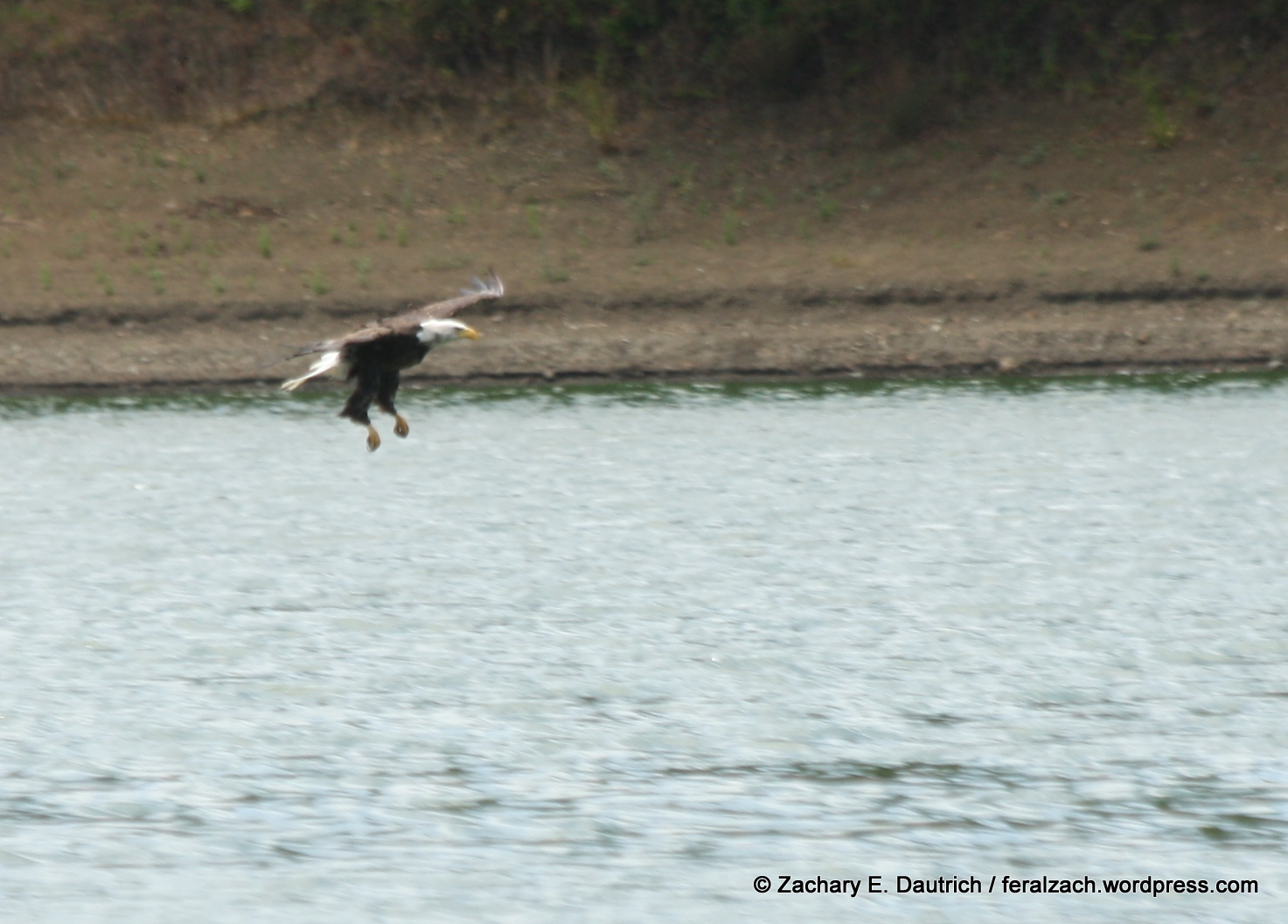
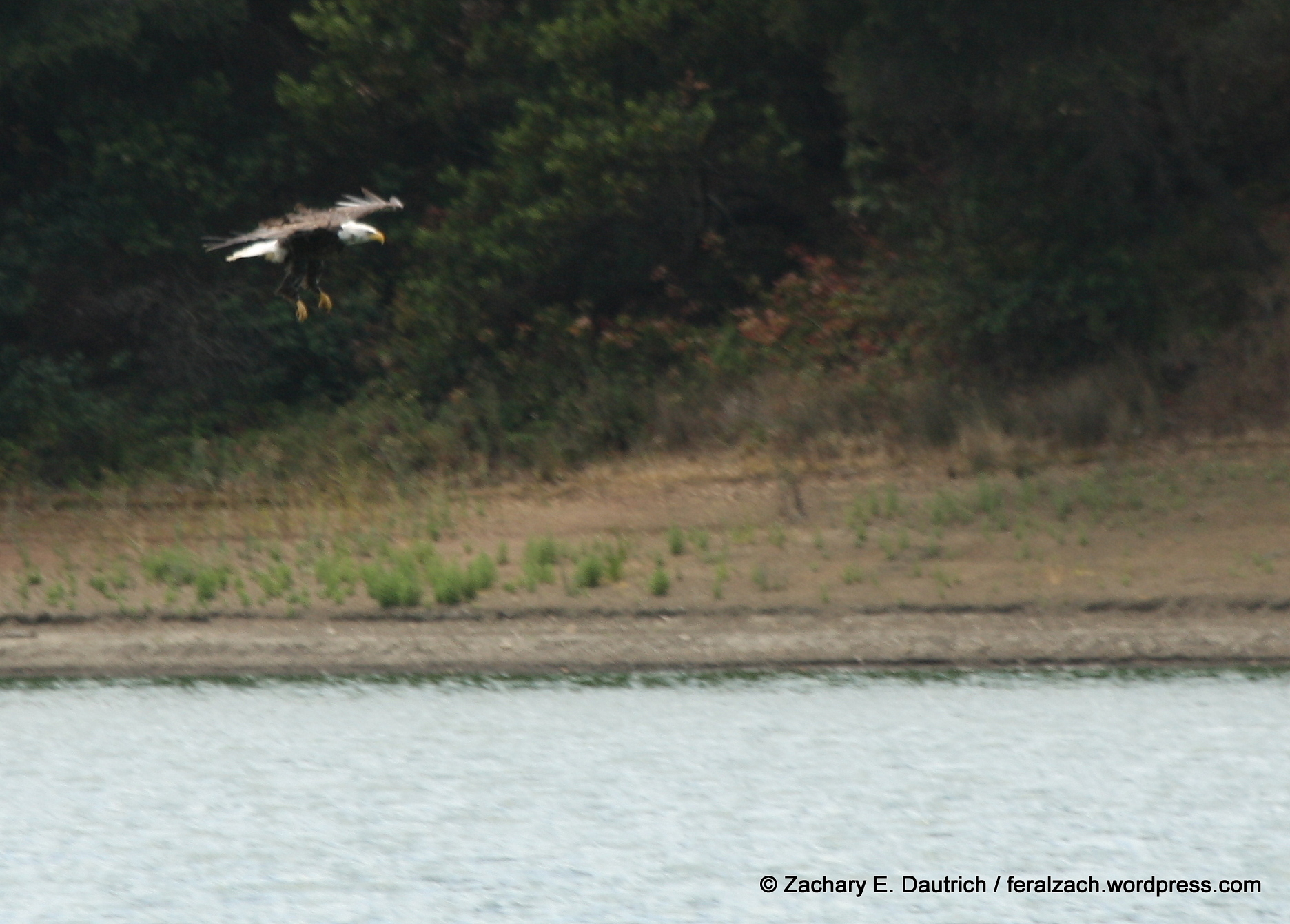
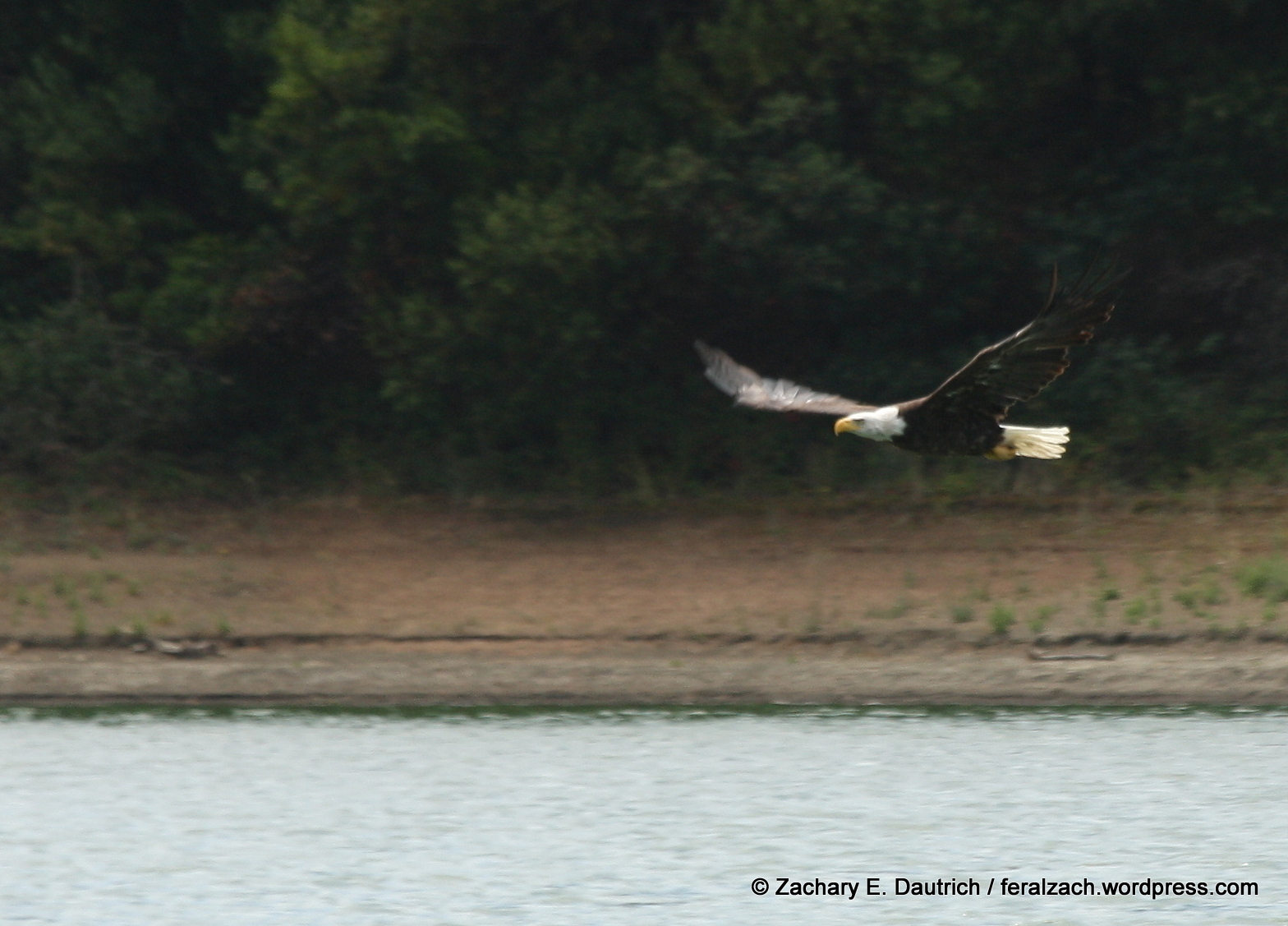
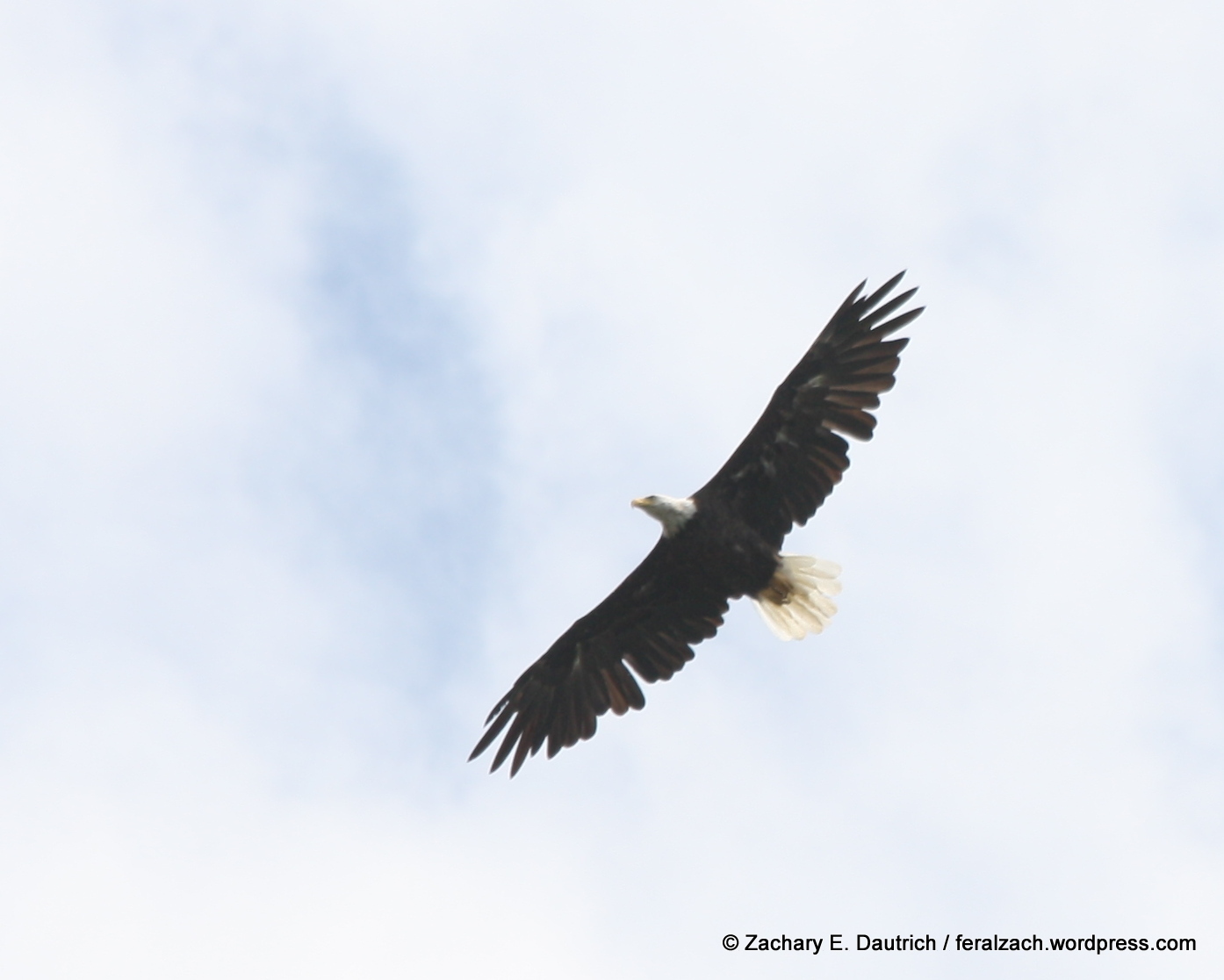
adult female bald eagle
an amazing day out on the water with these majestic birds. special thanks to Mary, Roy, Carol, Megan and Cagney for this adventure!

moss landing sea otters

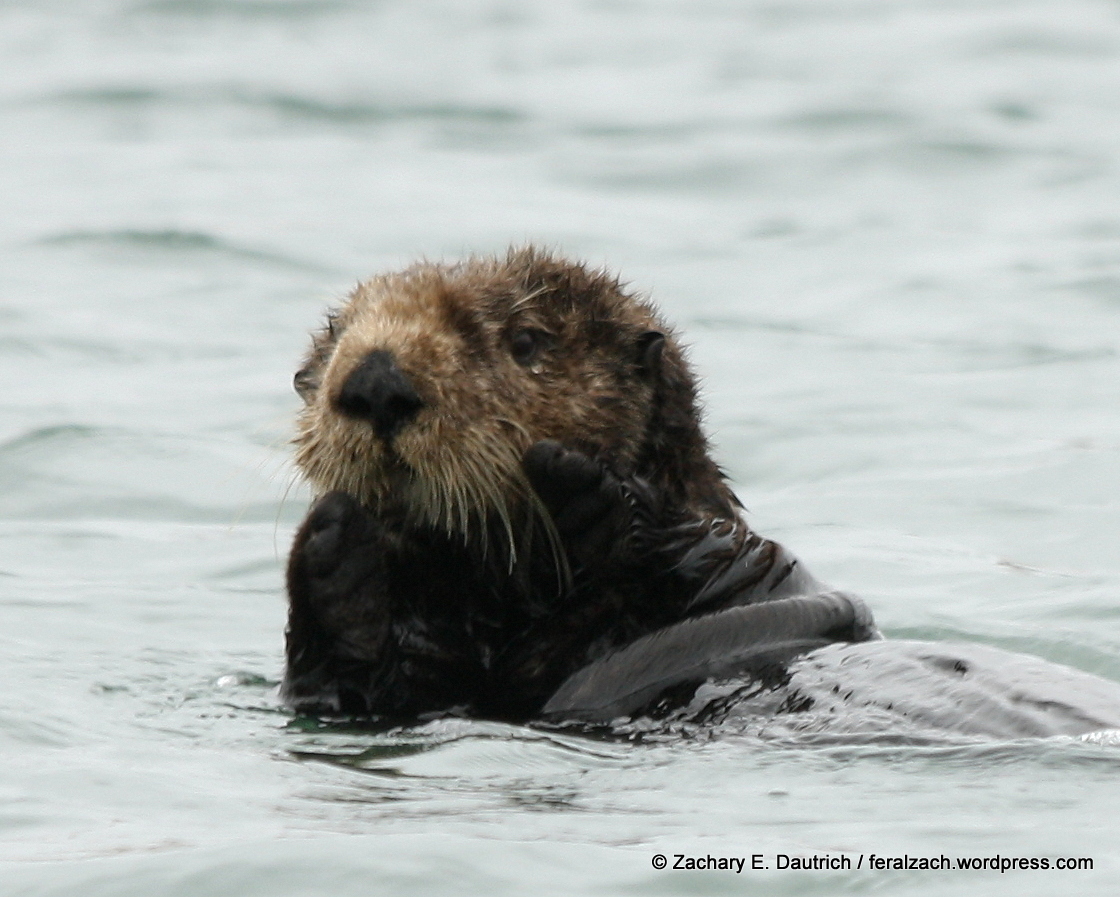
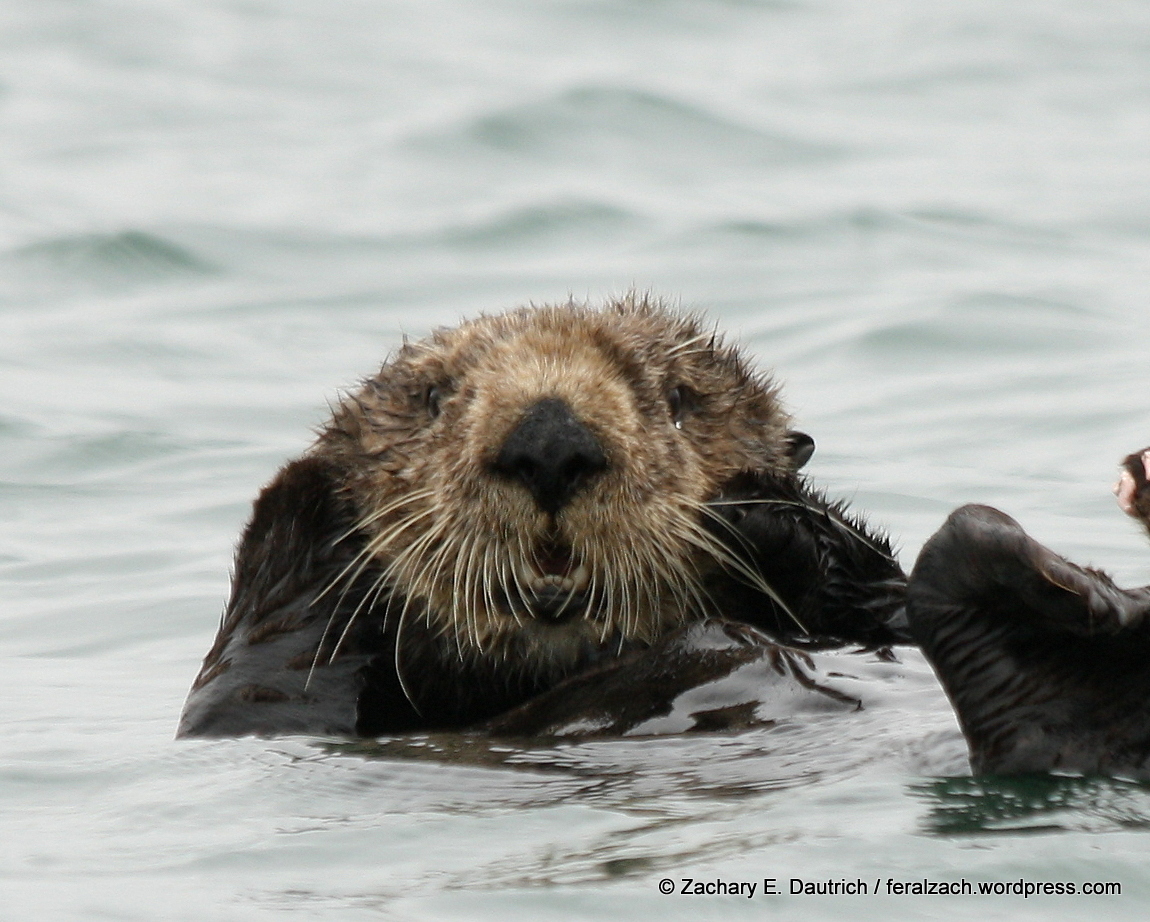
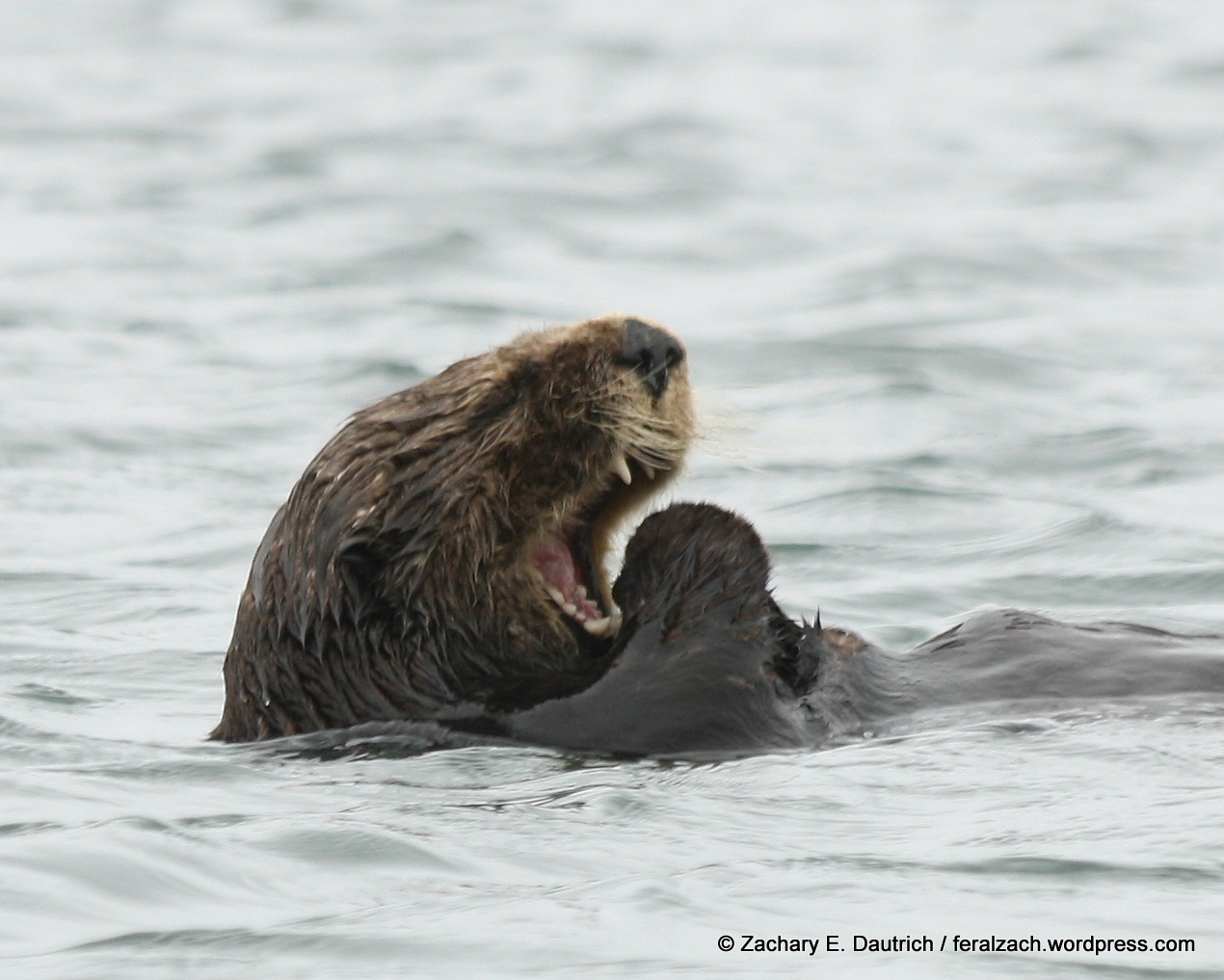
sea otter / moss landing CA
wow, so many sea otters! humpback whales spouting and breaching right off the coast, brown pelicans soaring pteradactyl-like overhead by the dozens. two-foot diameter egg yolk jelly fish undulating just under the surface, offering a glimpse into another world, as if a specter appearing at midnight through a mist to an unbelieving eye. sea lions making a enough noise to drown out the ocean itself. harbor seals popping up like prairie dogs in a field, to take an inquisitive look at the strange creatures paddling around them – or with heads protruding vertically from the surface to nap and rest in the relative safety of the inlet. gulls, whimbrels, and other sea birds floating to and fro over the waves rolling into the bay, or picking their way over the sand flats in search of food.
this is a special place. monterey bay, and the monterey bay national marine sanctuary – a living testament to the efforts of many people to preserve an ecological diamond.

brown pelican / moss landing CA
otters in huge rafts, 15-40 of them in each. groups of male otters rolling, splashing, sparring, wrestling in the water. others grooming, some sleeping wrapped in their blanket of kelp to stay put in their rolling, flowing beds of water.

“raft” of sea otters / moss landing CA

sea otter eating a clam / moss landing CA

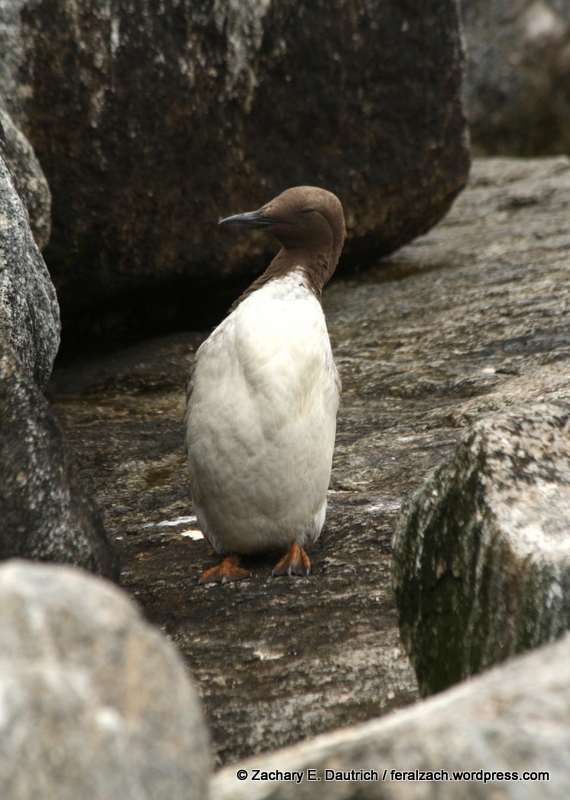
common murre taking a break / moss landing CA
they are a photogenic bunch. i could have watched them all day, despite the evidence of boredom shown by the subjects towards their onlookers …
pine marten
While backpacking in Lassen National Park, we came upon this lady/fella along a lake. Initially I just saw something glowing along the lake and thought it was a person with a very dim led headlamp on. Then the glow disappeared and re-appeared about 5 feet away from where I saw it last – and being focused on it, I could see it was two small glowing blue eyes!!!! It continued to go ahead of us for a series of two or three starts and stops, then while I was paused in the trail, it hopped up on the trail and came towards me! We had a few moments of just staring at each other – it seemed as curious about us as we were about it. After it approached us on the trail, it climbed a nearby tree to give us a thorough inspection from a safer vantage. So awesome!!!
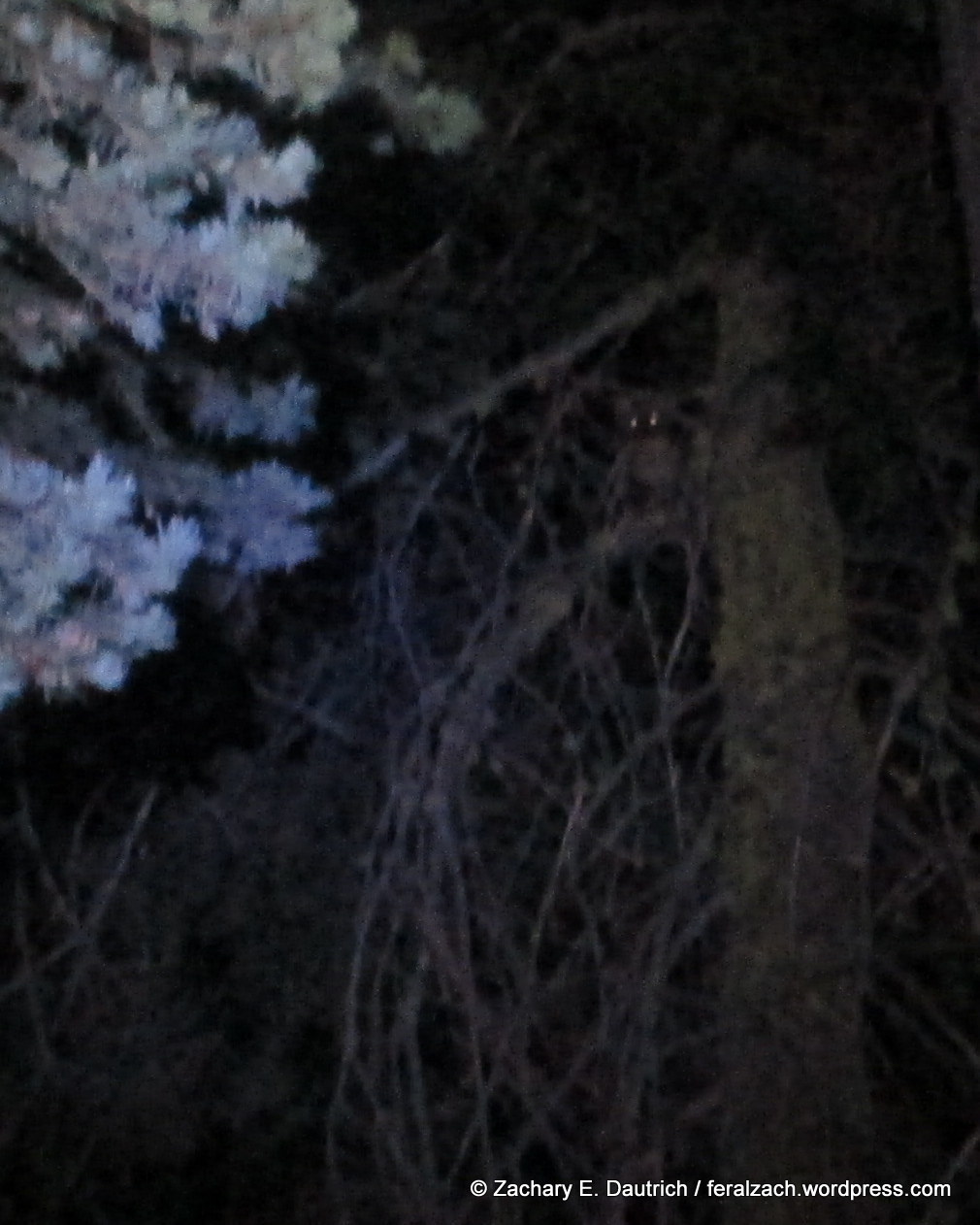
american pine marten / Lassen Nat Park CA
About 100m down the trail after our encounter, I found what is likely fresh pine marten scat.

pine marten scat
Quite an encounter, so amazing to get to see this creature up close and to have such a personal interaction with it. I love the weasels!!
a visitor in the night(s)
While strolling on a busy beach in Rhode Island where I was visiting for a few days, I noticed some tracks on the perimeter of a protected area at the mouth of a river that flows into the ocean. The area is fenced off to protect habitat for piping plover nests and least tern nests from the thousands of people that come to the beach to cool off in the summertime. The tracks caught my eye because of the gait and they looked very “weasel-ly” from a distance … in a lope similar to a typical otter gait but much smaller.


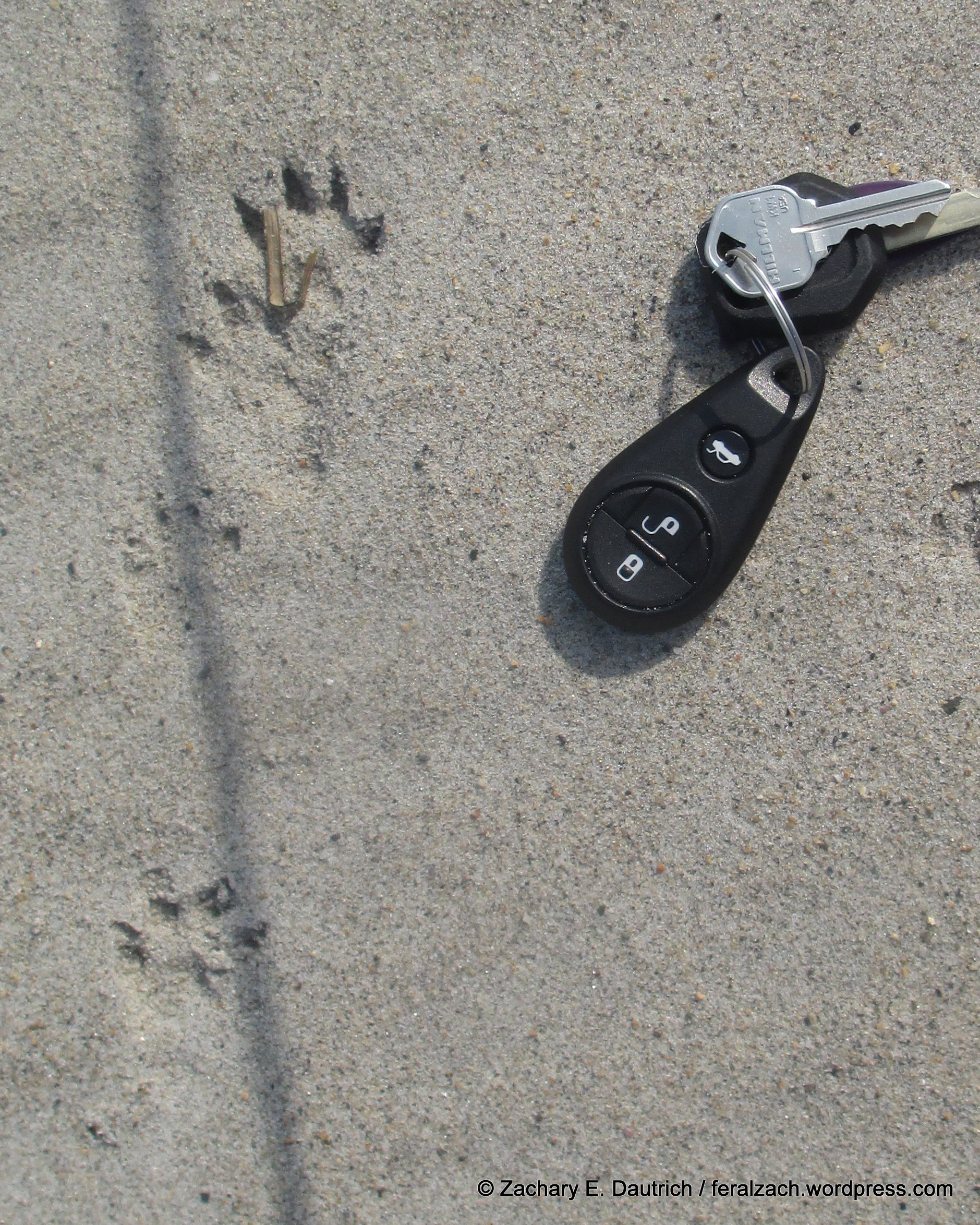
Two of the four mornings that I scouted the area I found its tracks! I haven’t seen mink tracks yet in the Bay Area, we don’t have them anymore – though they are making their way back in this direction from the north, where friends of mine have spotted them in Sonoma County. I was excited to see them, especially since they were so clear and there were so many of them in a place that I didn’t expect to find anything but shorebird, dog and people tracks.


Whenever I go to a new area, I check to see the species that are typically there and mink weren’t listed – though curiously fishers (a larger, more arboreal relative of the mink in the Mustelidae family) are being seen more often and causing some problems due to interactions with (aka making meals of ) domestic pets. Mink are common in much of New England, so it’s not all that unusual to find them where I did since their range is continuing to expand at this time. They spend a lot of time in the water and are very similar to (but much smaller than) another of the weasel family, the otter. It was an exciting find!
Wish I could have seen it …


mink tracks with piping plover tracks / RI

mink tracks with piping plover tracks / RI

mama marsh hawk bringin home the …
lizards!?
yup.

female northern harrier w lizard / Marin County CA
fledge week!
During this past two weeks I’ve had the fortune to see a lot of local raptor young and fledglings – peregrine falcons, red-tailed hawks, northern harriers, white-tailed kites, osprey, and even one black hawk / red-shoulder hybrid. I’ll have more detailed blog posts and the stories about each of these soon, but for now here are a few pictures.
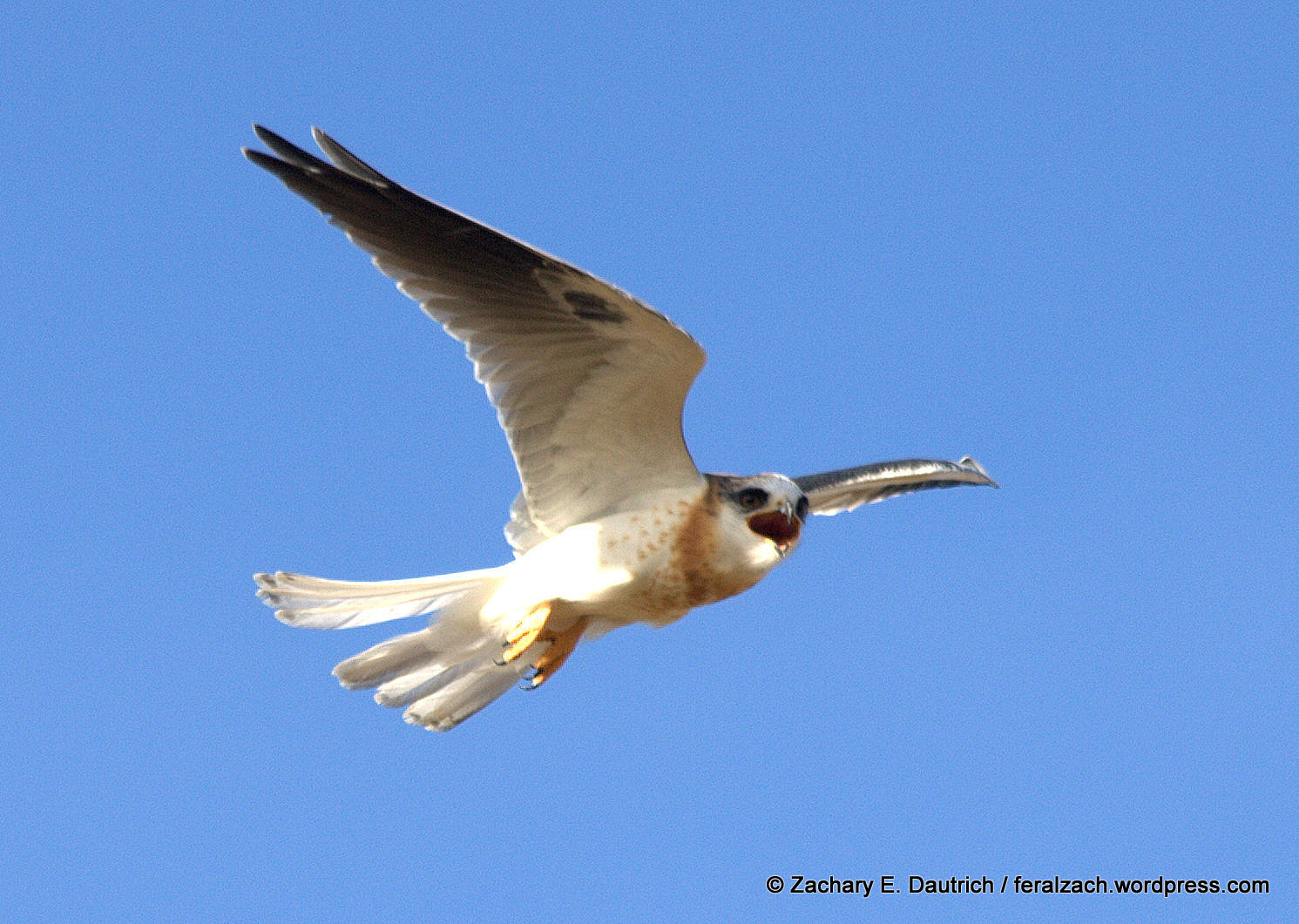
white-tailed kite fledgling / Marin County CA
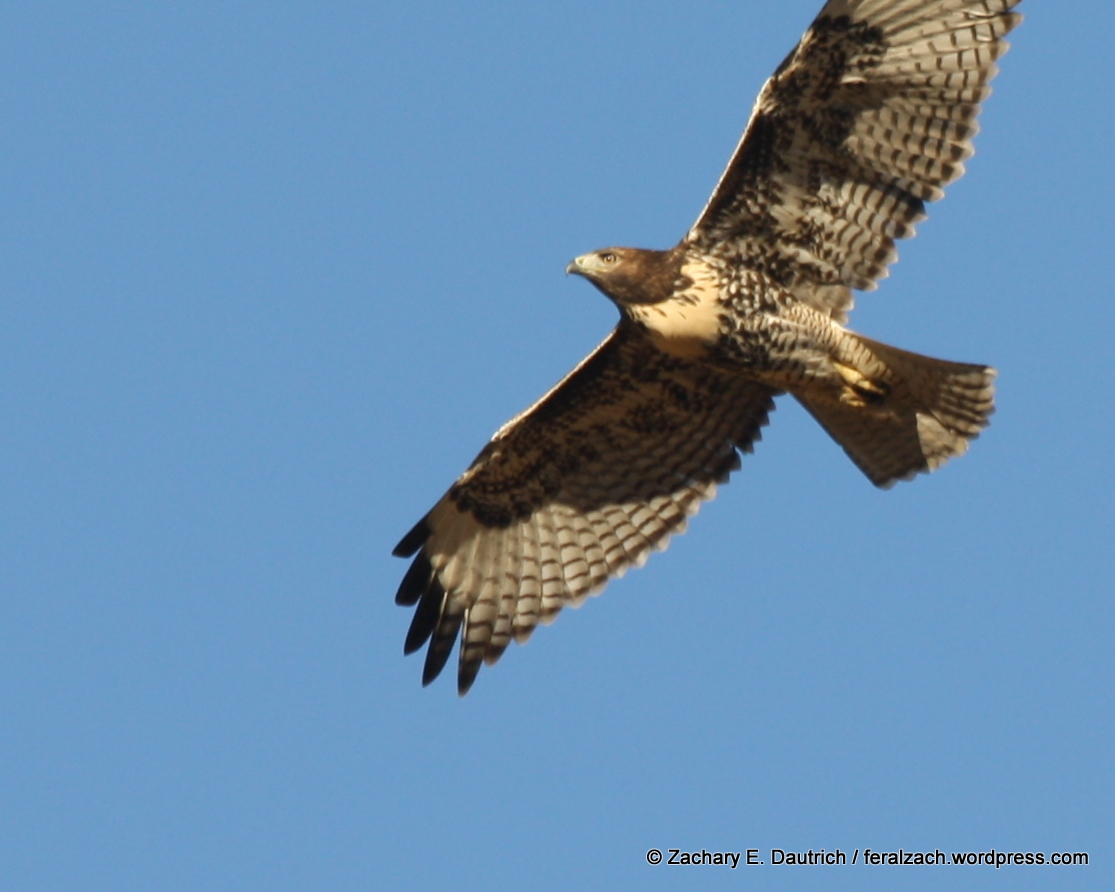
red-tailed hawk fledgling / Wildcat Canyon Reg Park Contra Costa County CA

northern harrier chick / Marin County CA

blackhawk / red-shoulder hawk hybrid chick / Sonoma County CA

osprey with 3 chicks / Mare Island Contra Costa County CA

juvenile peregrine falcon / Sonoma Coast, CA
sunset under a falcons’ playground
The winds surged onto the coast
like a flood of oncoming water;
And seemed to convince even the water below
that on this evening,
they could together move the giant rocks around which they are usually forced to flow.
But as the wind and the water
danced with the rocks in their daily ritual,
debating who is mightier;
The falcons flew above and through it all.
I had nearly given up on seeing the falcon fledge(s) from this nest, located on the side of the sea cliffs – instead I was ready to yield to the winds that seemed determined to drive people and most living things to seek shelter elsewhere. I watched as cormorants and gulls flapped their wings so hard and fast, only to barely make headway in the gale. Instead of leaving though, I took refuge behind a lupine bush that afforded slight shelter from its relentless surge. The rock face that rose in front of me was glowing in a yellow light that made all the colors of the coastal plants seem to glow, with hints of orange starting to invade the palette before me, foreshadowing the oncoming setting of the sun. I was astounded how the small plants that made a home in the crags on the face of the rock barely moved in the 40 mph winds, and was a bit disappointed not to see the familiar form of a falcon hiding somewhere in the midst of it all.
My eyes shut for a few moments after an already long day, and when they opened I immediately saw that familiar form on the very top of the rock – a peregrine!
juvenile peregrine falcon / Sonoma Coast, CA
It seemed to look at me for a few seconds, then it jumped off its perch and floated into the air, a few quick flaps of its wings propelling it with speed right into the strong winds.
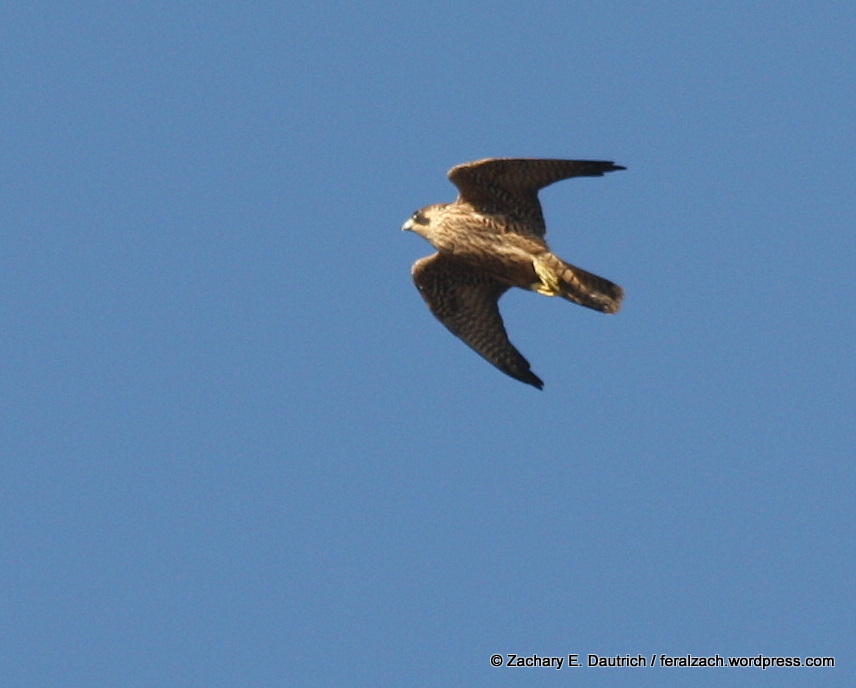
Soon it broke its relatively even glide with some quick dives at a few small birds in the chaparral – exuberant, youthful frolicking – and a bit ungraceful! It was happy to be alive and happy to be a falcon. Flying! It was definitely a newly fledged bird, and I was happy to see it had survived this long. Moments later it had disappeared.
I soon gave up my plan to watch the sunset over the waters, as the wind now was my only companion now and it seemed intent on its solitude.
On a whim, or an intuition (or an invitation?), I decided to drive a little further into the park instead of starting my journey “home” (though wasn’t I already home?). As I crested a hill, and the Pacific Ocean once again dominated my view to the west, the sun seemed to renew its invitation to watch its daily finale. Suddenly out of the corner of my eye, two small darting forms caught my attention in the sky above the tallest hill over the cliffs of the sea …
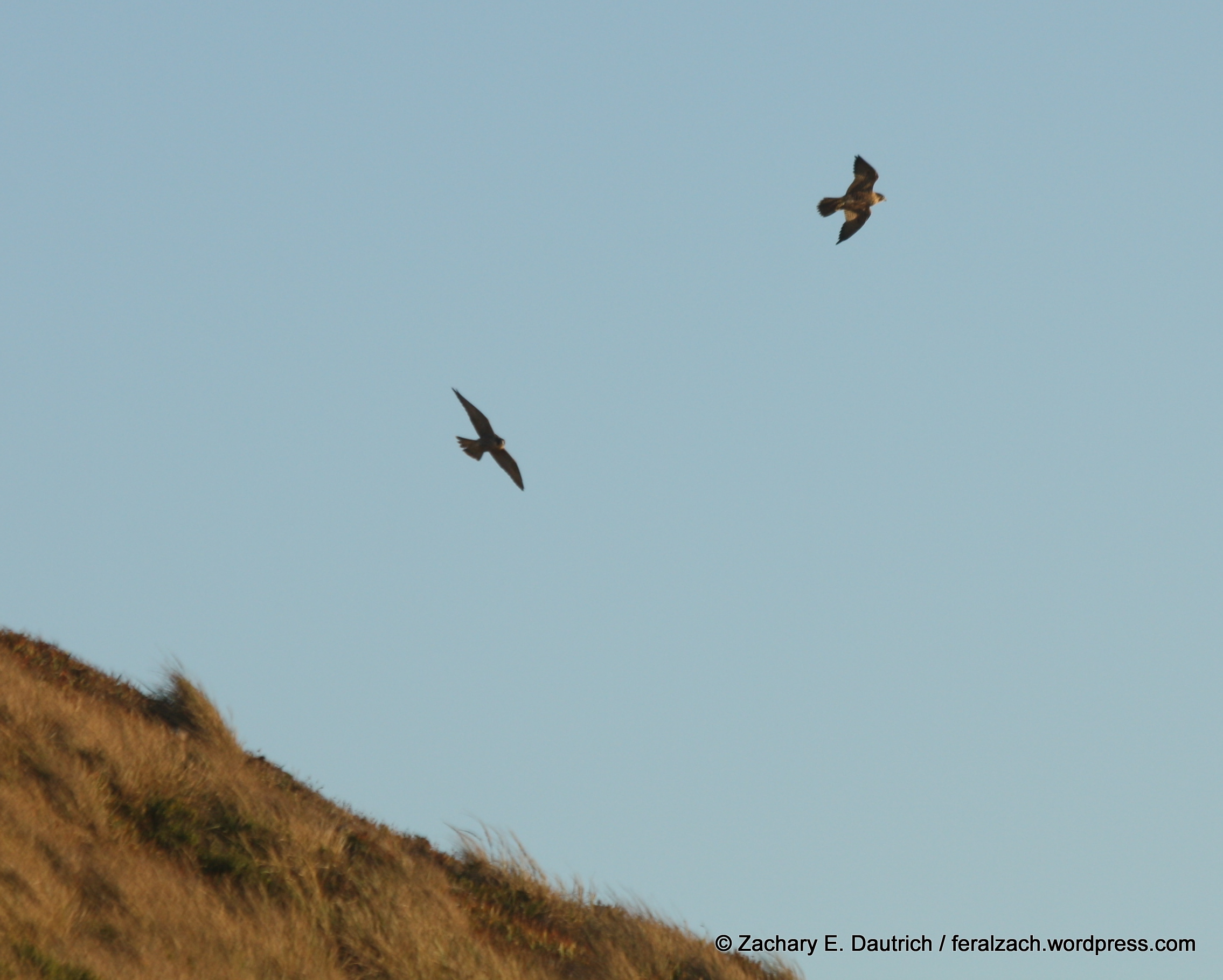
Falcons!
There were two falcons playing in the updrafts of wind on the large hill side – chasing each other, diving at one another, flipping upside down to grasp talons – an aerial game of tag! I immediately pulled over, jumped out of my vehicle and ran to join them, shouting out loud into the wind and forgetting for a moment that I couldn’t leave the ground to join them.
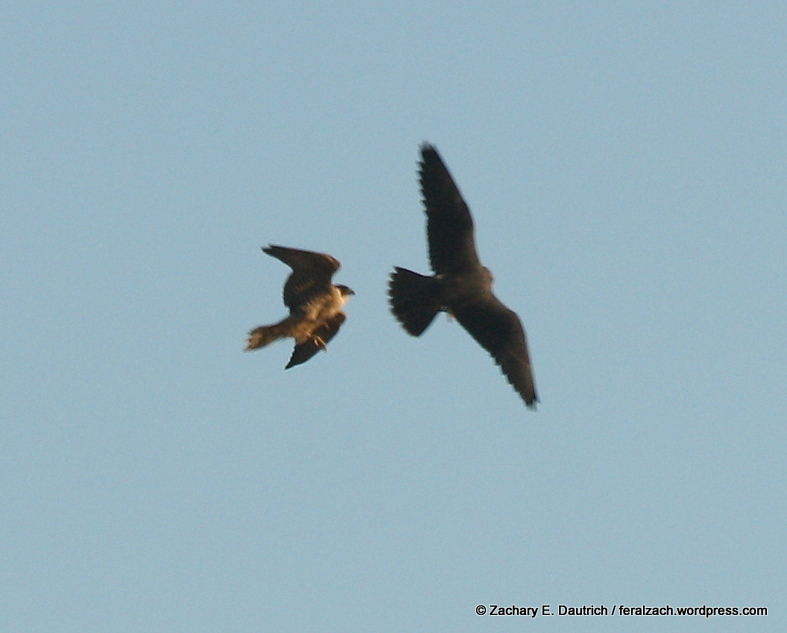
In my previous trips to check out the nest, I had only confirmed one baby, but apparently there were at least two that survived. And now these recently fledged falcons were testing and honing their flight skills with each other in the sky above me. So amazing to witness, so fun!


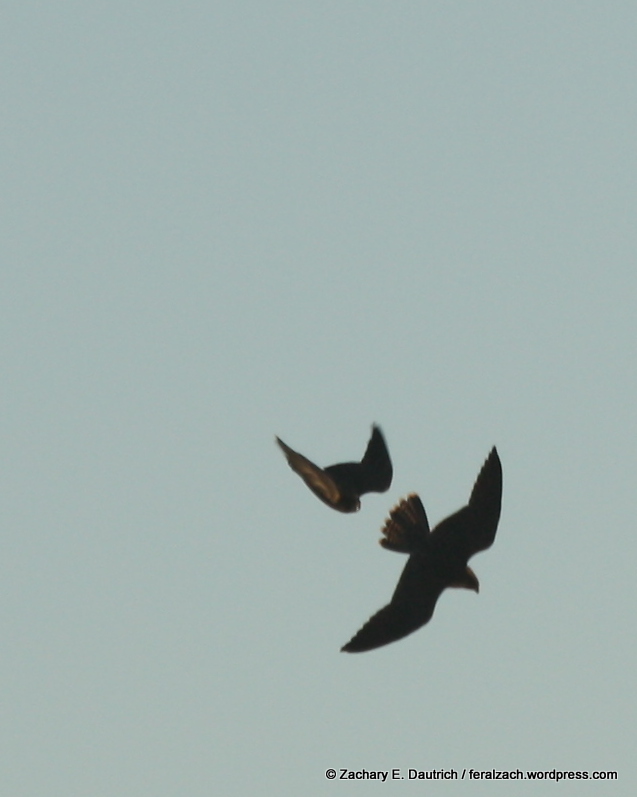

I had no choice but to accept all the invitation before me, so I settled in on a deer path that cut across the slope of the hill facing towards the setting sun. The falcons continued to come back above me a number of times, and at one point when one of the two disappeared, the other left its hover in the wind and banked in my direction, and I could feel its eyes on me! I got a fly-by! They are inquisitive creatures, and especially at this time in their lives they are investigating everything. Or maybe it could tell I would have like to join them up there.

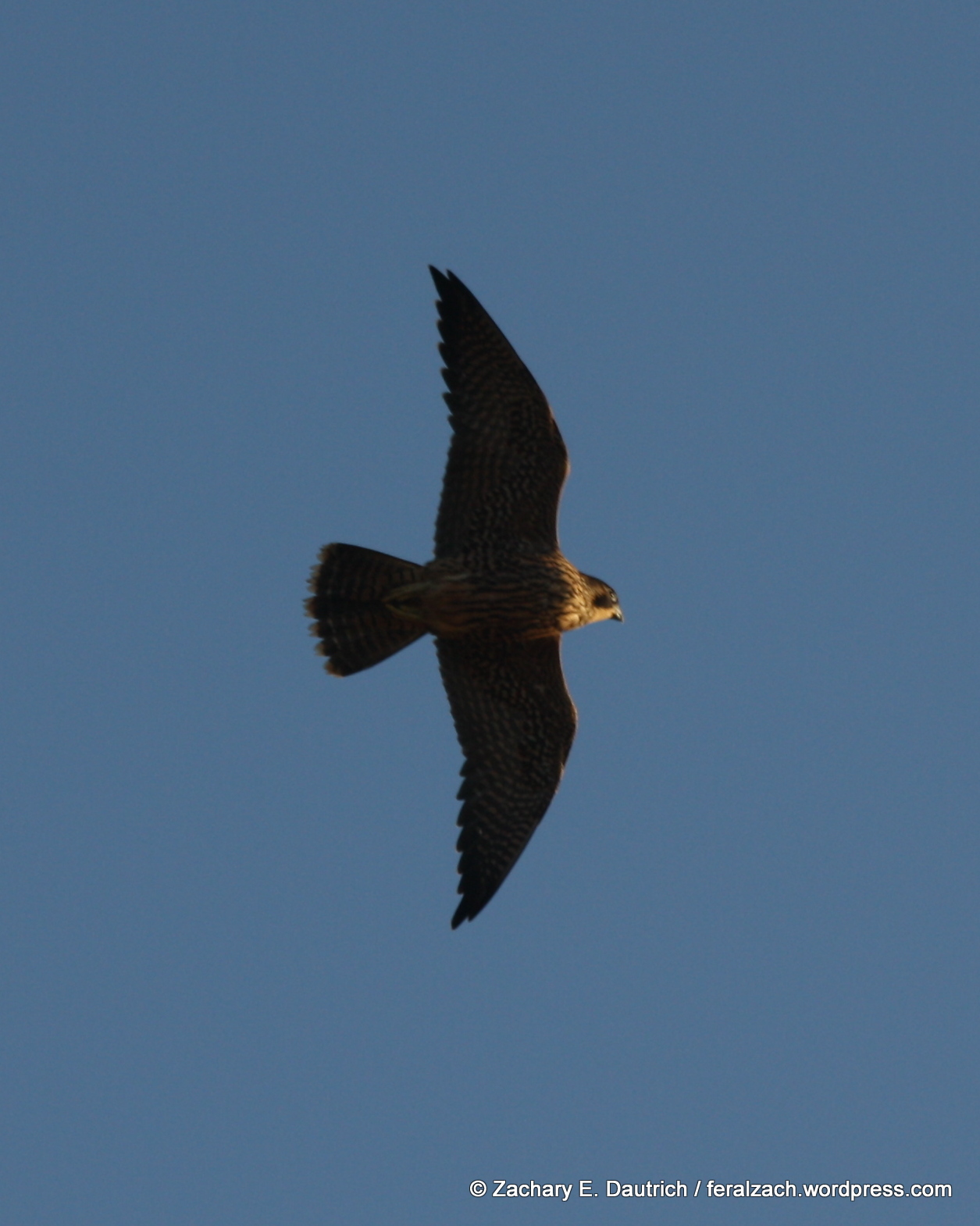
There are few things that are as fun to see (or be a part of) as young animals or kids playing, and I felt really grateful to have gotten to see this short moment of time, when these birds don’t have a care in the world and are just bursting with life and joy and excitement about being alive. Inspiring, and a reminder that we still have that in each of us if we can just take a bit of time to reconnect with it.
the elephant poaching problem – the sad death of Satao
I don’t often post external links on this blog, but this news and the associated story had a deep impact on me. That combined with some first hand accounts I’ve had recently from friends from South Africa regarding this problem that has now re-ignited like a forest fire out of control.
Kenya’s Biggest Elephant Killed by Poachers
&
One of Kenya’s Legendary “Tuskers” Killed by Poachers
The elephant and rhino poaching problem has once again become an extremely urgent issue – quietly it seems, poachers have multiplied in numbers and their tactics have changed, from employment of locals using crude weapons and trapping, to that of highly militarized groups using night-vision equipment and high powered weapons. There is simply nowhere left for these animals to hide when facing an adversary such as this. If this continues, they will be gone from the wild.
While at a workshop recently with two trackers from South Africa who work closely with Kruger National Park in South Africa, I actually inquired about the possibility of using my tracking skills as part of a group to help combat poaching. There response was that at this time, they don’t need trackers – they need mercenaries with weapons. They shared first and second-hand accounts of rhino and elephant poaching and how once again it is out of control in most of Africa, and beyond the capabilities of the traditional anti-poaching squads to deter. Not only that, it seems many of the protective groups are slow to acknowledge that they need more help.
One of the main drivers fueling demand and higher prices is said to be the rising middle class in countries such as China, a country where much of the ivory and rhino horn goes. More people with disposable income, combined with lack of education around the issue, fuel the demand and the problem.
We’ve all heard stories about how intelligent elephants are, and anyone who spends time with any animals knows they are capable of feeling emotion and, in addition to their own intelligences (not all readily measured by human science), some of having an intellect akin to what humans have and measure. Elephants seem to be exceptional among the animals with regard to their intelligences and sensitivity.
Reading about this giant of an animal, Satao, who seemed to have the awareness to know that his giant tusks made him a target, simply leaves me in awe and breaks my heart.
If you are interested in helping, there are many opportunities to donate online. Spreading awareness of this issue globally, and education of the sectors feeding demand, is one approach to curbing the problem. Share these articles. Talk about it. Feet on the ground is also necessary, but not something most of us can easily support directly (see this article for an interesting approach that is now happening).
So keep Satao in your thoughts, and also consider how locally similar issues might apply and what you can do about them. Maybe it’s not poaching in your area that is the problem – maybe its encroachment of the human footprint into lands that are needed for the survival and flourishing of a healthy population of species. Maybe it’s helping to save some marsh land on a waterfront where high rise buildings or industry is set to replace a living, breeding, nesting area for many different species of animals that in turn help keep water healthy. Or helping to support people who are trying to create/maintain wildlife corridors that provide connections between wilder areas to help ensure genetic diversity in animal populations. Maybe it’s just being aware of how you use your own water and taking steps to conserve and respect that water. It all matters.
It’s interesting to understand why there are so few elephants with tusks as large as Satao’s. It’s called selective breeding. Beside the fact that animals with large tusks are targets and get killed quickly, as those animals with the biggest tusks are killed off, their opportunity to breed and pass those genes on is reduced. At the same time, the elephants with smaller tusks have more opportunity to breed. So there are fewer elephants with the genes to grow large tusks.
Perhaps that is the one thing that will save them – a population of tusk-less elephants.
[As a side note, it’s the same phenomenon that is supposedly happening in parts of the U.S. South with species of rattlesnakes, where groups have rattlesnake “round-ups” that consist of gathering all the rattlers they can find and killing them (I’ll refrain from commenting on that practice because I believe it goes without saying/writing). Because the snakes that are caught are typically ones that rattle, this activity after many years is supposedly helping to breed more rattlers that don’t rattle!! Nice work Sweetwater, Texas, better start making those rattlesnake skin boots triple ply!]
This world would be emptier and infinitely less interesting without wild elephants or rhinos. Or wolves. Or mountain lions. Or monarch butterflies. And less healthy. Humans are finally starting to understand the interconnected-ness of all life on this planet, and the health of our entire ecosystem, which directly affects humans, is jeopardized with every animal (or plant) that goes extinct or is relegated to being found only in zoos.
I remember the first time I moved to California from the East Coast, while on one of my first hikes came the realization that there are wild animals out here that could kill me (back East it was generally just people to be concerned about), and with that realization suddenly came an aliveness that made me remember my place in this world. It made me alive. It’s not about fear (as most of these animals don’t want to be anywhere near you, much less attach a person) – it’s about respect. As soon as we lose that respect for this world, part of us dies too.
That wildness has given me so much, and I don’t want it to be on my watch that our future generations lose this part of what it is to be a human being on this planet. For my sake, for humanities sake, for future generations sake, and for the sake of all the wonderful life that we share this Earth with, let’s use our “superior intellects” to make good choices and be good stewards of this place. We’ve certainly shown that we can do the opposite.
the story of a kill
I was wandering on the edge of a marsh by the San Pablo Bay just north
of the Richmond Bridge, an area I’ve been exploring a lot lately.
As I moved across a transition of pampas grass into more open
grassland area prior to the pickleweed marsh, I flushed a red-shoulder
hawk from the ground. As it flew away, I didn’t see anything in its
talons. Intrigued, I wandered off the trail to see if I could figure
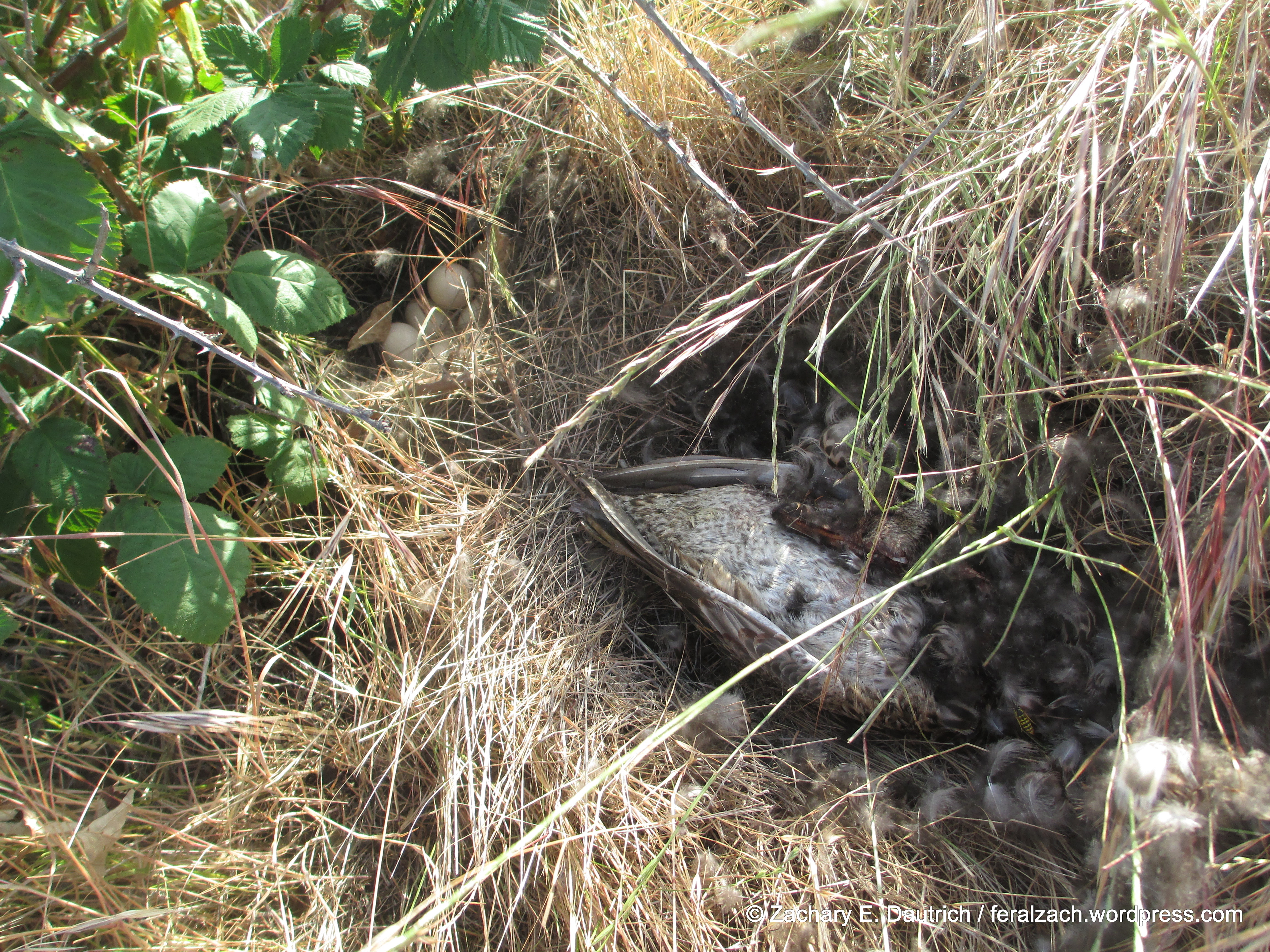
out what it was doing. Lo and behold, I found a dead duck! Female
mallard, to be specific, and she was lying inches from her nest
underneath a blackberry bush. The nest was beautiful, and it contained
nine eggs.

I was a little shocked – I have seen red-shoulders get all sorts of
prey including voles/mice, snakes, robins and other birds – but I
would not have suspected it would/could take a full grown duck.
Granted, she was comprimised being on the ground and on her nest, but
it’s still impressive.
I feel confident the rsha made the kill. The kill was very fresh, and
almost the entire neck of the duck was plucked and eaten. The breast
and the eggs were untouched. You can see the circle pattern of plucked
feathers around the kill, indicative of a bird predator.


I returned to the site later in the day, about four hours later. The
carcass was untouched since I had been there except for yellow
jackets.

As a sidenote, I learned that ducks are difficult to foster – I tried
to find someone who was willing to take the eggs to try to incubate
them to no avail.
(though I did crack one open, it was still mostlly yolk – I suspect
they had been laid very recently and perhaps she had just started
incubating)

I probably could have eaten the eggs (and the duck breast, for that matter!) – but I decided to leave them for the other creatures of the swamp that night. Sure enough upon my return a few days later, there were just feathers and a few bones left.
lots of eyasses!
so many babies right now! in addition to the exciting black hawk / red-shoulder nest and eyas (in my last post), i’ve gotten to see some other fun sites.
the three eyasses at the fruitvale bridge have successfully fledged and are learning to fly. when i was there last week, they were still unsteady in their flight, and one was doing a lot of “practice flapping” while gripping tightly onto the bridge span. so fun to watch. he took a little time to stare down at the strange two-legged staring up at him. when the adult female showed up (empty taloned), one of the young kept harassing her and pushing her off her perch. they are a hungry lot!
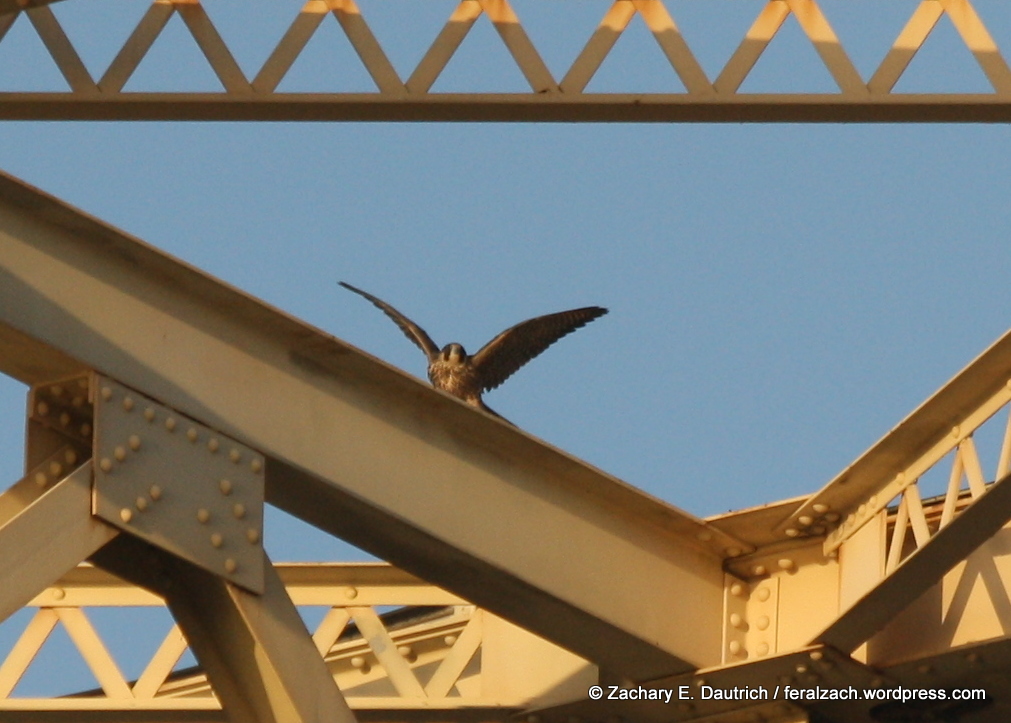
fledgling peregrine falcon / Alameda County, CA
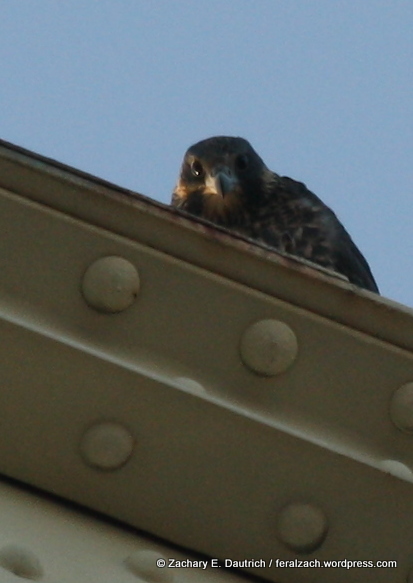
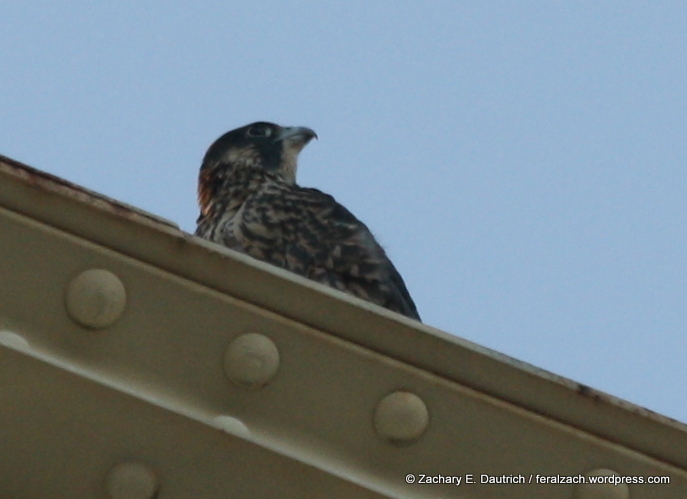
i stumbled on a nest that i hadn’t ever seen before, after hearing the young begging for dinner. this red-tailed hawks nest near wildcat canyon should be vacant very soon – these young are looking ready to go. i saw their parents hunting until well after dark trying to keep their bellies full, not an easy job!
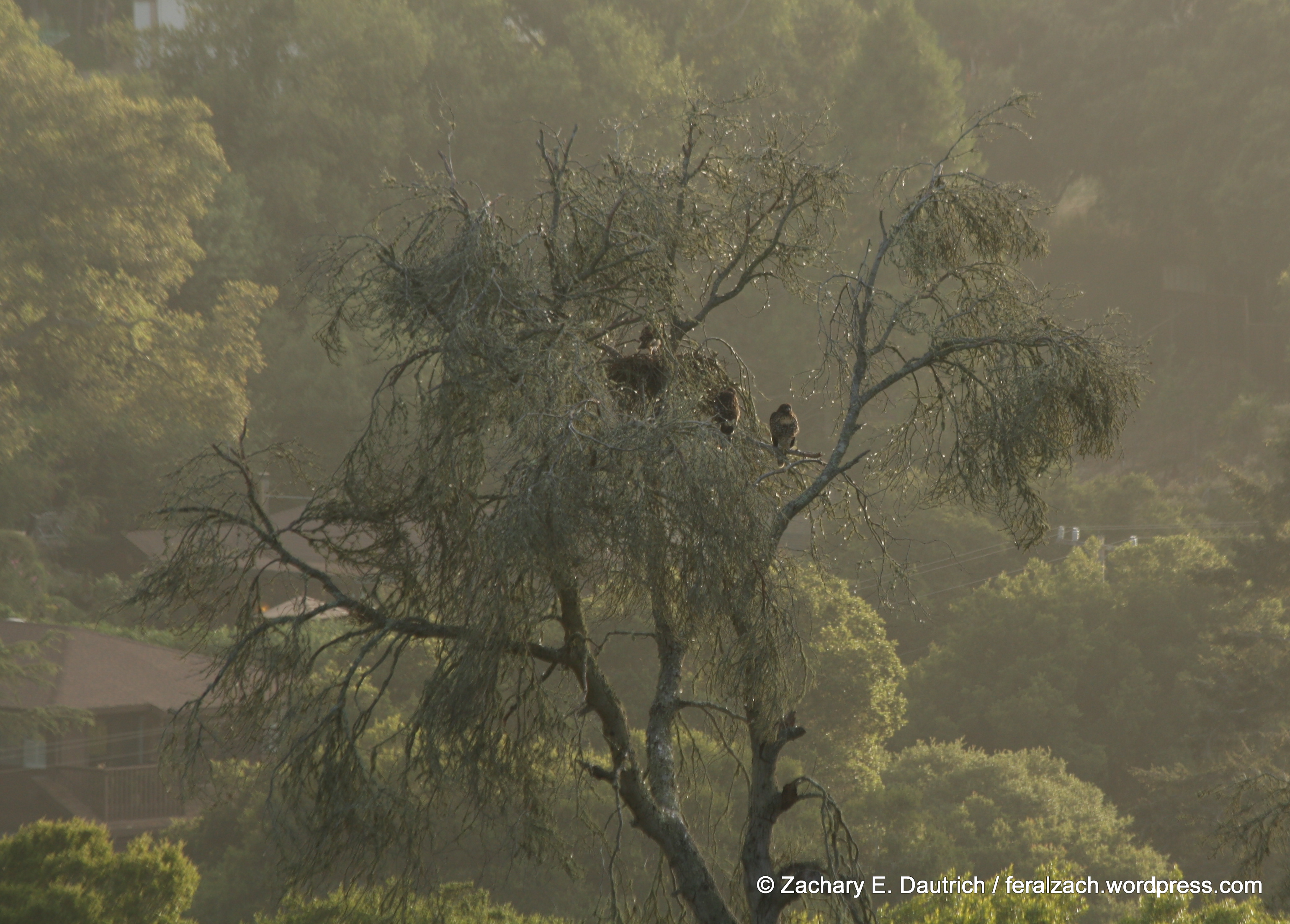
red-tailed hawks nest / Contra Costa County, CA
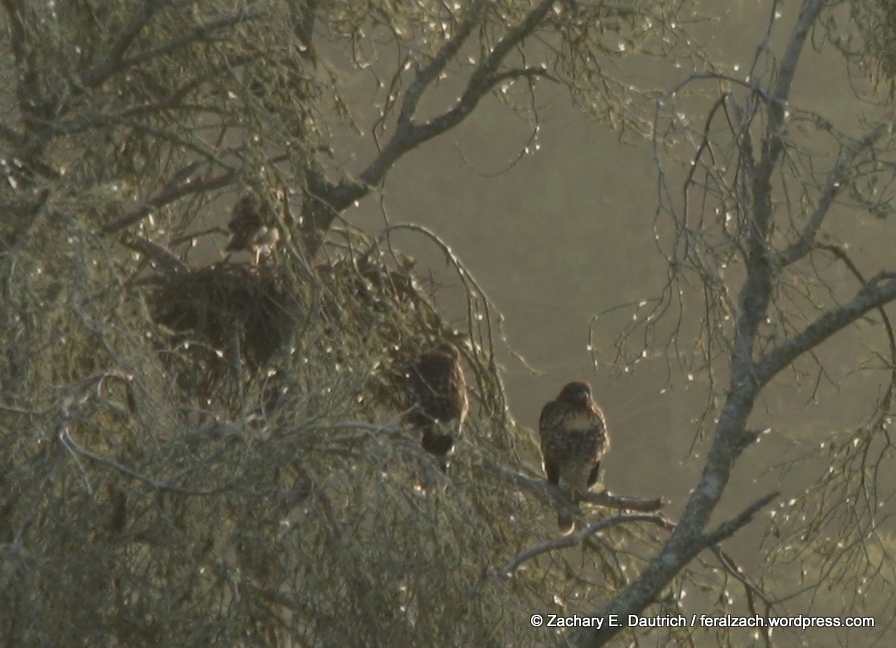
three red-tail eyasses
i’m still hopeful that i’ll get to see some young harriers soon, for surely the behavior of the the pair (pictured in some previous posts) in the marsh by the bay indicates they are around.
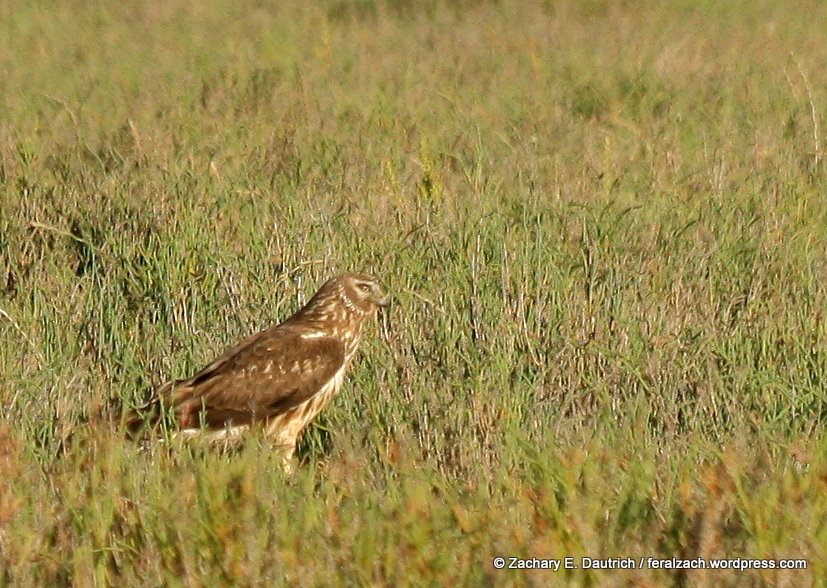
female northern harrier / Marin Co, CA
 feralzach