
a black hawk in sonoma county – an inter-species love story
First off, let me say that I don’t count myself as a “birder” – not in the commonly understood definition of it, anyway. I’m not into checking boxes by a species and keeping track of my life bird count. Don’t get me wrong, I understand why people do it, and I’m happy they enjoy it. It’s just not me (so don’t call me a birder).
But I do love birds, and find myself drawn to them in particular among all my relations in the plant and animal world. For me, it is the interaction, the connection, with these other lifeforms that is the real juiciness. That is what drives my passion to be out in nature – genuine connection. Often that takes the form of simply witnessing … which in and of itself is extremely rewarding. Sometimes it’s not even seeing the animal, just its track & sign. But occasionally there’s an actual interaction, and when it happens – on the animal’s terms – it is magical. Sometimes too, it’s the story that accompanies a sighting that makes it memorable. It’s always about the story though, isn’t it?
So the appearance of a black hawk in Sonoma County – while certainly alluring to birders who get to check another box on their list – is of more interest than just that. It is also a unique love story.
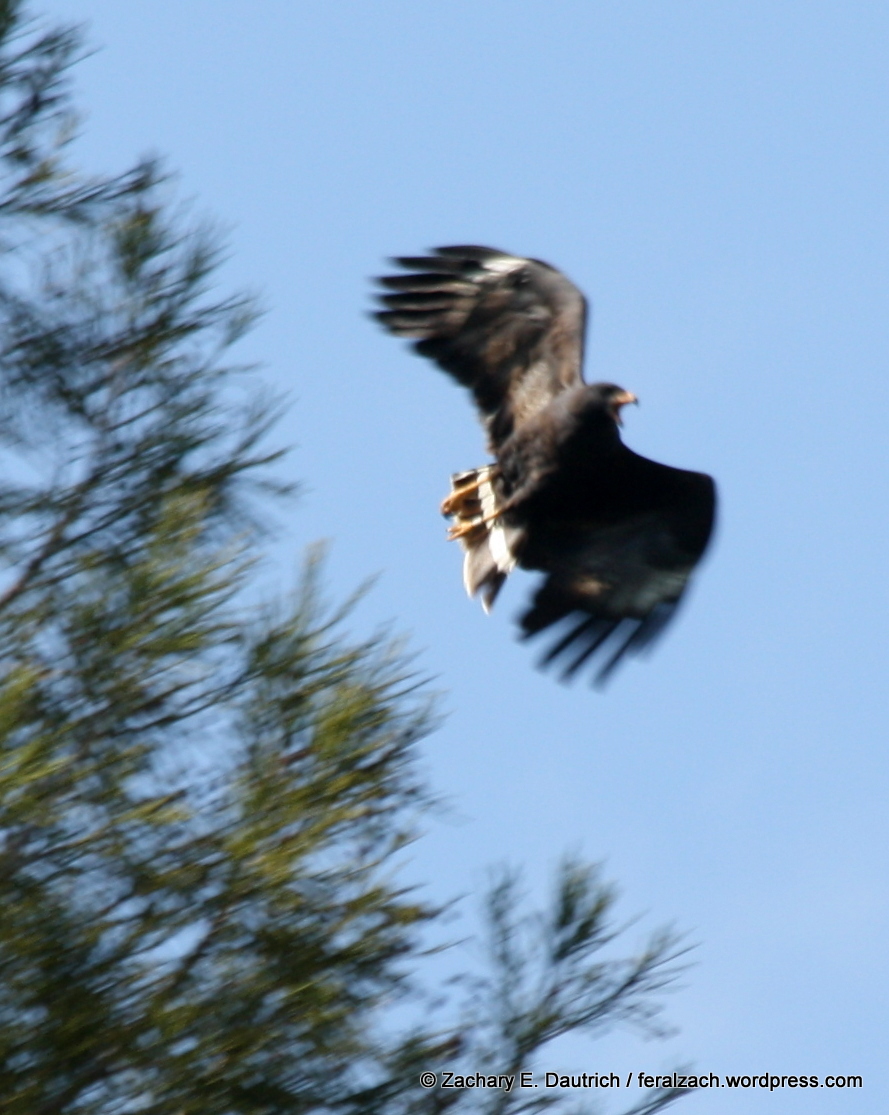
(not so) common black hawk / Sonoma County, CA
Not only has a black hawk (normally native to texas, arizona, new mexico and points south) chosen to make its home here, it has taken a mate of another species (no, it’s not me) – a red-shoulder hawk!
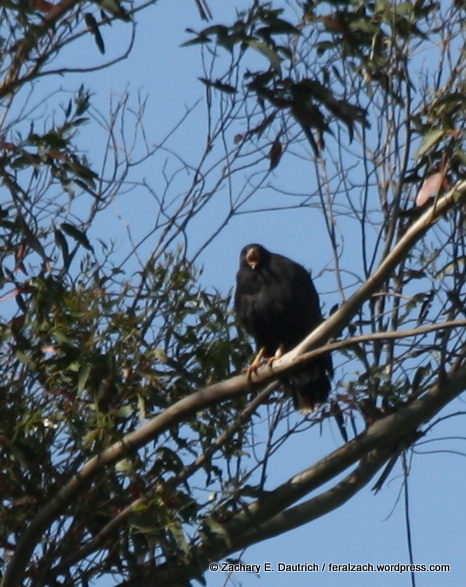
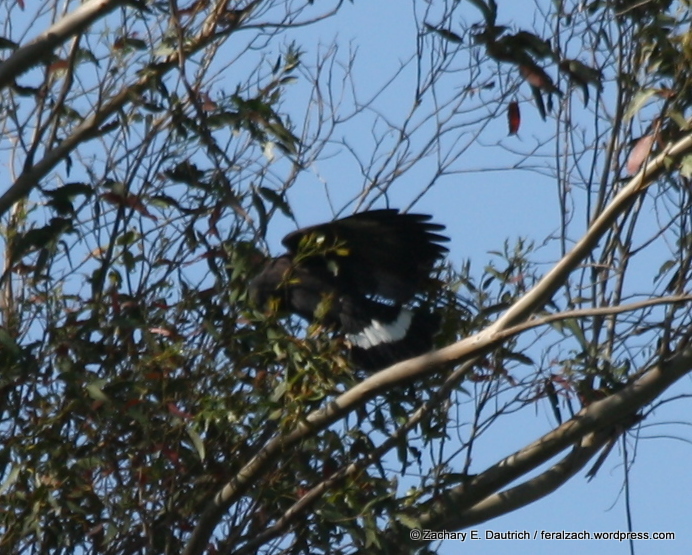
I started watching the nest about a month ago after being notified of its whereabouts by some friends at West County Hawk Watch. It is located in a tall eucalyptus tree, and not easily viewed due to a lot of other trees around it (and private property). My first day there, they were brooding and I got to see two nest exchanges. Initially the black hawk was on the nest, then after a bit of time she started to make some vocalizations that reminded me of a kestrel. A few moments later, a red-shouldered hawk appeared in the air and flew to the nest, taking over incubation duties for enough time for the black hawk to stretch and do a little bit of preening. Then she was back on the nest – but not until she grabbed another few branches to add to it …
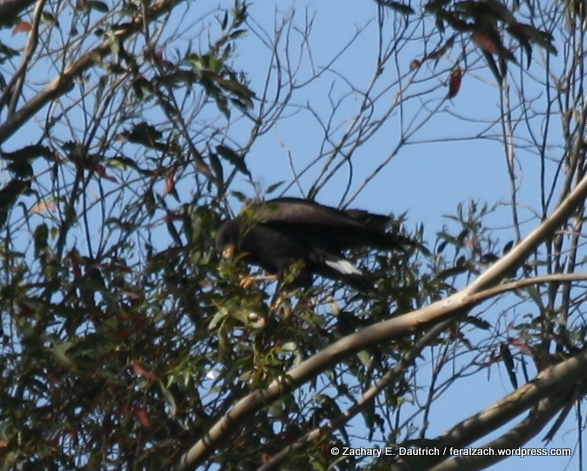
I’ve returned to the nest a number of times since, most recently on Sunday. It was a very hot day with temperatures in the upper 90’s (f), and when I arrived the black hawk was in the nest panting (black feathers are an interesting feature on a bird that typically lives in the hot dry desert?!). Once I set up a scope, my eye was treated to what I had been hoping to see – a fuzzy white head! There is at least one baby!
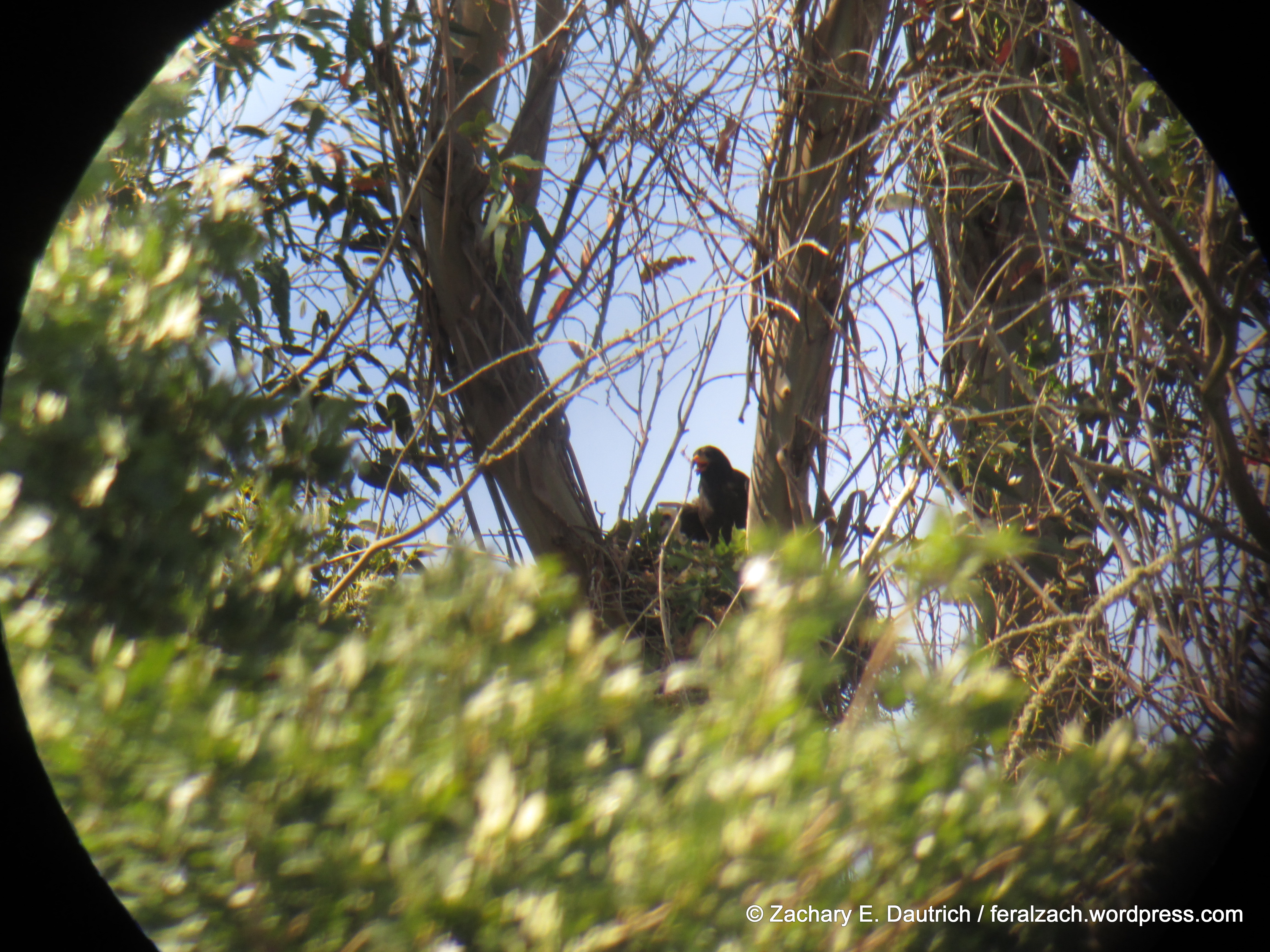
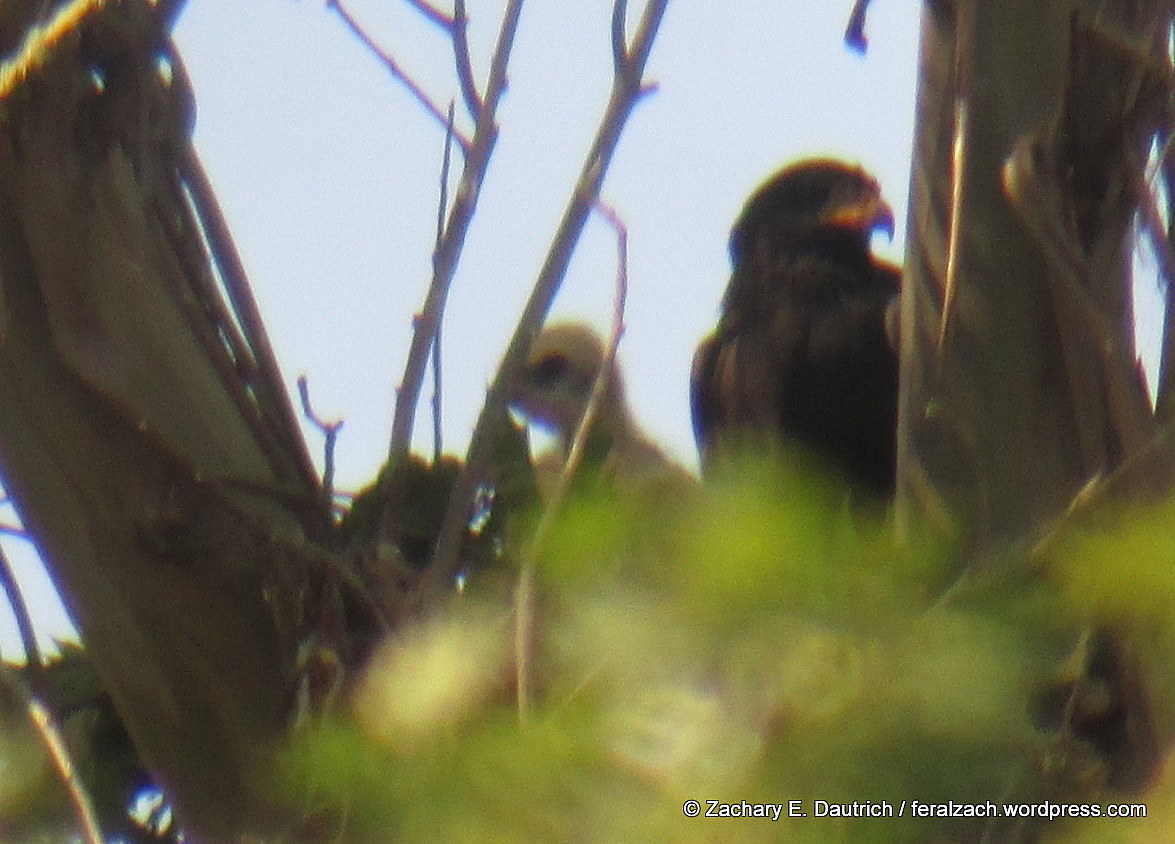
black hawk and eyas / Sonoma County, CA
I had heard that this same couple, the black hawk and the red-shouldered hawk, had young last year. I felt lucky to get to see it with my own eyes. What will this little creature grow up to look like? Time will tell, and I hope to have updates soon as the little one grows and starts to get its first set of feathers.
I never saw the red-shoulder on Sunday, likely because I was there during the hottest part of the day when there is little animal activity (they are smarter than me, evidently). The pictures were digi-scoped, so they aren’t the best quality, but it allowed me to capture this exciting occasion.
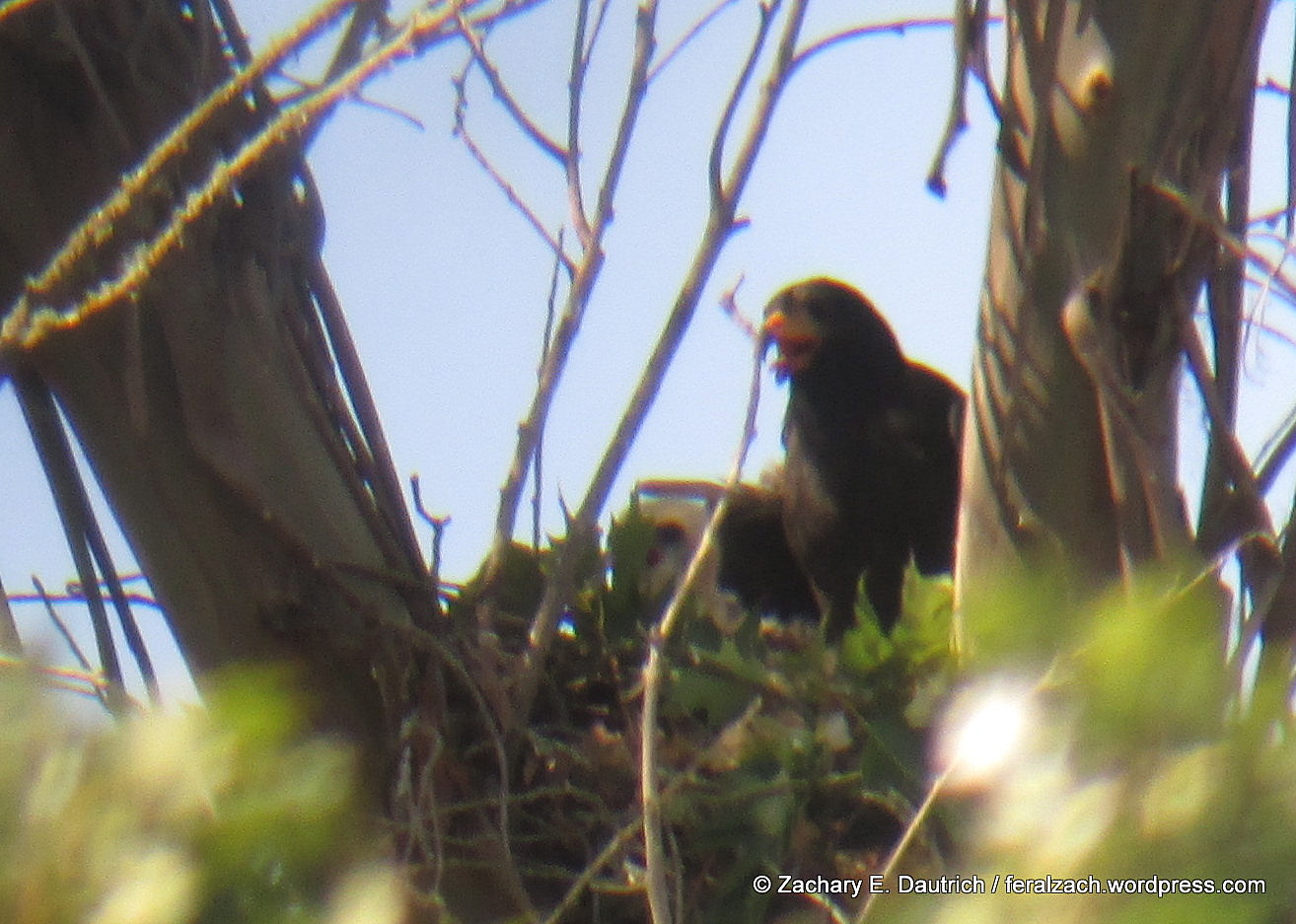
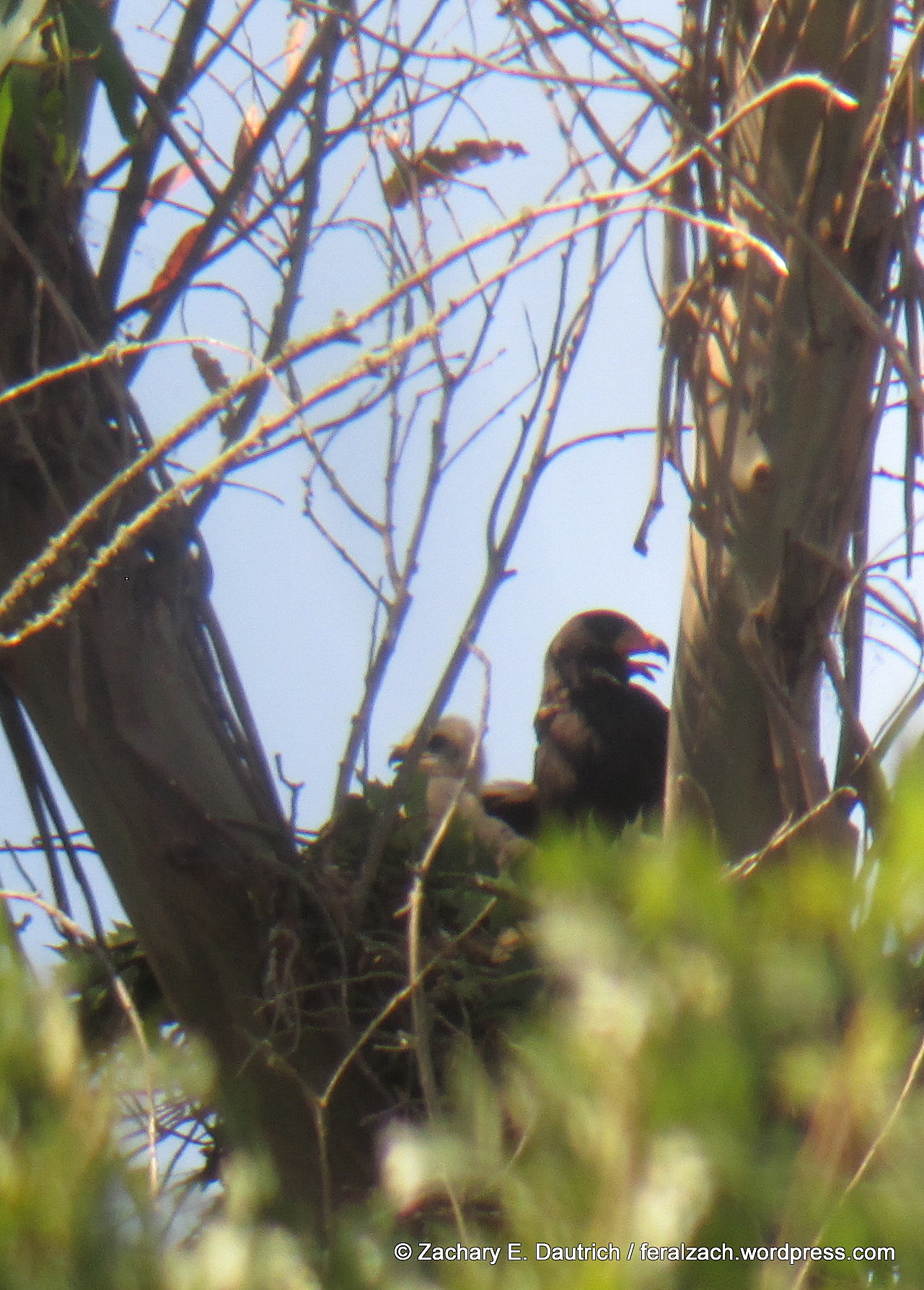
Thanks to Larry Broderick and Yvonne Motherwell for sharing the location of the nest and supporting efforts to document and spend time witnessing these amazing animals.
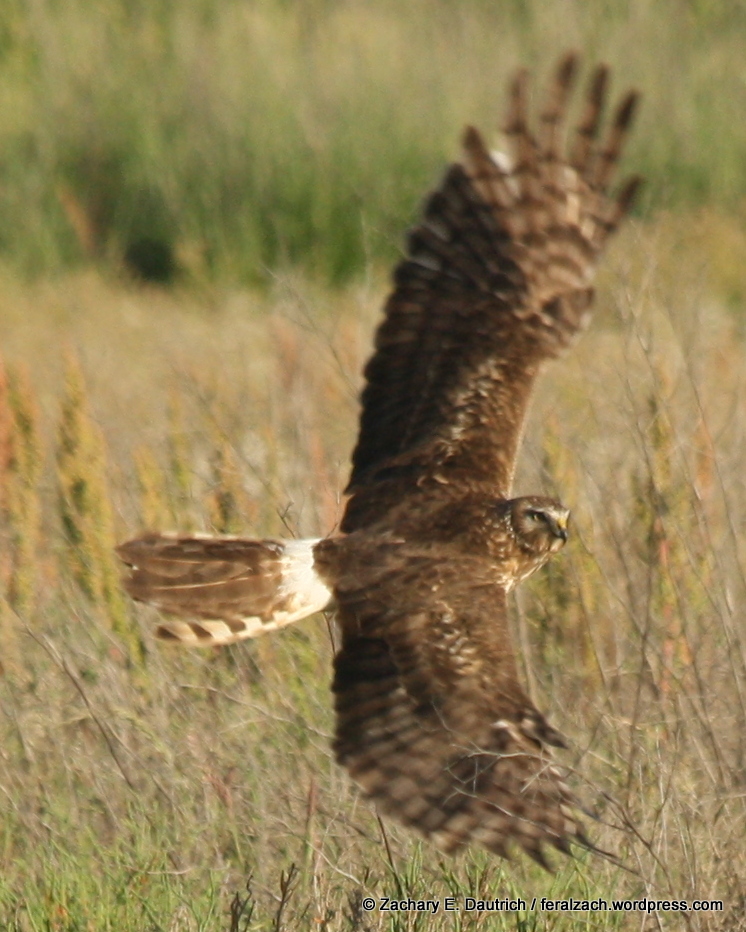
a few pics
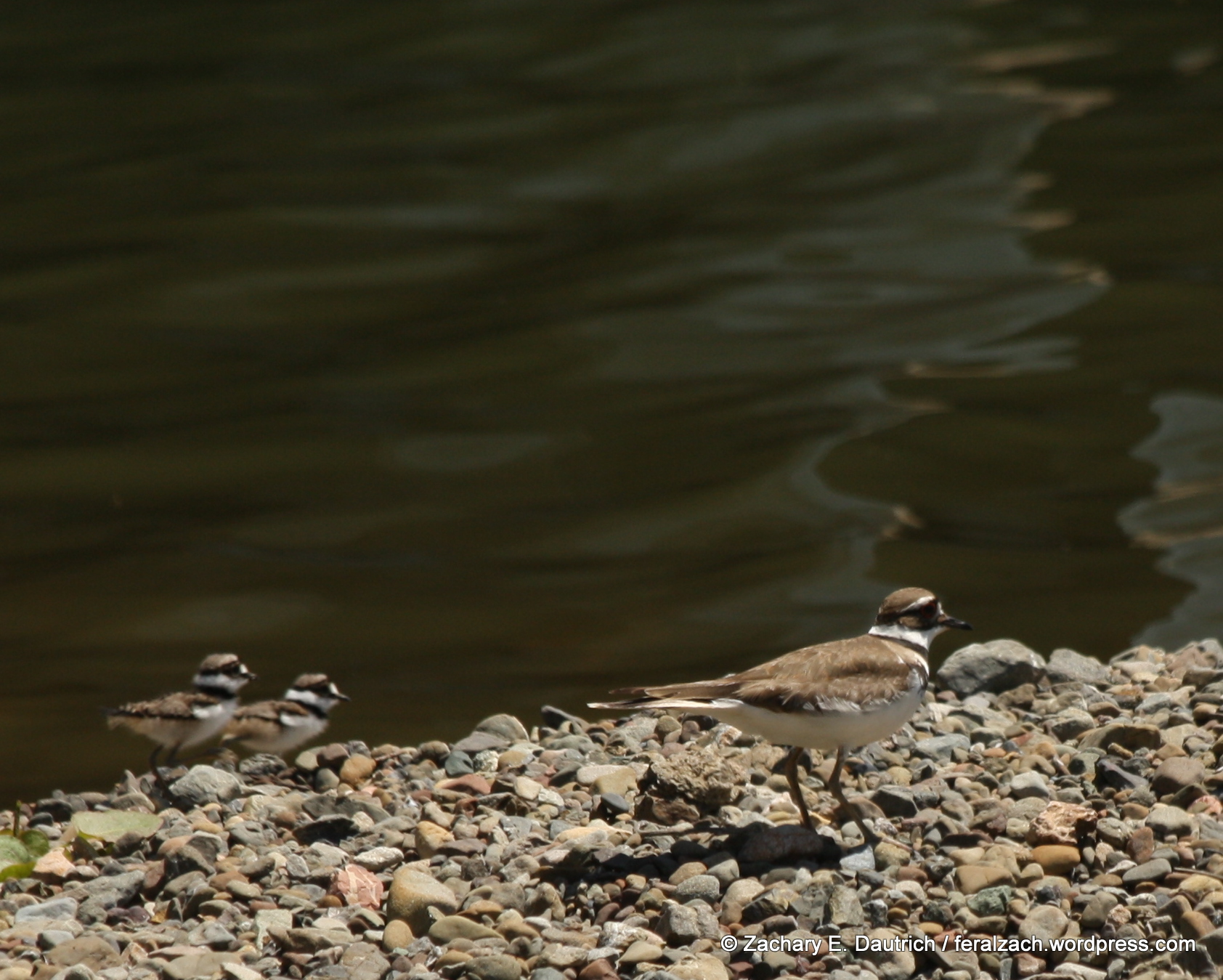
Killdeer and young on Salmon Creek
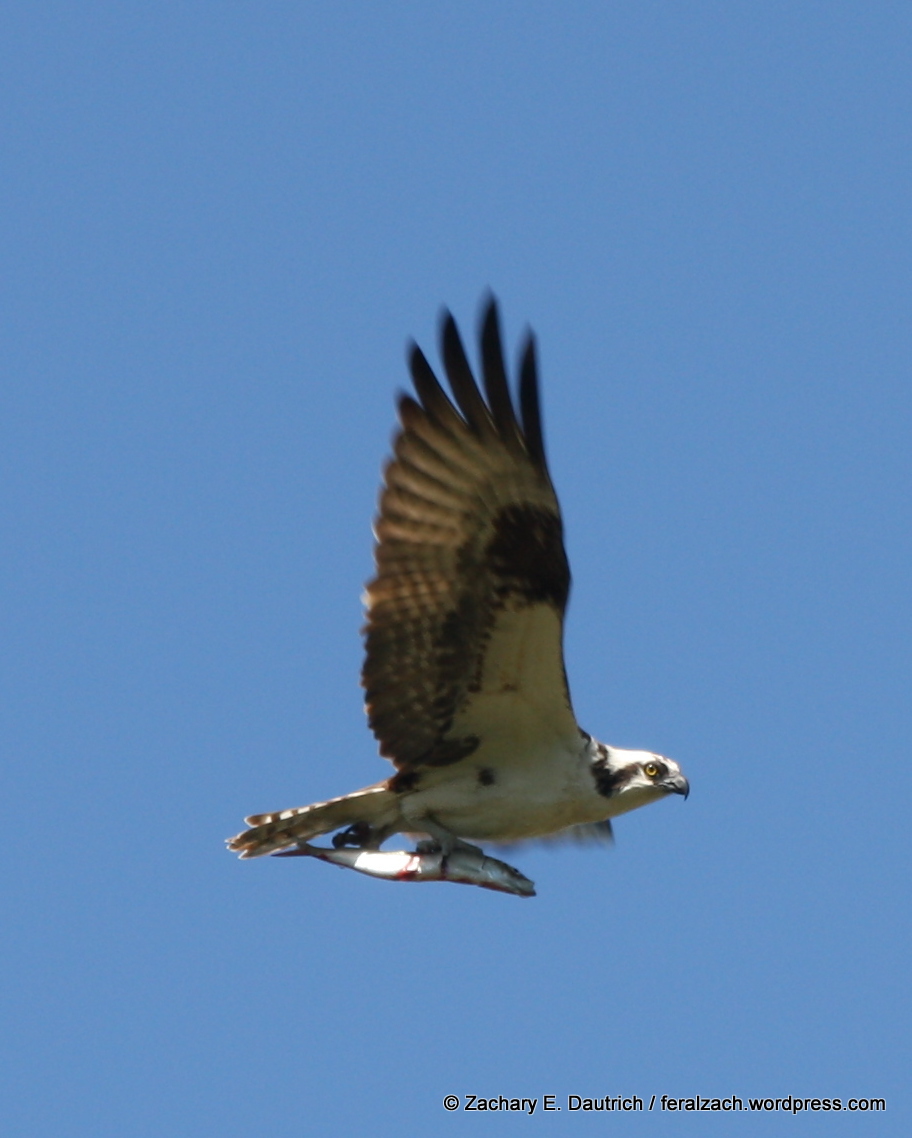
osprey with breakfast
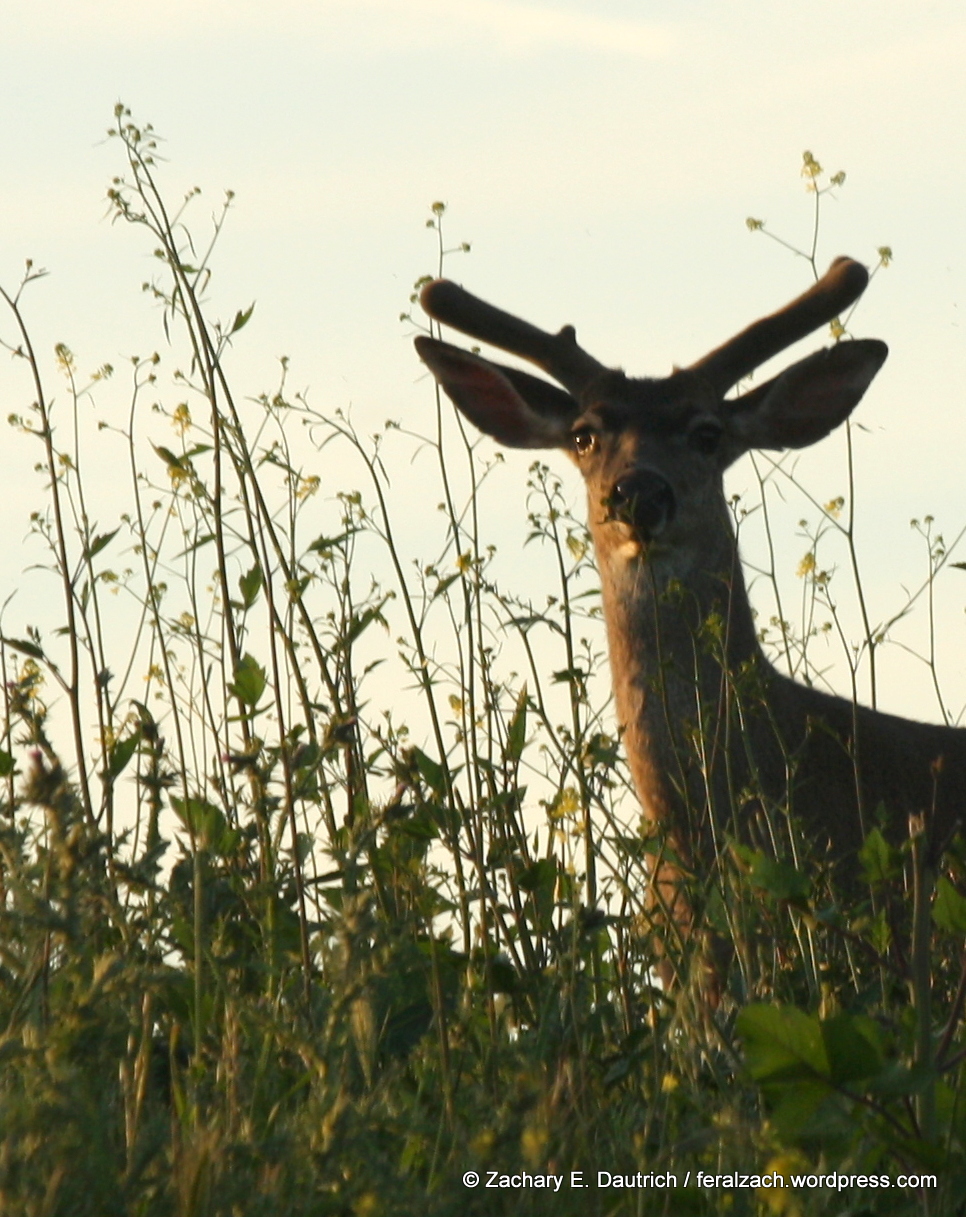
a deer friend of mine, my hiking partner

the unseen
I see you
on the top of the tree
watching the sunset
fully present in the red glow of dusk;
I hear you
calling to say you’re here;
On an island amid the hard top landscape
among loud iron beasts screaming by
and double-pane prisons
armored against what’s real;
Your world just a blur to busy eyes
unable to see what’s in plain sight;
I see you
I hear you
I feel you
I love you
goatsucker!

common poorwill
I saw this little one a few weeks ago in the mountains east of San Jose – it landed on a dirt road in front of us as we were slowly driving back to camp – with headlights and an additional LED flashlight, I was able to get this picture. It is a common poorwill, part of the nightjar family of birds, which are nocturnal birds of prey. I don’t often see them, but it’s actually the second time I’ve photographed one in the wild! See my earlier blog post from last January (2013).
They were know as “goatsuckers” due to folk tales that they sucked the blood of goats during the night. So far, there has been no evidence of this – but they do eat a lot of insects.


soar
i could watch the eagles and red-tailed hawks soar all day
everyday

adult golden eagle
[Grant Park, Santa Clara County CA]
rain wanderings and newt attacks
I couldn’t help but smile in the dwindling light tonight, as my footfalls fell softly on the soft wet ground to a chorus of water drips falling from the leaves around me. It hasn’t been often this year to feel the rain drops on my face – hopefully we continue to get some more before the usual rainy season ends in a month or so.
As I reached the high ground on my short wander in Wildcat Canyon, the winds started to pick up and the rain became heavier. I gave a couple of hoots at a spot where I usually see one of the pairs of owls, and after a few steps I saw one of them perched out on a branch in his “transition” spot where he goes just before heading out to hunt. He was hunkered down in the direction of the wind and rain to the west, leaning over to allow the gusts to flow around his feathery coat. But after a few moments, he seemed to think it a better idea to go back to bed, and he returned into the deeper woods of Monterey Pine and Douglas Fir where he took a few moments to give a few hoots.

great-horned owl
As I hopped down the side of the hill, I noticed a number of newts were also out enjoying the rain. Towards the bottom near the parking area, I found one of them enjoying some breakfast – an earth worm!
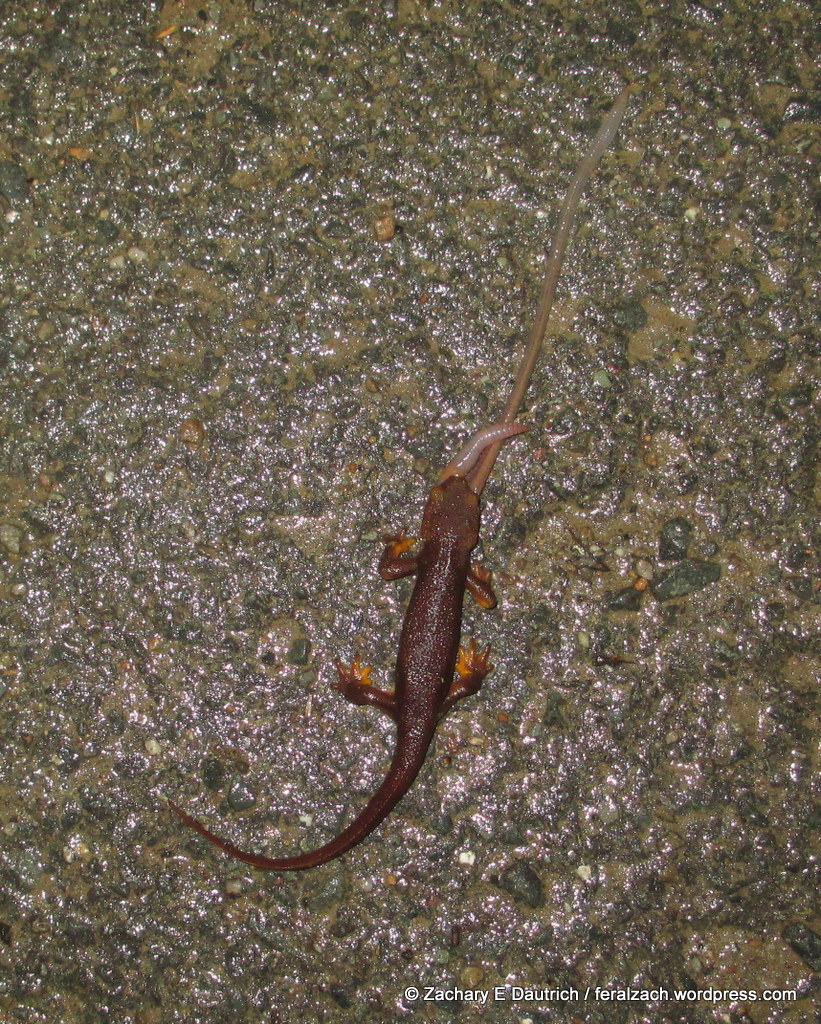
newt eating earthworm
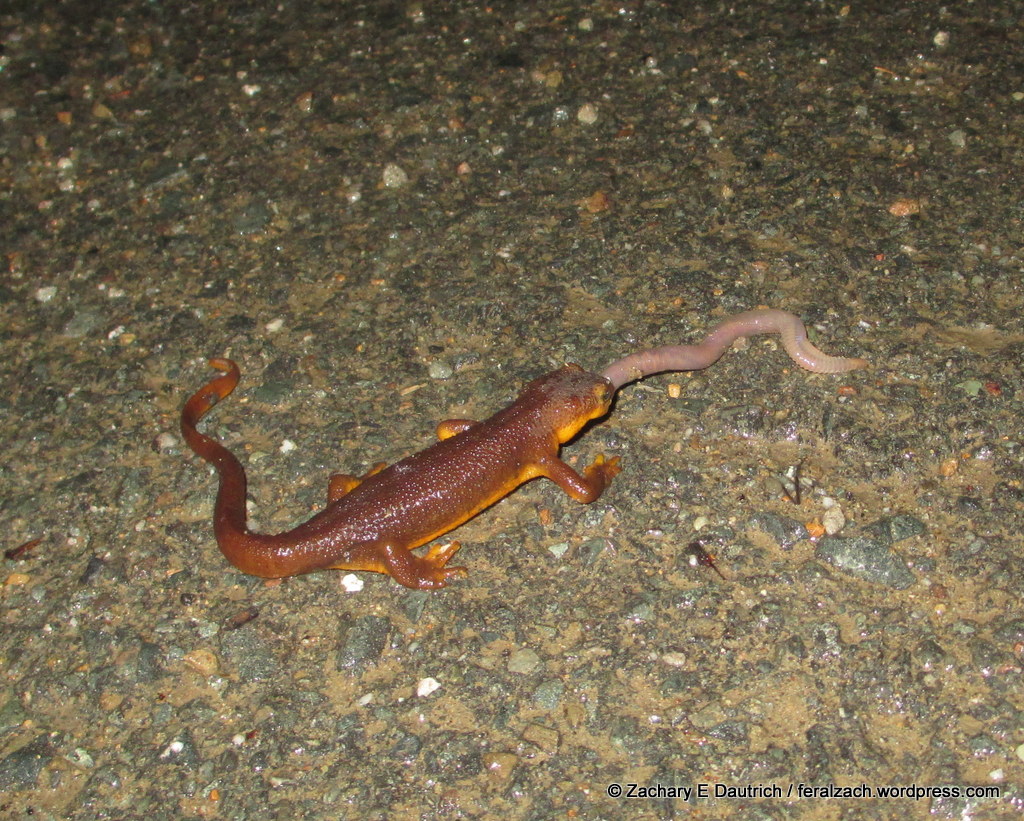
newt eating earthworm
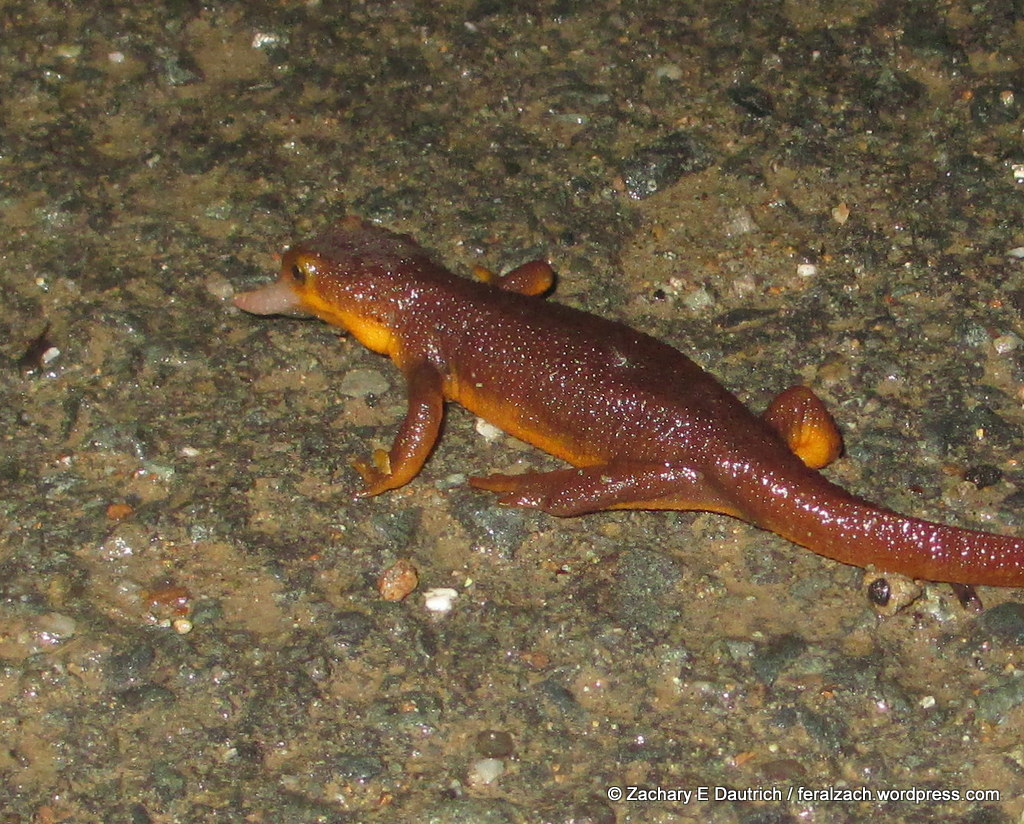
almost done …
It only took the newt about a minute or two to finish the worm, which didn’t seem to struggle all that much. After it was done, it walked off into the canopy of some milk thistle on the side of the path.
I love newt feet.
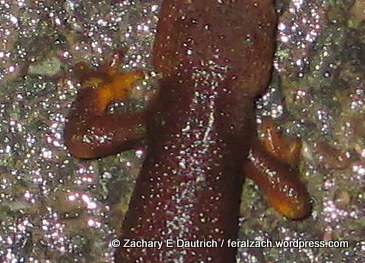
newt front feet

newt rear feet
The newts I saw tonight are likely the California Newt, Taricha torosa – hard to differentiate from the rough-skinned newt (Taricha granilosa) which is also found in this area.
Let it rain!

chasing mountain lions blog to resume soon …
I’m excited to report that I am helping with a new puma project in the Bay Area, my other blog chasing mountain lions will be updated with a new chapter soon …
Here are pictures of tracks of two of the cats that we are tracking and trying to capture right now in the mountains East of San Jose near Mount Hamilton:
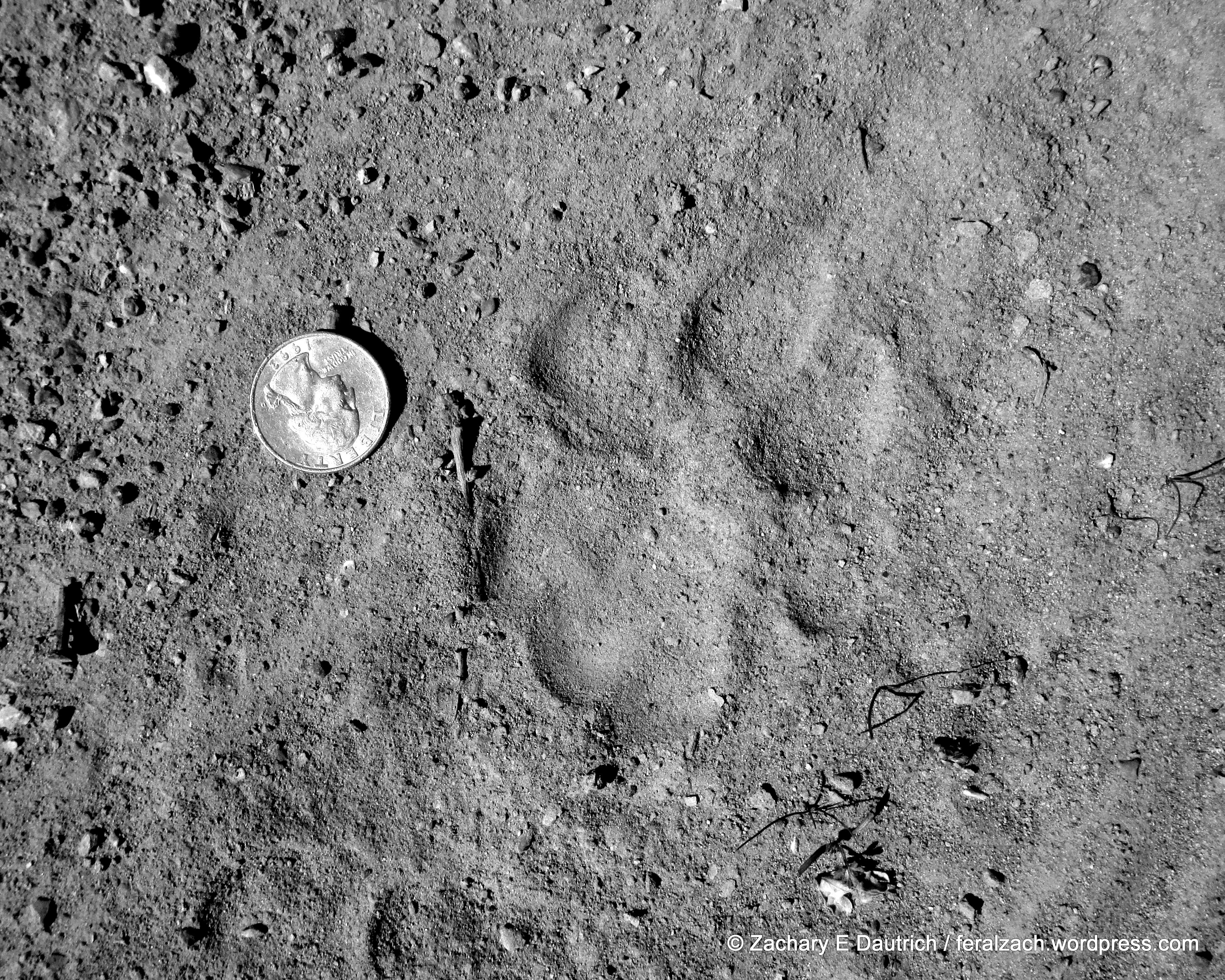
male puma track

female puma track
And here are a few of the residents where we are tracking the lions for capture (to outfit them with GPS collars) …
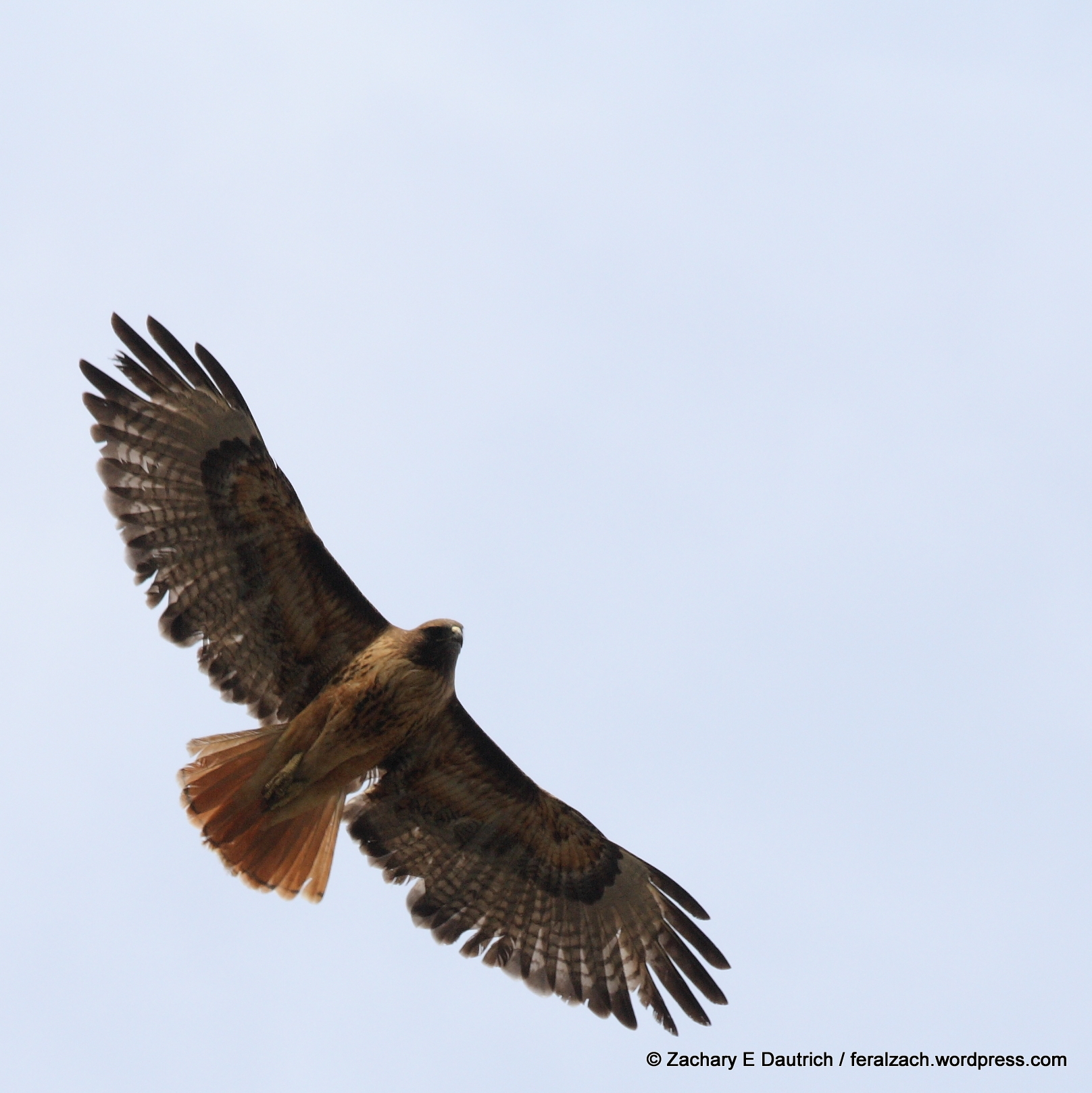
red-tailed hawk
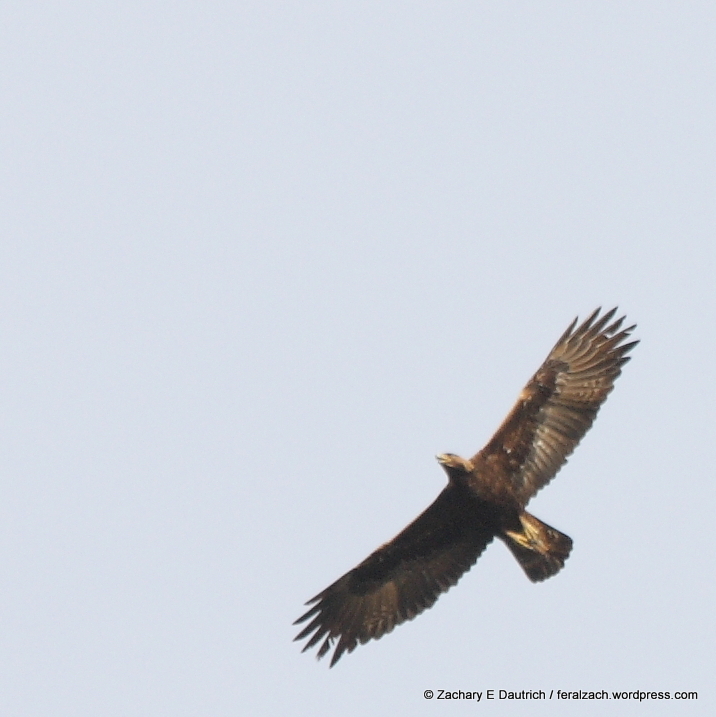
adult golden eagle
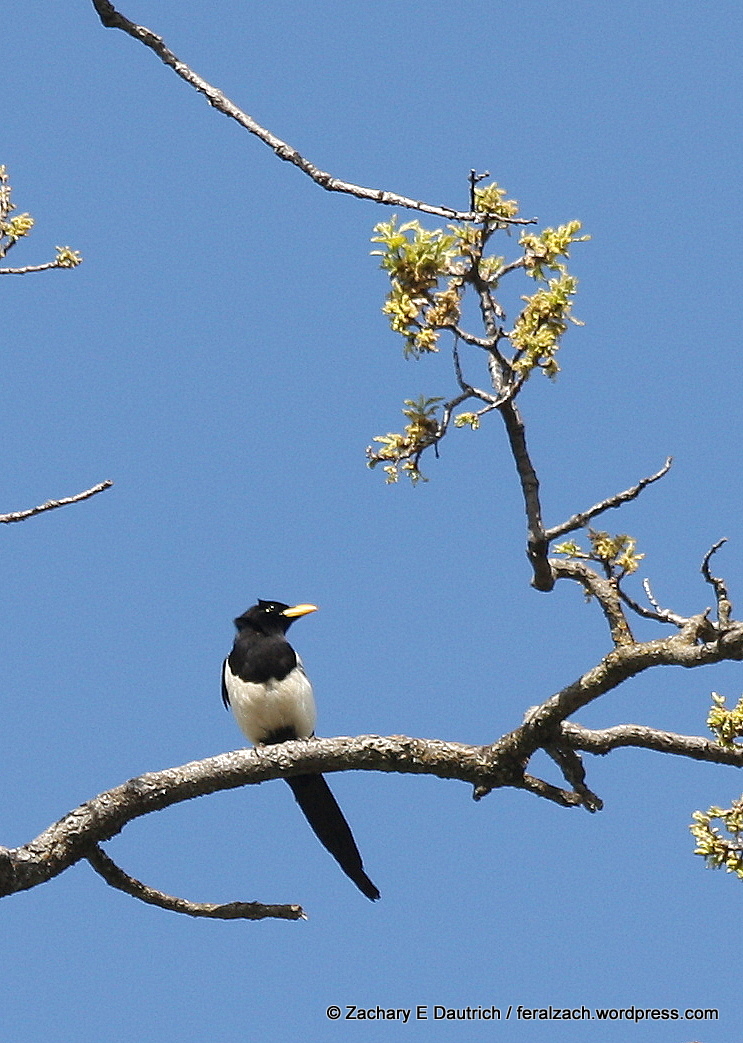
magpie

white oak “monster”

great-horned owl

the amazing pooping bobcat

60 second old bobcat scat!!
More to come soon …
trailin’ hogs!
I had the good fortune to go for an adventure yesterday with a friend to practice trailing animals – the species of focus was the feral pig (feral hog).
The weather was outstanding, despite some strong winds early in the day. It doesn’t get much nicer here than these sunny days with clear blue skies and temps in the 70’s – and the light was great too. I knew it was going to be a good day when not long after sunrise I saw a juvenile bald eagle (hatch year / 1st year) perched in a tree overlooking a creek. It was eyeing up some water fowl and steelhead, the latter of which were spawning in the creek bed below.

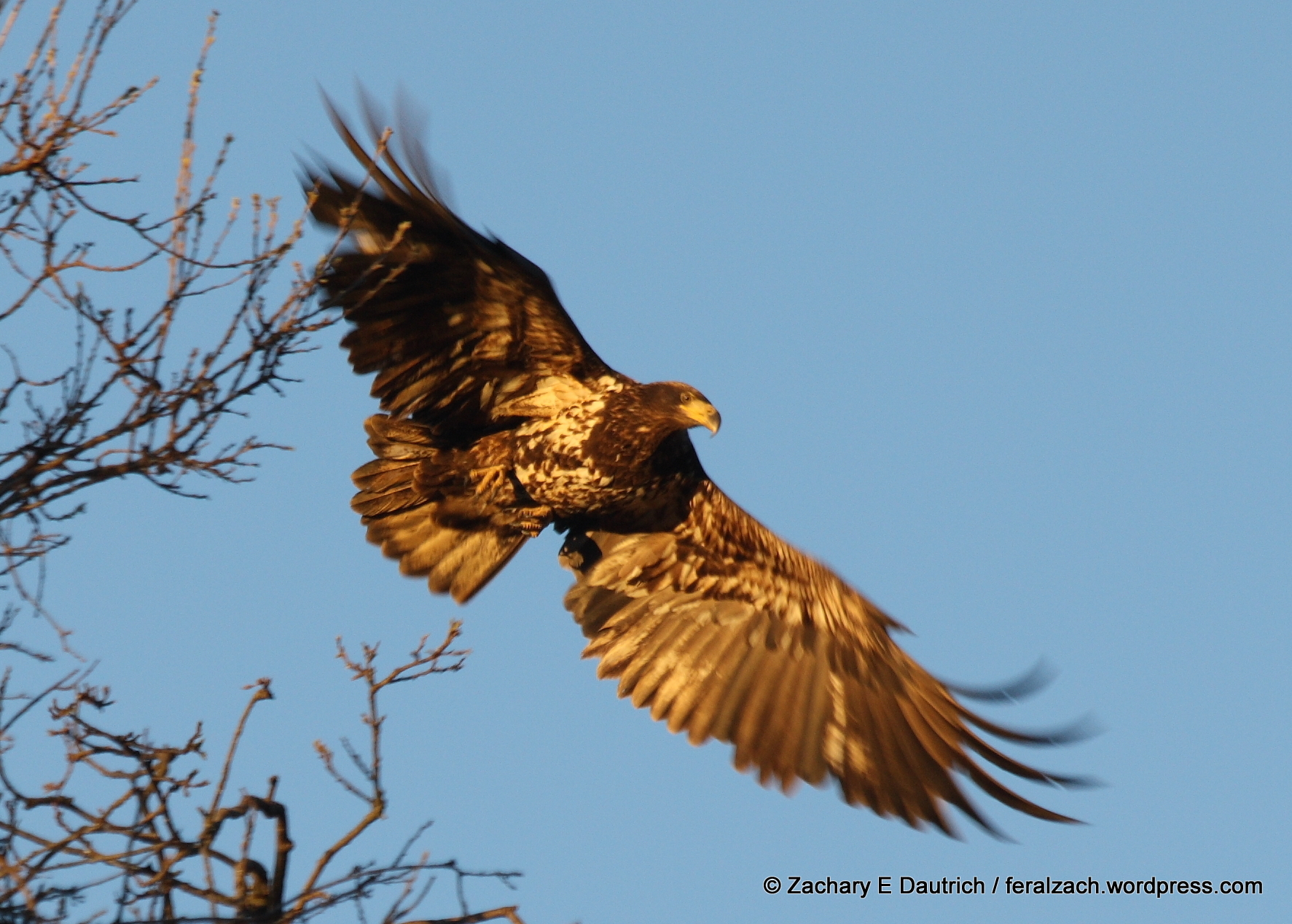
[juvenile bald eagle]
Steelhead are a type of salmon, and once were found in great numbers up and down the west coast. As with many of the salmon, their populations have been suffering due to over-fishing, habitat loss, and pollution. This time of year, mature fish swim from the ocean back into small creeks and streams from where they were born, where they create nests in the creek beds to lay their eggs. Unlike other salmon who die after spawing, some steelhead return to the ocean for another go. Interestingly, according to current science taxonomy, they are the same species as rainbow trout – the difference being that steelhead are anadromous, meaning they spend part of their life in the ocean. Because of this, they look physically different than fresh water rainbow trout (larger). These fish shown below were probably close to three feet long!
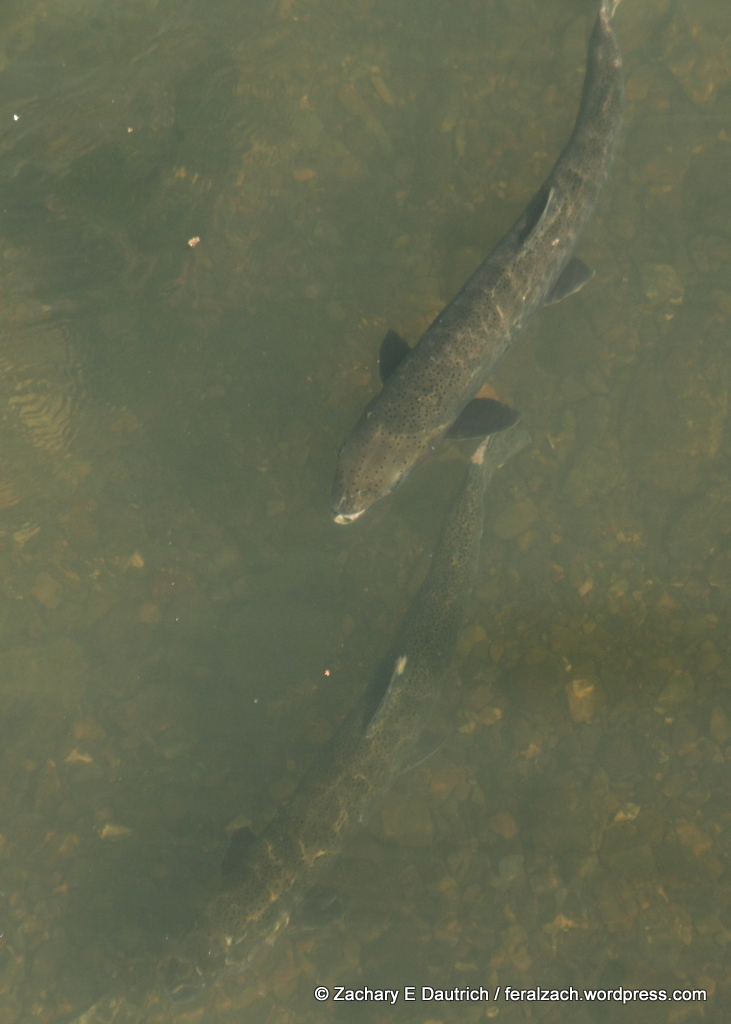
[steelhead]
I was on my way to a remote area of western Sonoma County where we were going to do our wander, on some land miles from any roads by the Gualala River. I feel like Sonoma County is my “second childhood home” – and it felt so good to be visiting on this beautiful spring day.
When driving along a ridge line with views going miles in all directions, the land looks like a piece of bunched up fabric – deep, drastic valleys at the bottom of steep descents that fall from high mountain tops and ridge lines. Huge stands of douglas fir and redwood are on many of the north-facing slopes, with oak woodland spanning other parts of the more sunny areas. Some of the land remains ranch land, and many folks have made their living with sheep and cattle out here. “As the crow flies,” the distance between two points seems not too far – but when traveling on land, it can take a long time to travel a short distance. And there’s seldom a direct route. Perhaps it is this ruggedness that has helped keep it somewhat intact – it isn’t conducive to the industries of man. May it remain as such!*
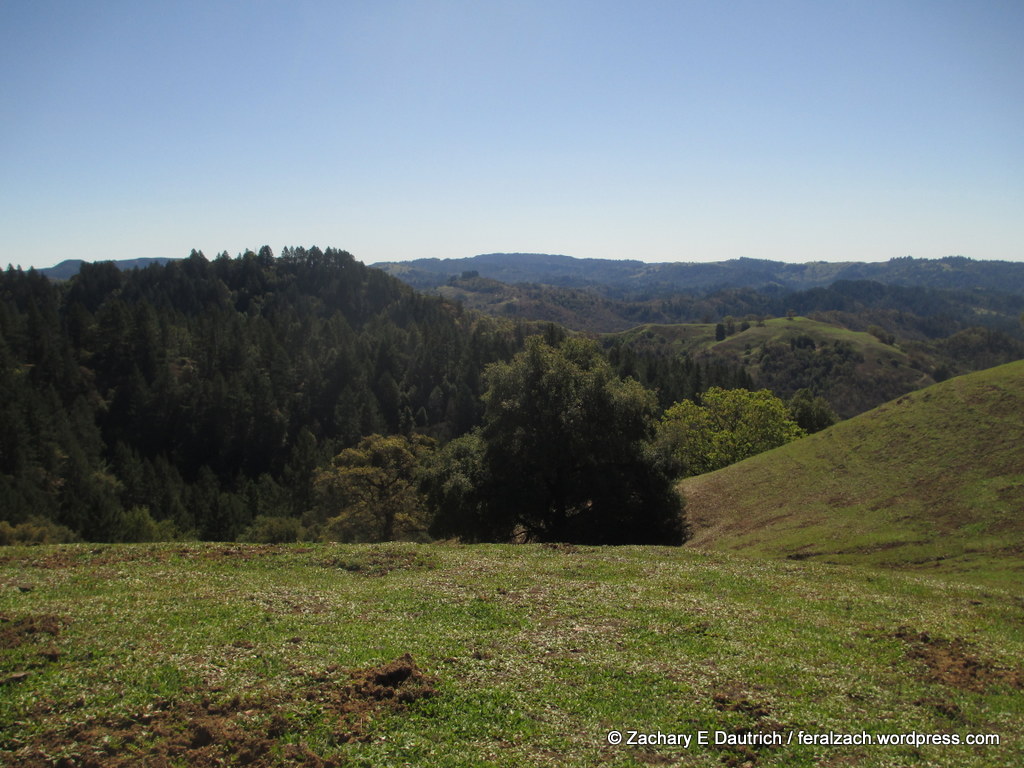
Feral pigs, also called feral hogs, are non-native animals whose relatives escaped from the domestic life and have secured a place for themselves and their progeny in the wild. Sonoma County has a large population of them, and many areas of the country consider them to be a pest. They certainly don’t tread lightly on a landscape – in areas of high density, the ground can be torn up all over the place from their rooting. They are an amazing animal – highly intelligent, very social, and incredibly adaptable. They can also get pretty big – some of the larger boars are around 300 pounds! And they can be pretty intimidating to see – large tusks, coarse hair covering parts of their body – they often don’t look like their barn-yard cousins.
I have mixed feelings about the native / non-native debate. The truth is that many of our ecosystems are so different than they were prior to European colonization – especially with the removal of so many of the apex predators – that it is unlikely they will ever be the same. Especially without reintroduction of the trees, plants and animals that were originally here and created a balanced web of life. You don’t grow old-growth redwood trees overnight. I imagine the pigs would not be as successful if there were wolves and grizzly bears around (as there once were in this area) – but I bet the main detractors of the hogs would be even less apt to welcome that strategy!
There is a difference for humans, psychologically, when labeling an animal as a pest and/or a non-native – somehow it’s life seems to be valued less. I have an issue with this. These are still living, breathing creatures, just doing what we all are doing here – trying to make a living. I’m not suggesting that all non-native animals should just run amok with no management plan in place, but I do believe there can be better, more compassionate management strategies that are also more supported by science. Ones that honor these animals as individual living beings, with a value the same as any other living being. Sadly, humans have used (and continue to use) this type of labeling to denigrate people too – whole cultures, races, and people of varying lifestyles have been subjected to horrible treatment because of this manipulative psychology of labeling.
+++++++
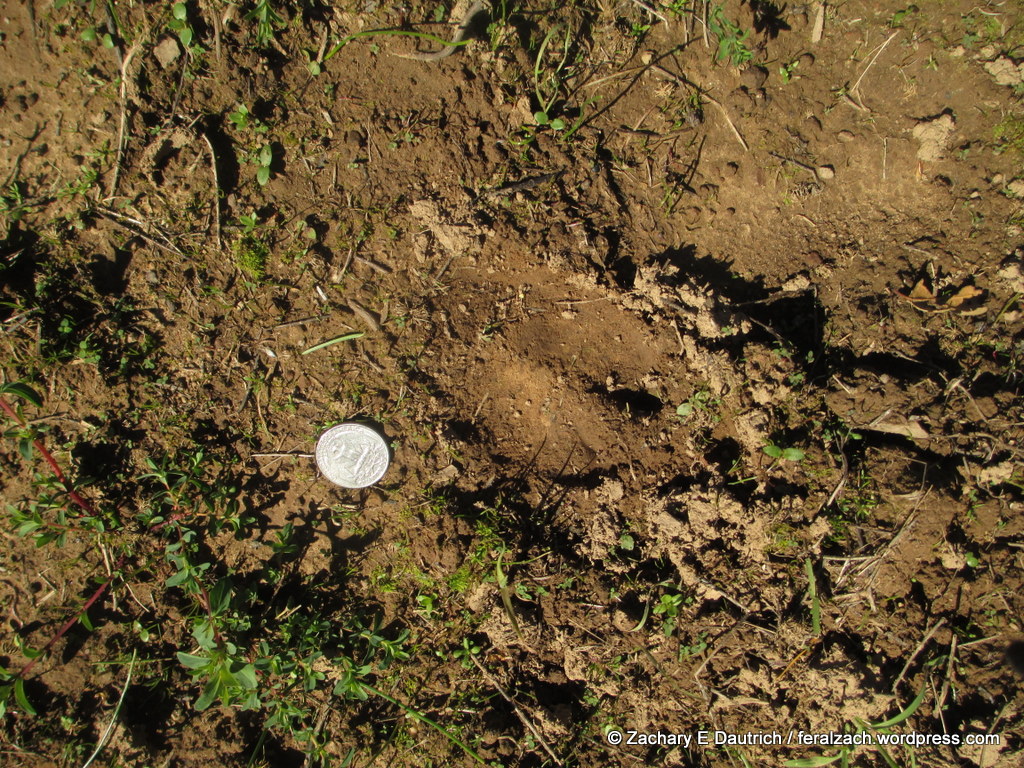
It was fun to get to be in the world of the hogs for the morning! We started off by looking for some fresh tracks so that we could have a chance at being able to trail and find the animal that laid them. The pig sign was everywhere – the trick was finding something fresh. Despite some of the recent rains, the ground in some areas was already becoming quite dry again, so it wasn’t holding sign as well as it had been just a week ago.
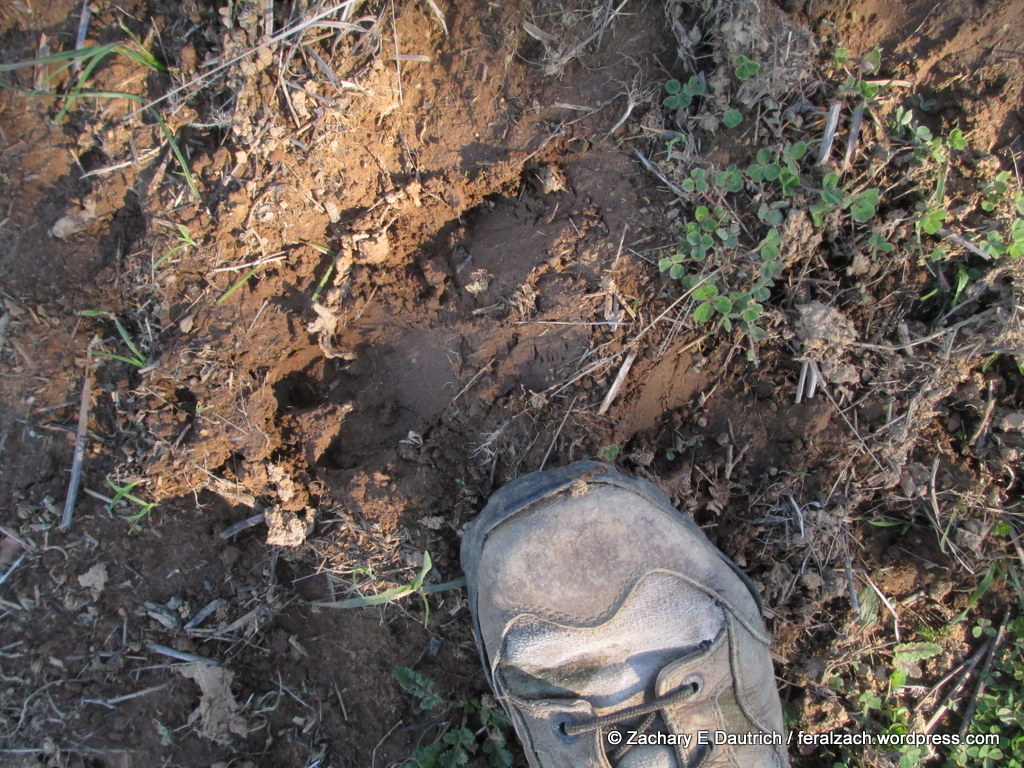
[some fairly fresh hog tracks]
We ended up on several different hog trails, the first of which took us down a steep hill side, traversing downward through the trees. We saw quite a few pig beds – all empty – strategically situated at the base of large trees on a steep slope, with crunchy leaves all around that would belie the presence of an approaching predator (or tracker!) and allow for multiple escape routes. After being on it for quite a distance, eventually we lost the trail – which seemed impossible, given we were following a number of individuals travelling together. How do 150 to 300 pound animals seem to vanish and leave no discernible sign? Perhaps there is a “pig vortex,” similar to the “raptor vortex” – the place raptors seem to often disappear to, out of the air, when you take your eye off them for a second! Amazing! Humbling.
We continued on, looking for another trail to follow, and eventually we found some more fresh sign just off the dirt access road we were following. After poking around a bit, we took a hog trail down another steep slope descending 100’s of vertical feet. There were some fairly fresh tracks on it, but mostly we were just curious where they were going as it seemed to be a highly used trail. It took us all the way down to the bottom of the valley – and to the Gualala River.
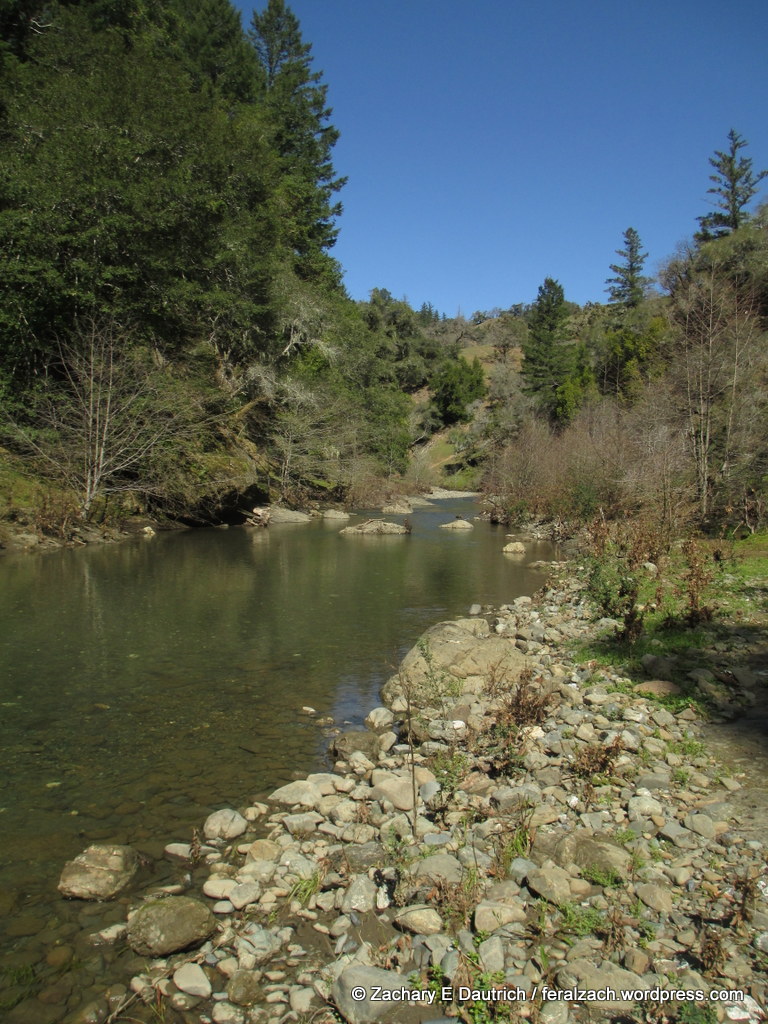
I could have spent days at that spot. The river was gently flowing past, its gray-green waters moving over small round river stones on its bed. Small waterfalls and seeps were cascading into the river from the steep hillsides, scouring the rocks and making a home for glowing moss and lichens. An abundance of life, and signs of animals passing through, was everywhere. I was overwhelmed by the calm and beauty.
I finally couldn’t resist and waded into the water (it was also the easier route around some poison oak that was guarding a narrow pass on the steep banks!), and saw a couple of newts hanging out under the surface of the chilly water …
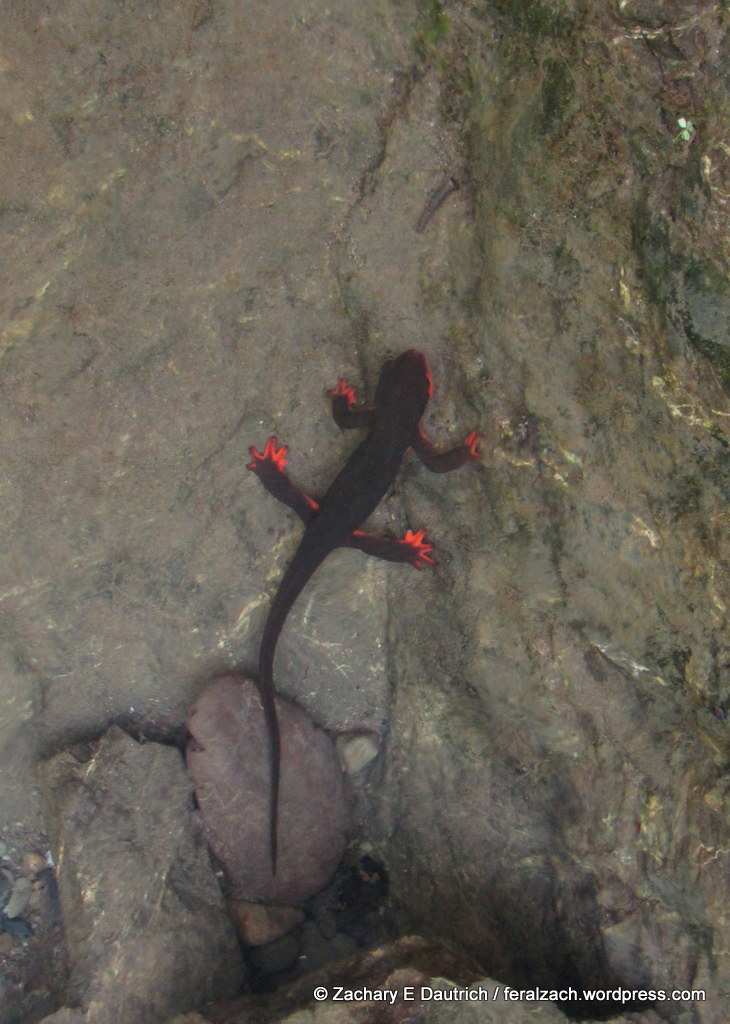
[red-bellied newt (Taricha rivularis)]
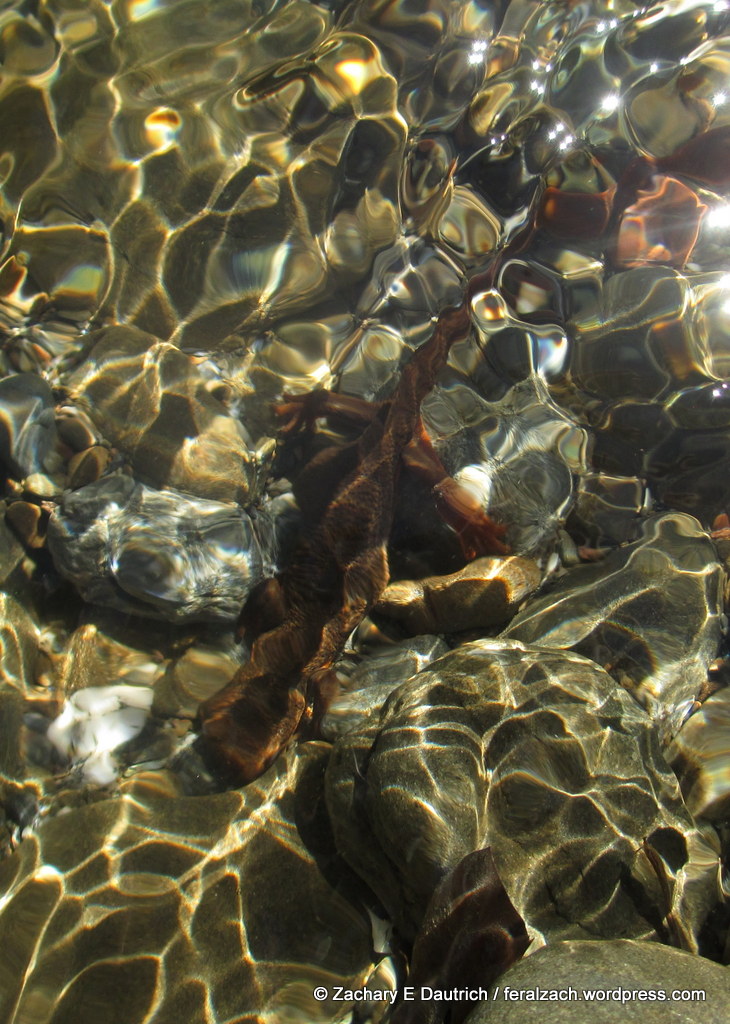
[rough-skinned newt (Taricha granulosa granulosa)]
Once I made my way back to shore, we saw a little snake sunning itself on a rock ledge. All the animals seemed to be in the same blissful, relaxed state that I was in … under the spell of the Gualala River and the warm sun above.
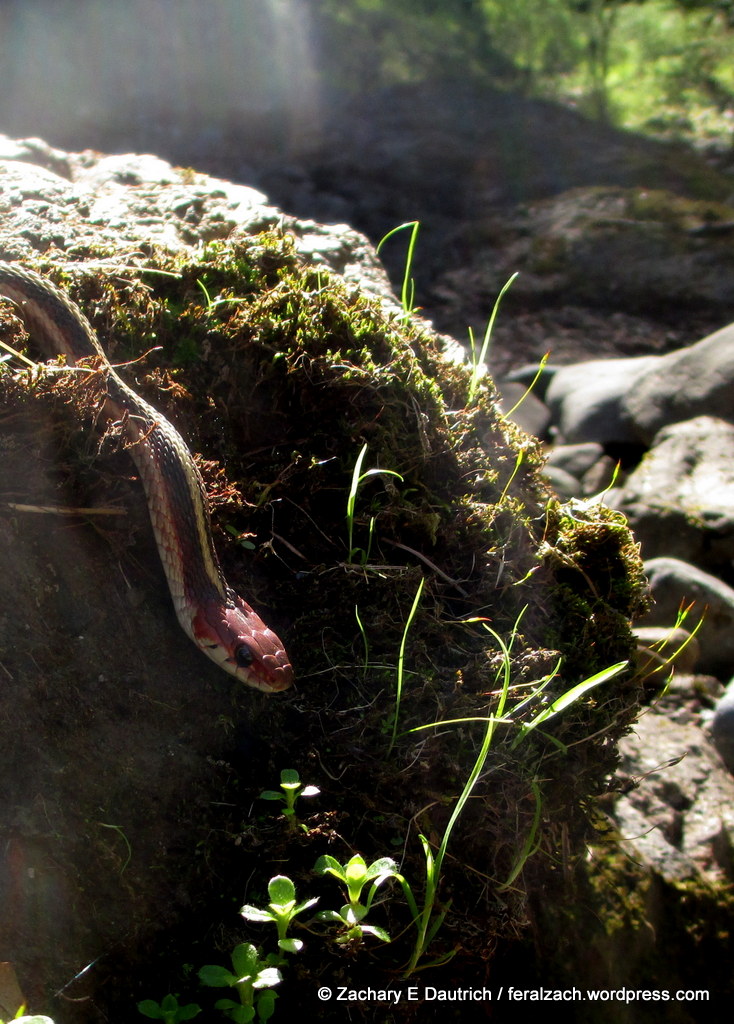
[CA red-sided garter snake (Thamnophis sirtalis infernalis)]
Finally, we hit upon some nice fresh hog tracks in the soft sediment on the banks of the river. Back on it!
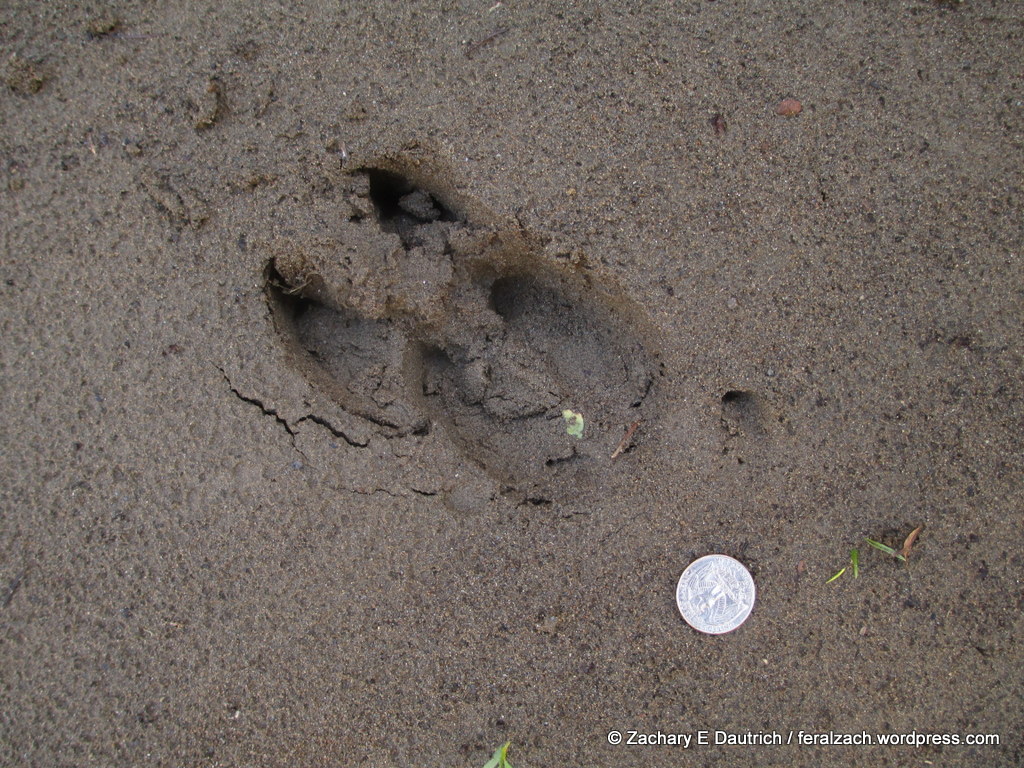
These were likely from a pretty big boar. We followed him back up the hillside from where we came, but once again after a little while we lost the trail. Humbling! As we fanned out and attempted to pick it back up again, we found another little creature on the hillside under a log that we had disturbed.
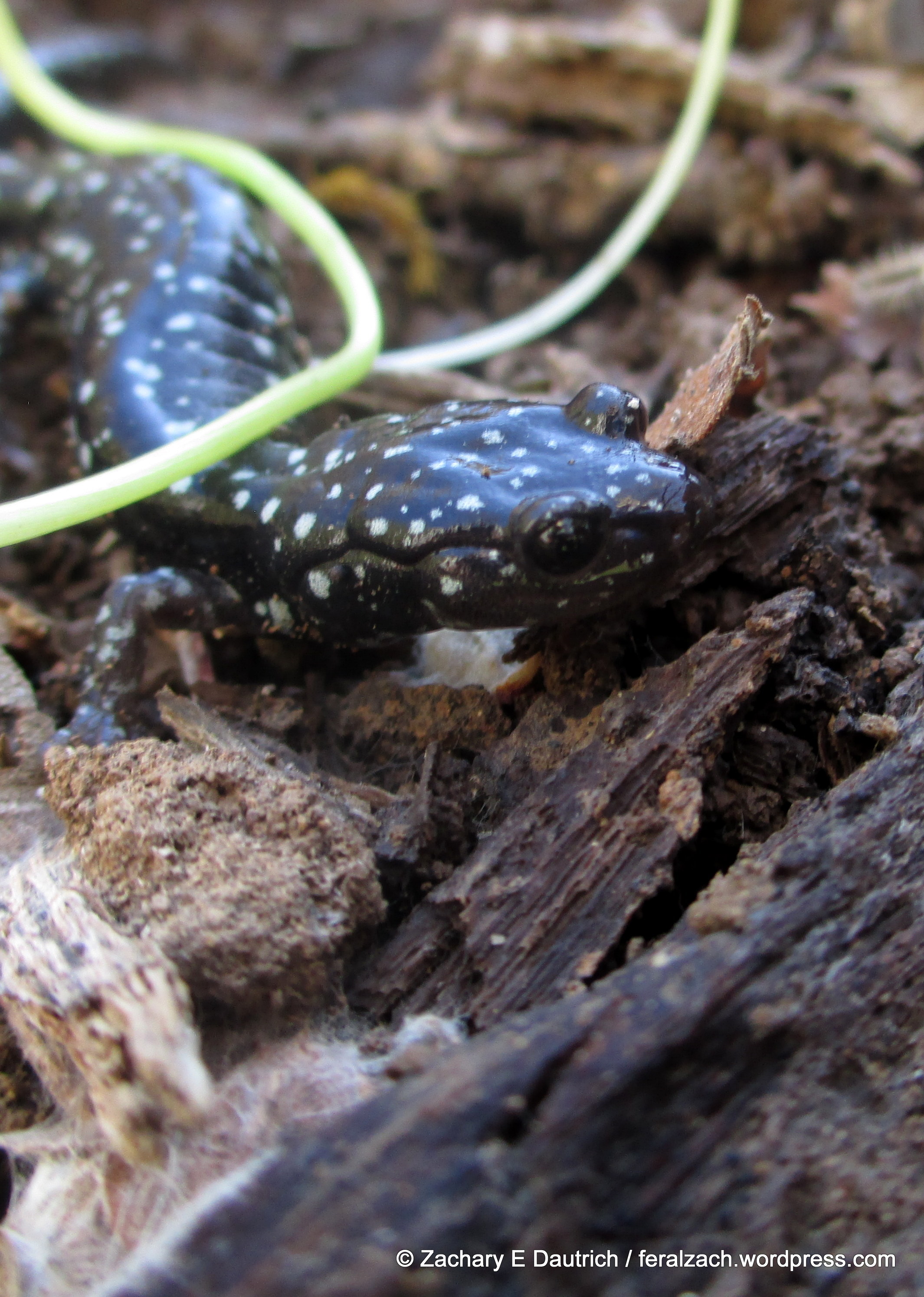
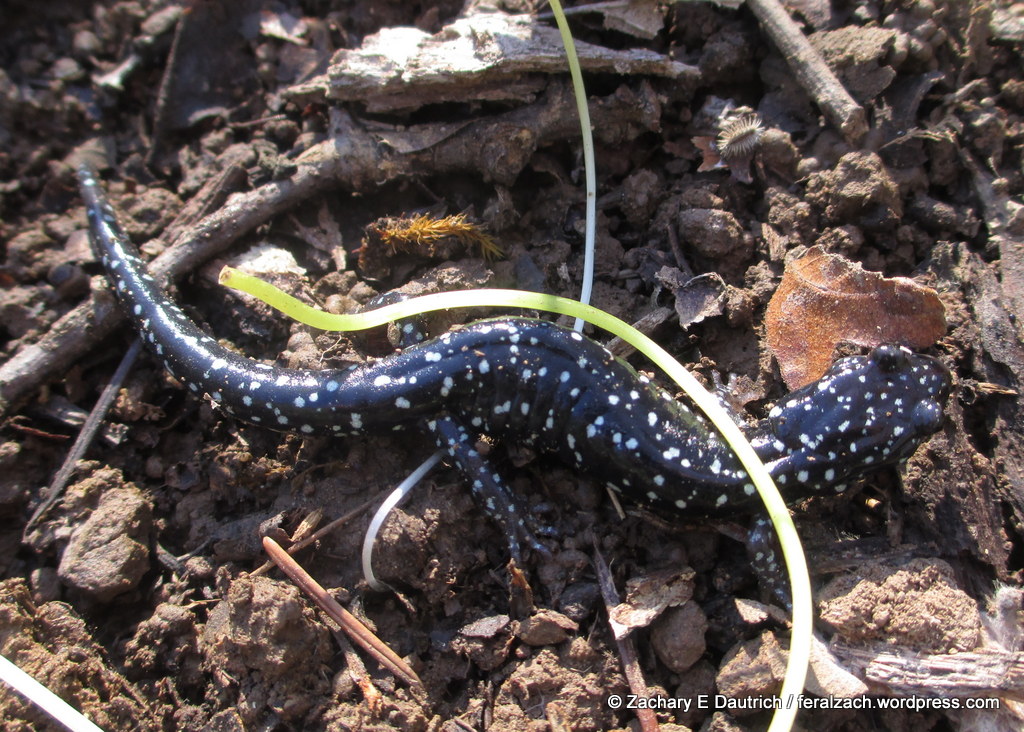
[juvenile speckled black salamander? (Aneides flavipunctatus flavipunctatus)]
We put a new rock and some leaves back over this young lady to keep her out of the sun after we left.
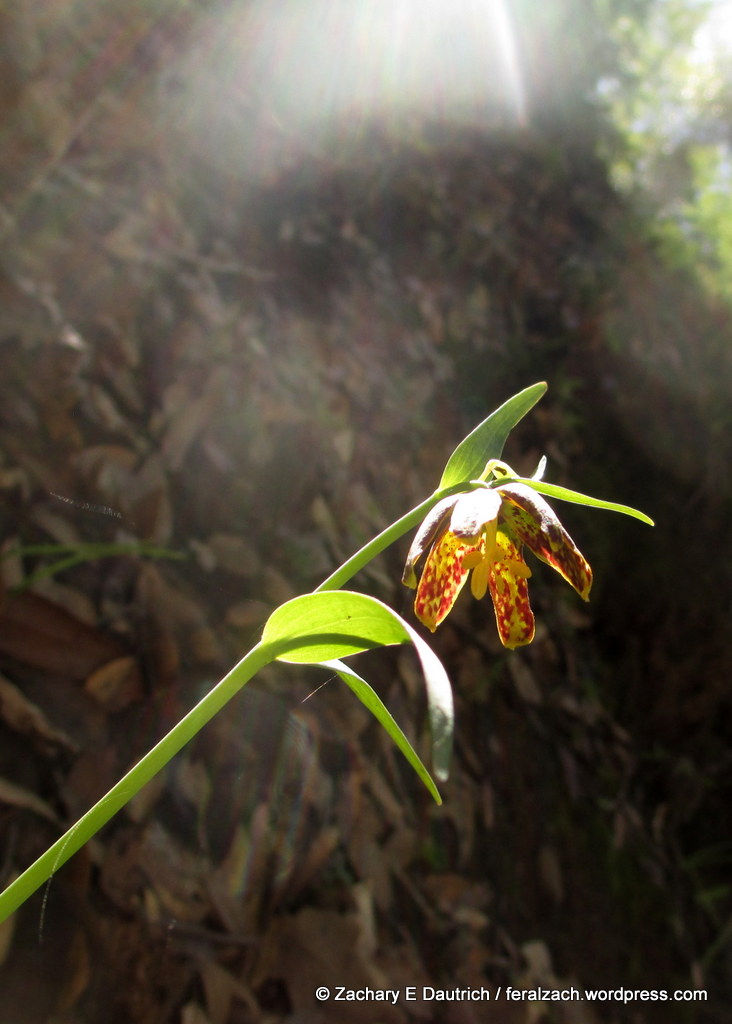
[some type of lily? anyone?]
[UPDATE – Fritillaria affinis aka the chocolate lily or checkered lily
edible bulb/roots
thank you Ann for the ID!]
As we got to the top of the hill, we found the boar tracks again … and it was one of the tracks that we had originally seen when we started on this trail! We had come full circle.
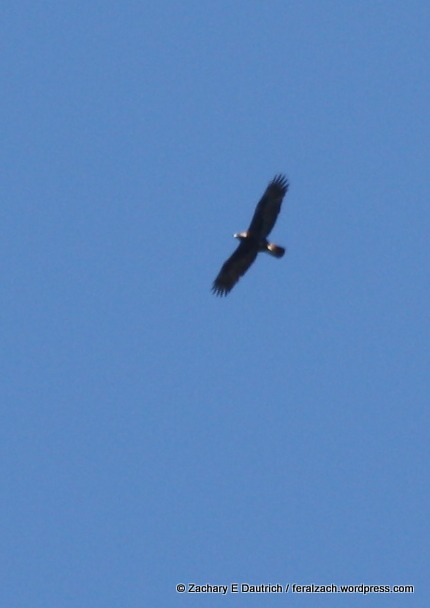
We reluctantly made our way out of the property, but as we were leaving we spotted one last treat – a golden eagle! it was a double eagle day. A good sign and a perfect ending to a great morning.
I am so thankful to have gotten to spend the day out there, many thanks to my friend Matt for taking time to share this special place with me.
+++++++
* As a side-note, in recent times vineyard owners have been trying to push into some of these areas because they are ideal for certain grape varietals, such as the popular pinot noir. Thankfully there are many organizations, including Native groups, that are spearheading the effort to keep this land intact from groups who want to convert forest to vineyards (or other clear-cutting). The amount of life that is impacted by deforestation is astounding, and humans have already destroyed 96% – NINETY SIX PERCENT – of existing redwood ecosystems since the west was “settled” … and old growth constitutes just a small part of that which remains. Scientists have barely scratched the surface of understanding ecology and the web of life on this planet, and it has been shown that the canopies of redwood forests contain a huge amount of biodiversity. Seems like there is a lot of value in honoring these remaining places – and perhaps a duty to do so.
frogs n snakes
everything is loving the rain
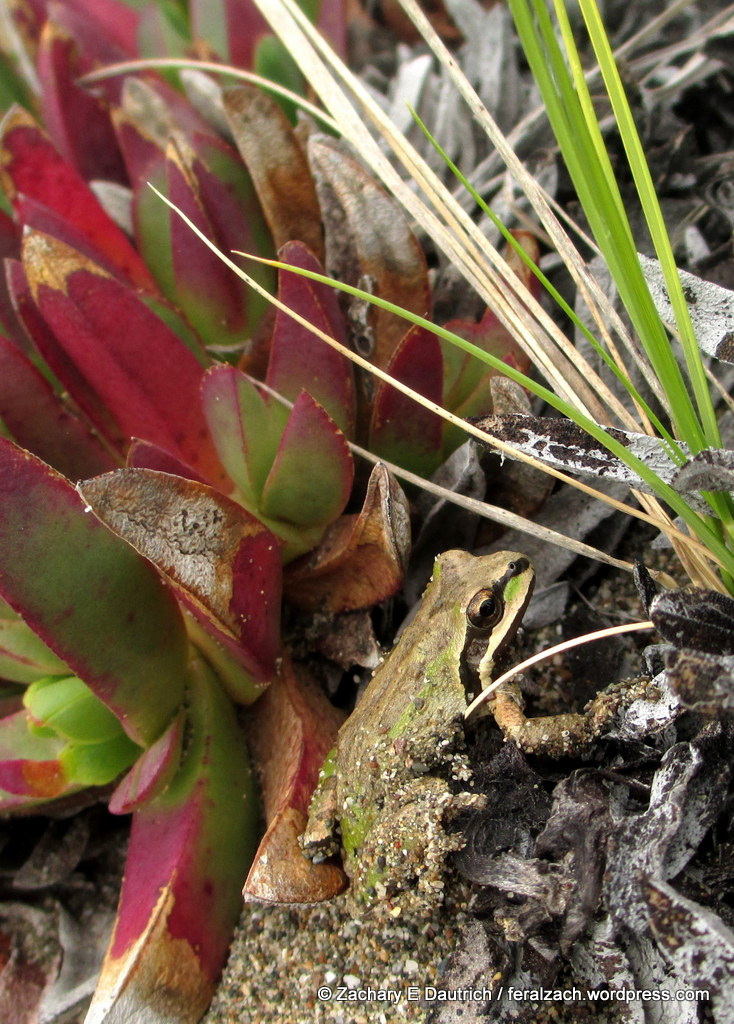
northern pacific tree frog with ice plant
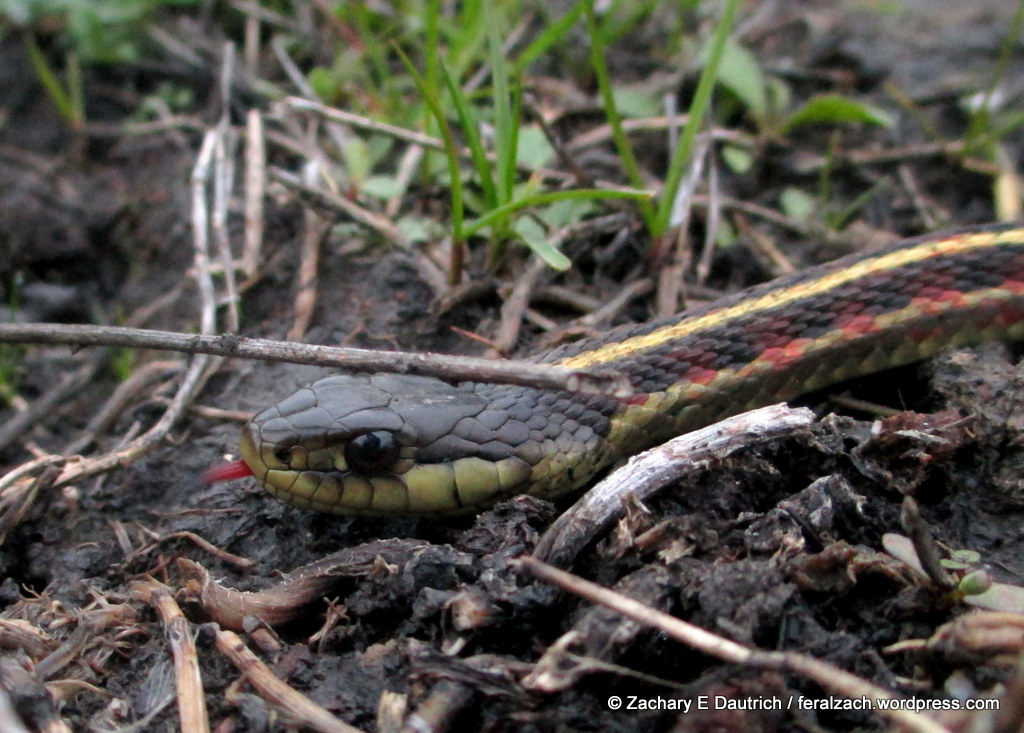
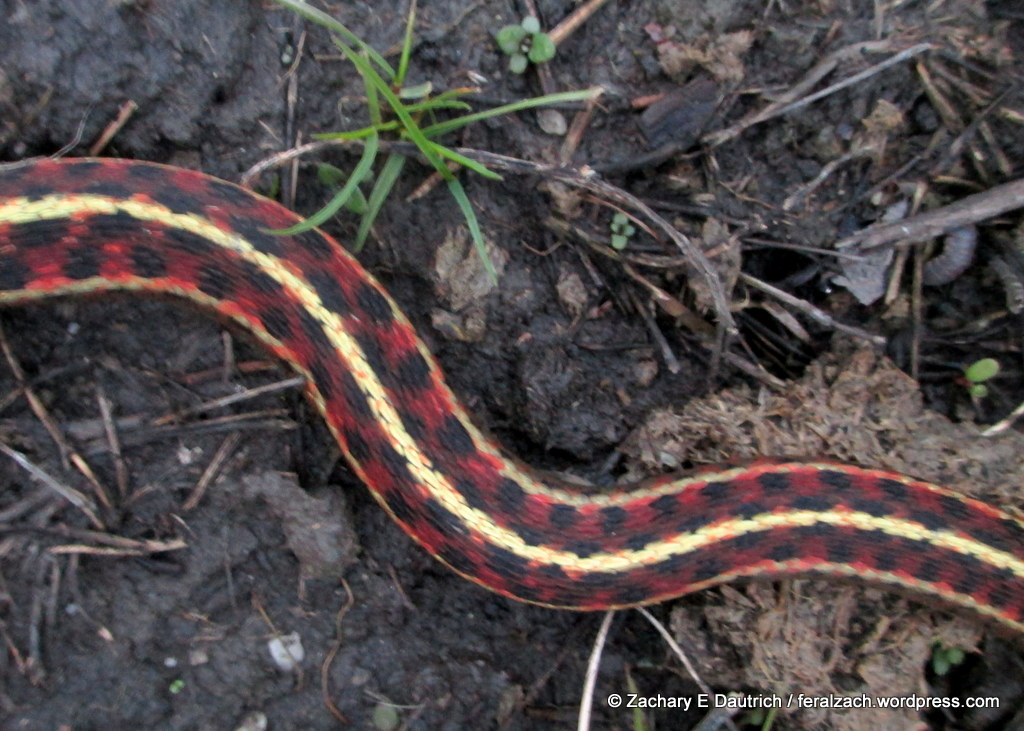
coast garter snake (Thamnophis elegans terrestris)

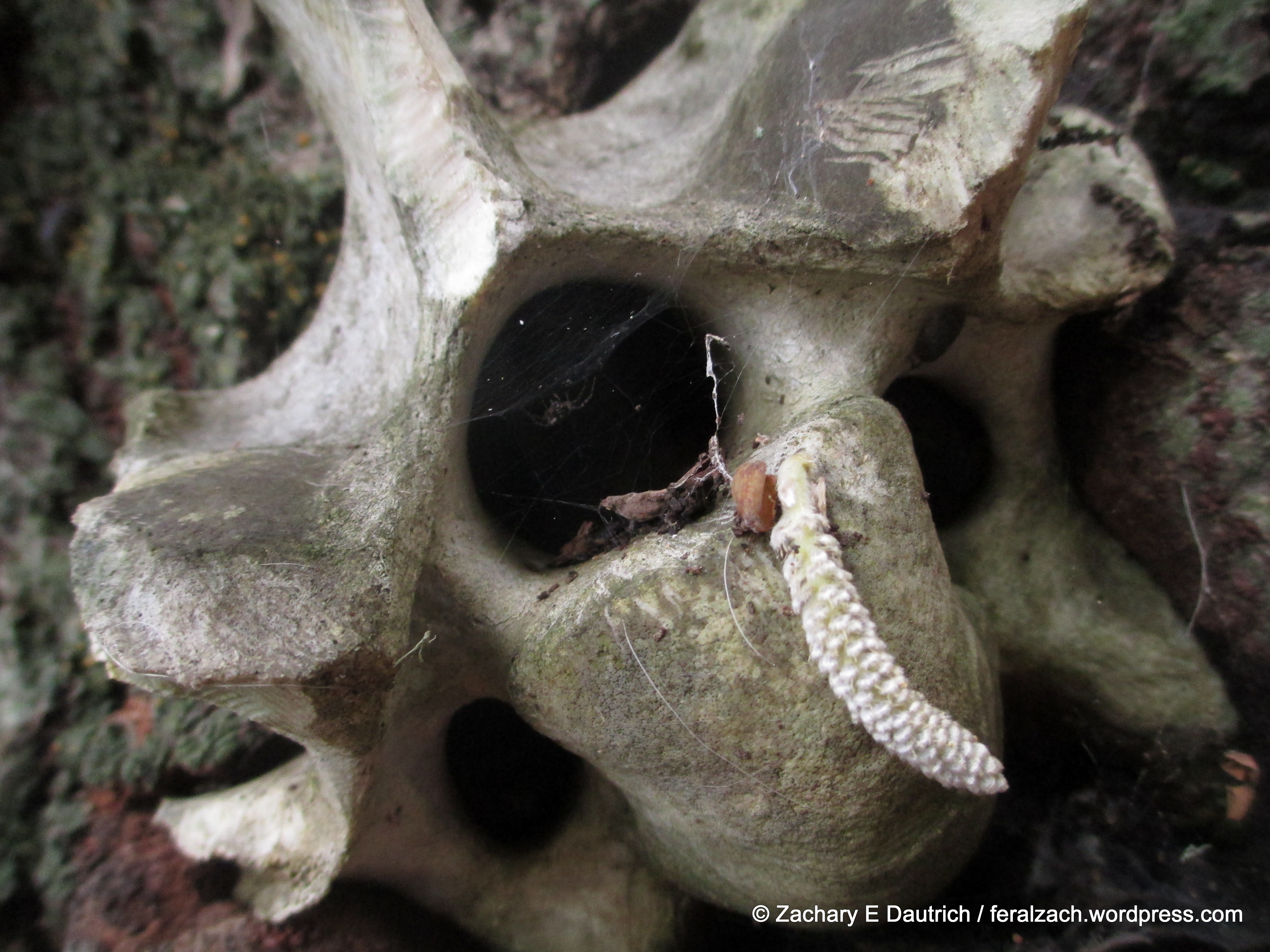
bone tree-fixtures
sometimes you find things in the least expected places, and that is part of the beauty of trying to stay aware as a tracker when you wander – constantly switching between the micro and the macro. looking in new ways and trying to be tuned into the track or sign that could be underfoot, while at the same time staying present to the live coyote that could be on the landscape ahead of me or the eagle that could be soaring above. a lot to track. that’s why i love the wander … it is a meditation, a whole-body/mind/spirit tuning practice that connects me to the land and its wonders. its the wonder wander.

as i moved through a zone of trees that sandwiched a seasonal creek bed that cuts through the landscape, i noticed a cow vertebra in the trunk of a bay laurel tree. uhh, strange. it had been there for a while – the tree had actually grown around it! who created this curious forest decor? perhaps it is some bigfoot feng shui? that is the most obvious answer, of course – though i would say this could also be a remnant of the Clovis culture, or even more probable the work of a werewolf. maybe an old prototype for an Al Jourgenson microphone stand?


regardless of its origins, what was really cool about this bone tree-fixture, was the little world around it. there were short mammal hairs on the trunk of the tree right by it, spider webs all around it, a sow bug just hanging out on it, and there were also a lot of rodent gnawings on it too (rodents love to nibble on bones and antlers for the calcium, and perhaps to also help trim their teeth). truly a work of living (and dead) art.

cow vertebra in tree trunk with rodent nibbles and sow bug
my “short wander” – in between the storms this week that are delivering much needed rain to our lands – turned into a “slightly” longer foray than expected. because of the rains that just passed and the storms rolling in, the animals seemed eager to use the clear skies to feed and frolic and flirt … the owls were hooting extremely early, and even flying around hours before sunset, while the red-tails were screaming and dancing in their courtship displays. the night shift and day shift were doubled up, and it was fun to see and hear it all at the same time. it was not necessarily an ideal time to be a ground squirrel or gopher, and they were on high alert.

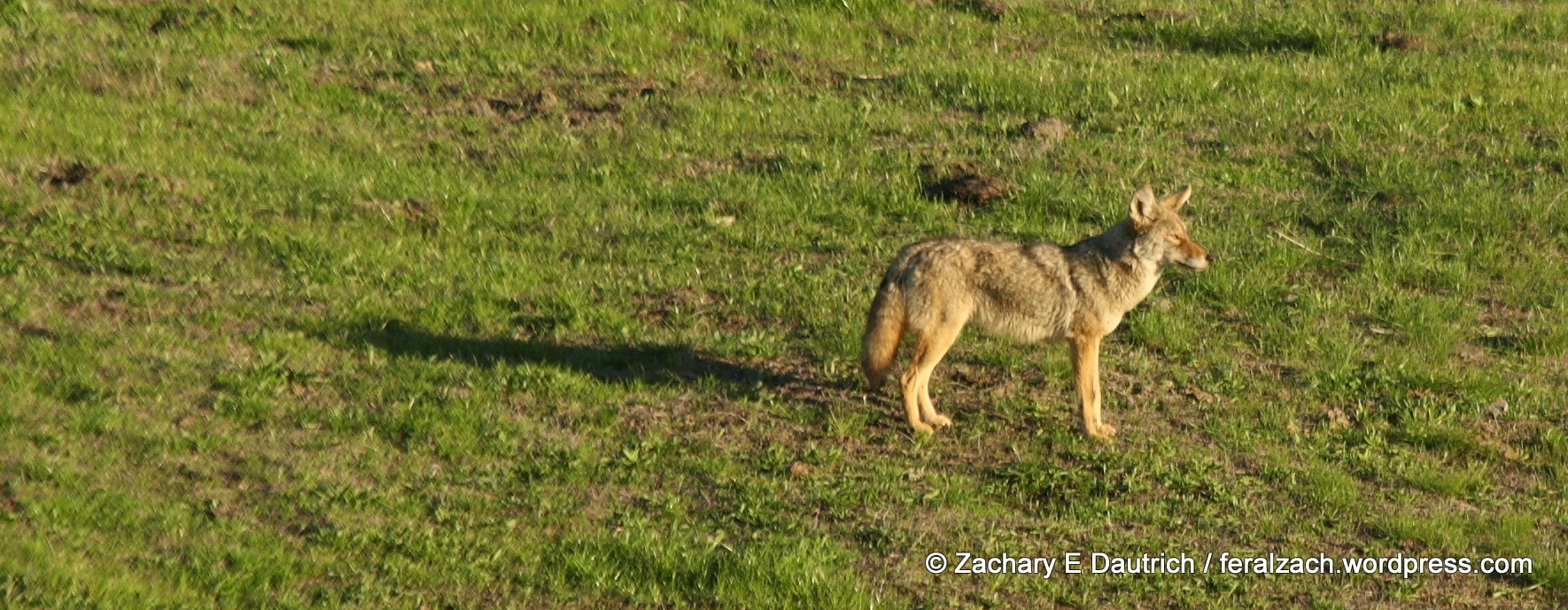
with the wet weather and reduced people/dog/cattle movement, i was excited to finally get some clear coyote tracks of some of the family i’ve seen the last few weeks …
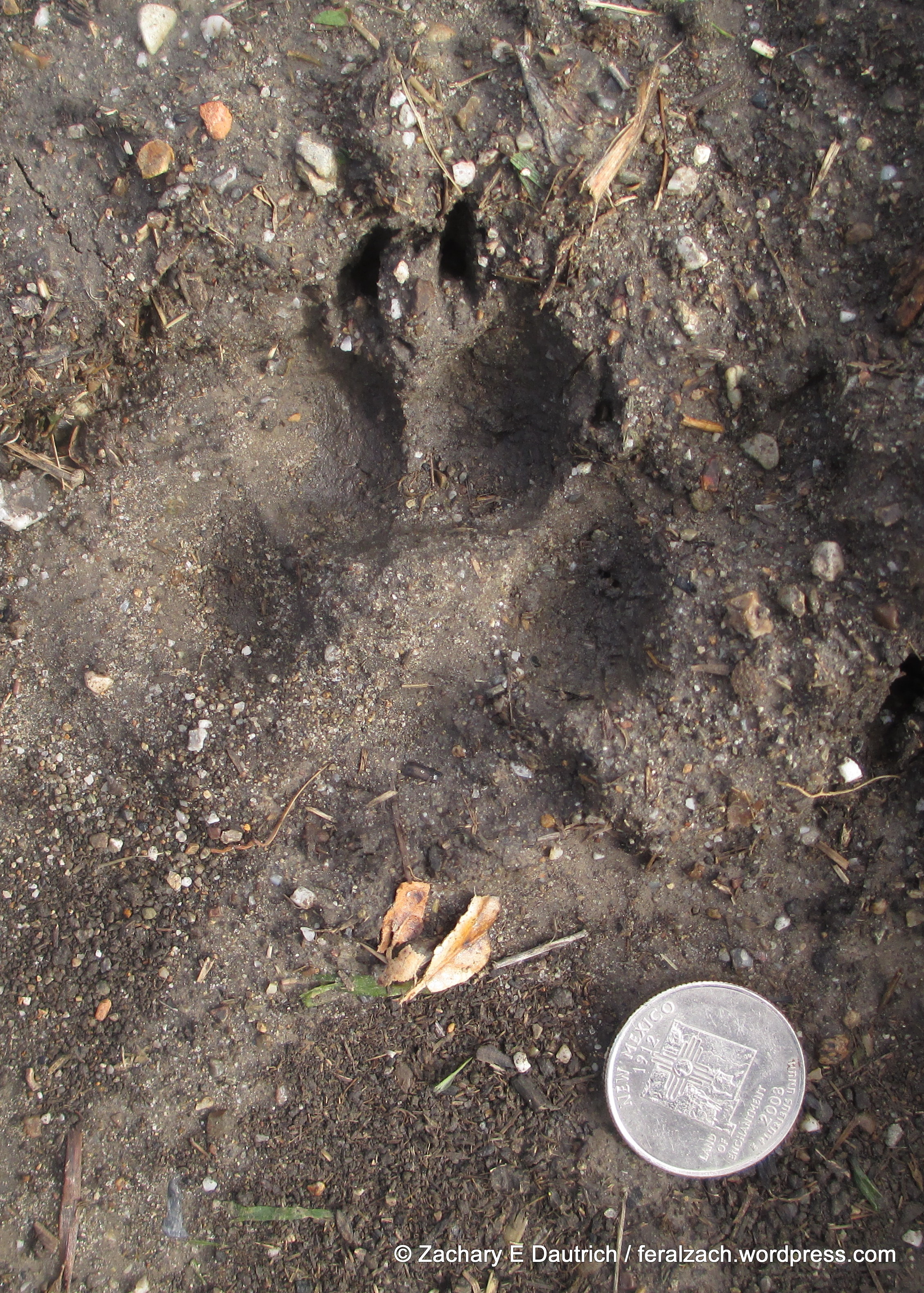
coyote track
it’s always hard for me to leave, i usually feel like i should be making a nest under a bay tree and settling in for the night with the rest of the beasts. as i left, i spent a bit of time with what was likely my third set of owls that i saw today (and possibly one set of four to six in the immediate area!). they weren’t up as early as some of the others that i had seen previously in the day, but they were hooting and calling to each other with a lot of intensity. they finally came together in the boughs of a eucalyptus tree, then headed off up the hill to hunt before the rains came.

great-horned owl
dark morph red-tailed hawk
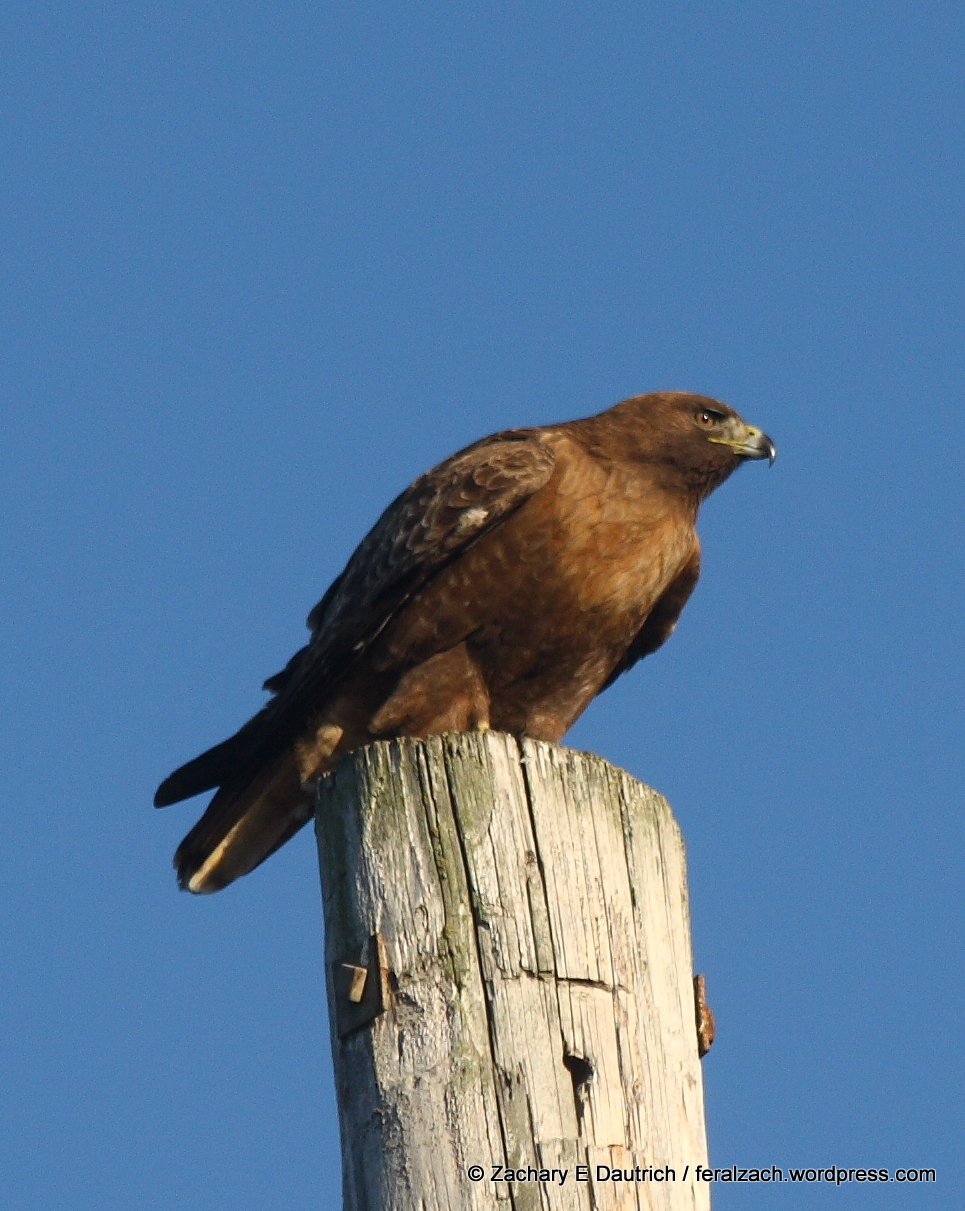
i ran into another old friend on friday … a dark morph (or rufous/intermediate morph) red-tailed hawk that has spent the last few winters in berkeley. it’s fun when i get to know an individual animal, and this one has been around for a few years but i just saw her for the first time this season about a week ago. i was happy to see her again.
when i first saw her we gave each other a little wave (ha!)

right about the time that i saw her, a huge flock of crows was moving through the area and it didn’t take long for some of them to spot her too. crows love to harass red-tails, and today was no different. first one or two took up the chase, and soon there was a flock of close to 50 crows escorting her out of the area.

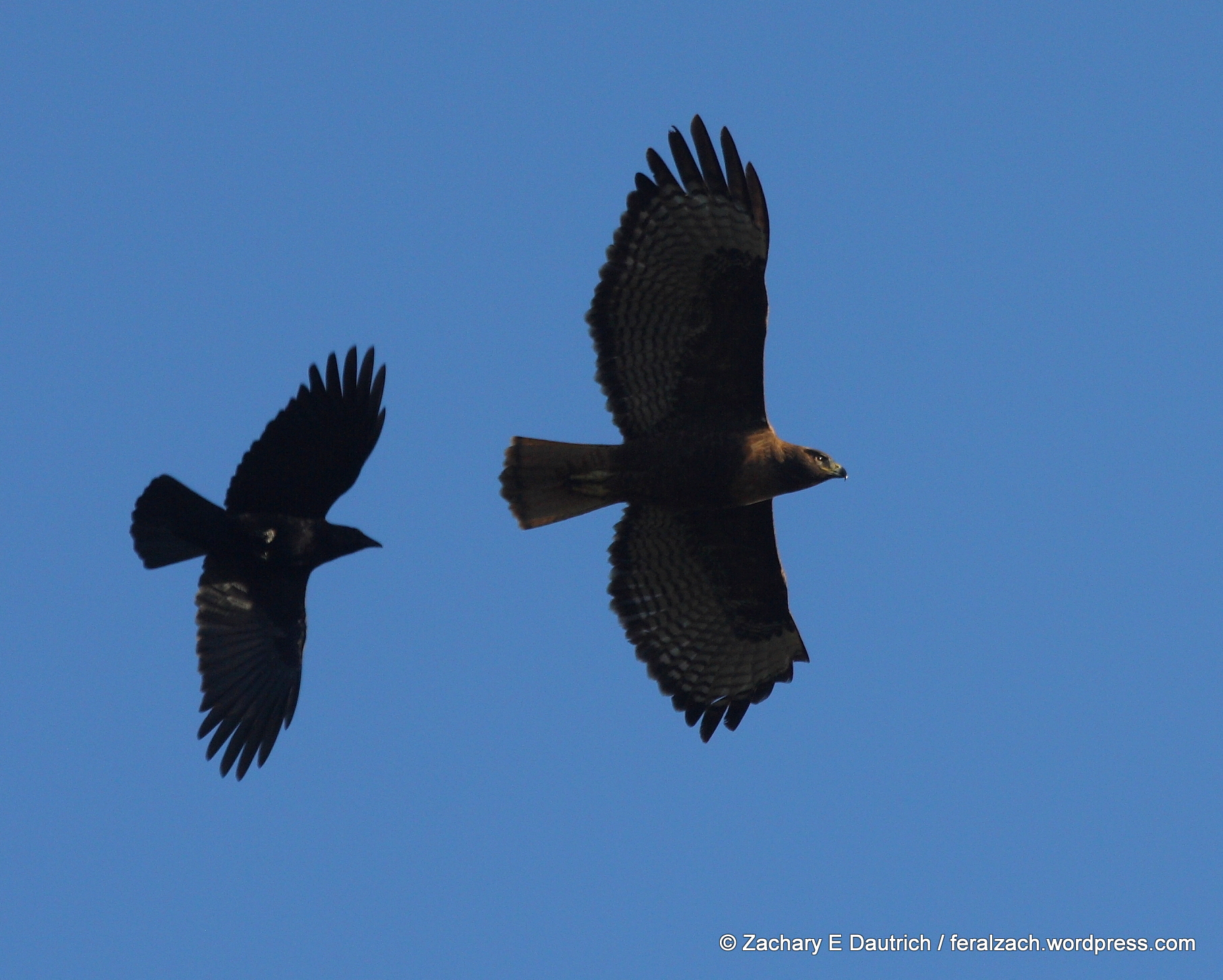

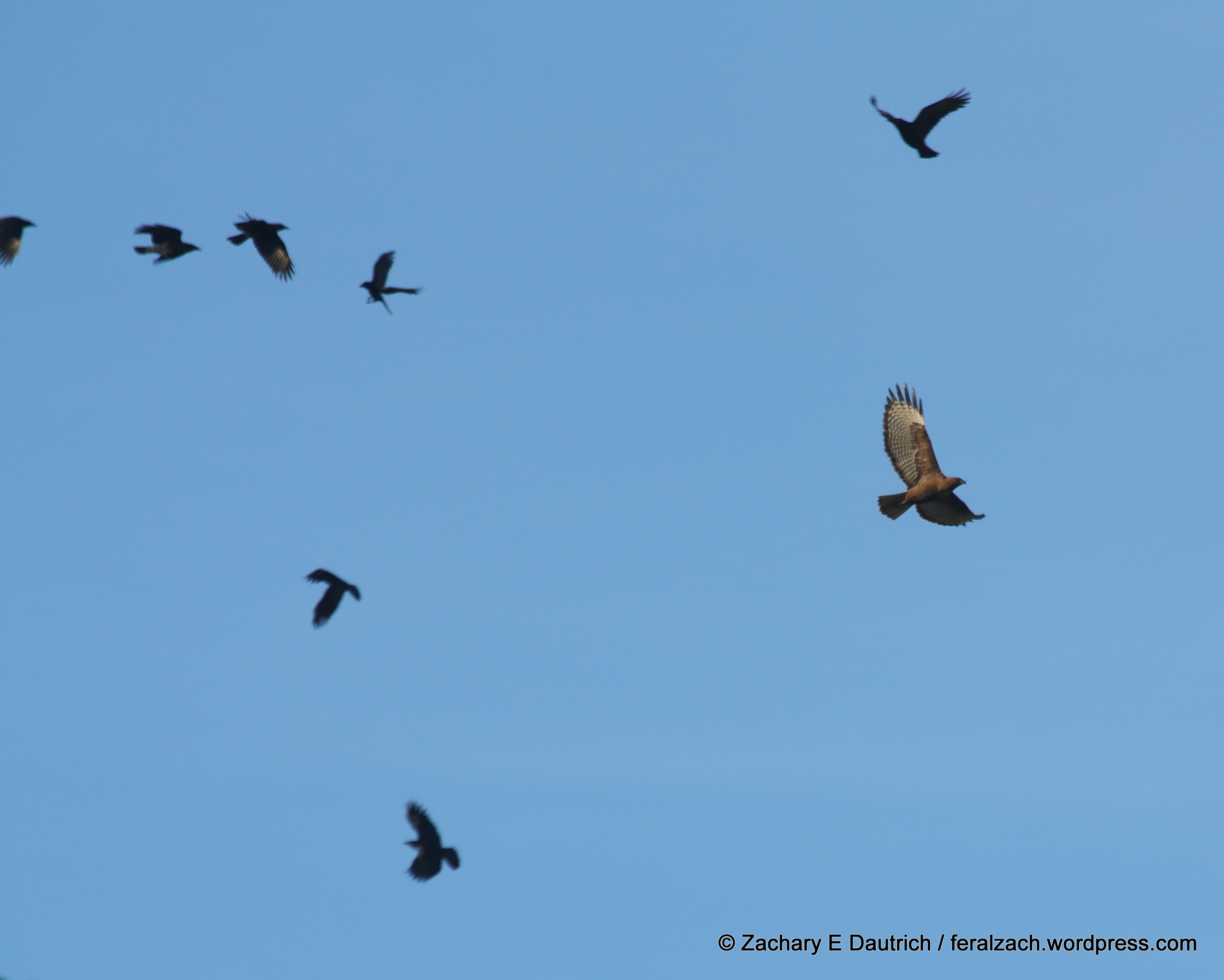
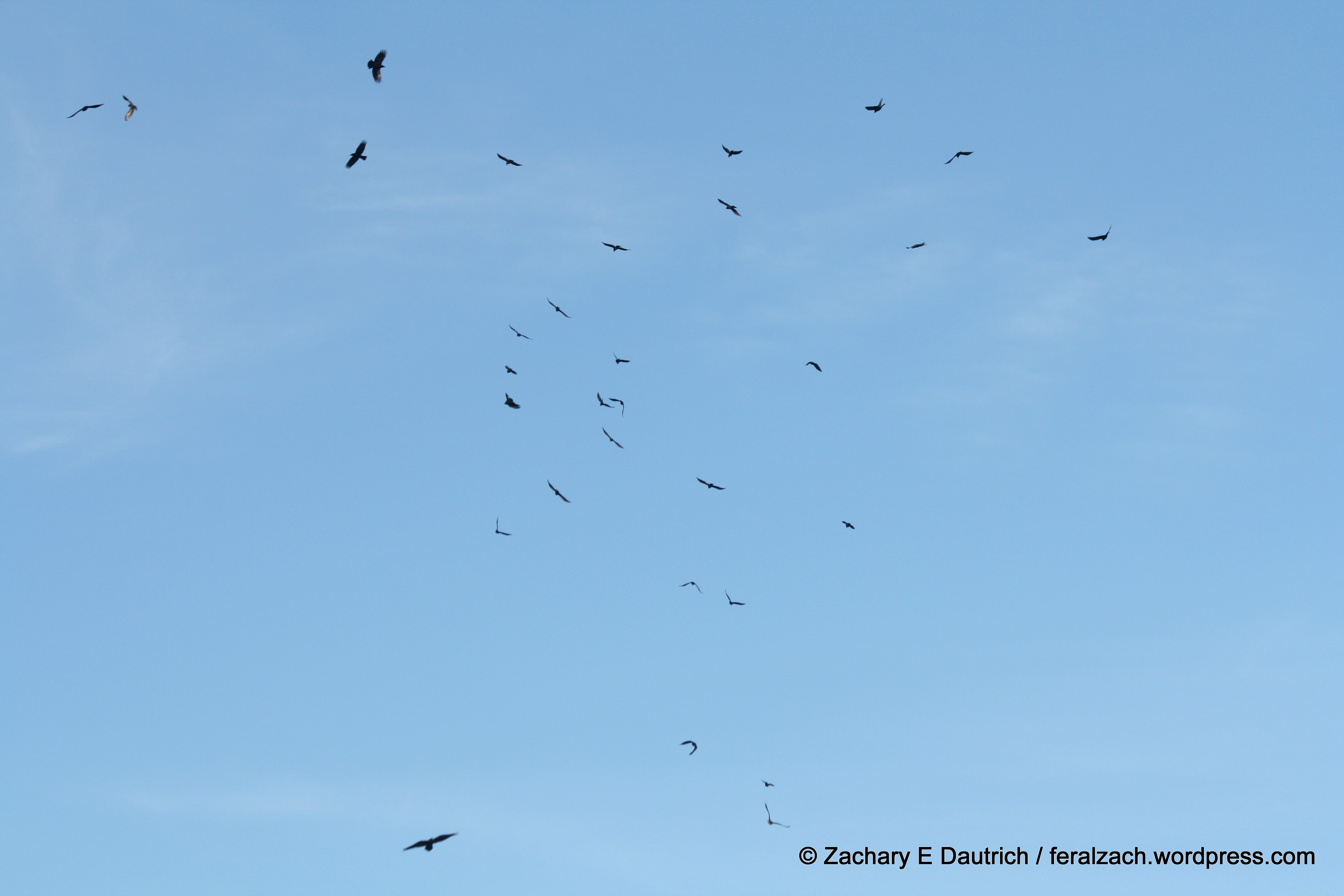
the mob goes wild
i’ve mentioned this before, but there are some corvid researchers (i can’t remember who) who say that this mobbing behavior could be a corvid “right of passage” – which makes some sense to me because there is very little reason that i can think of for the birds to do it other than fun or to establish social ranking.
fruitvale falcons
On this beautiful Spring-like (?!) morning, I had the privilege to see my old Falcon friends on the Fruitvale Bridge in Oakland/Alameda. Just after I arrived, Hiko, the tiercel (male falcon), came in to land on the Oakland tower with breakfast – which this morning appeared to be a Eurasian collared dove. Doing his part to remove invasive species today, I guess. Unfortunately my vantage point had the sun back-lighting my photos and I was pretty far away, but it was fun to watch as he really went to work on this bird, de-feathering it as we watched. Feathers floated down like a snow storm beneath him, he was working furiously to get at that meat!
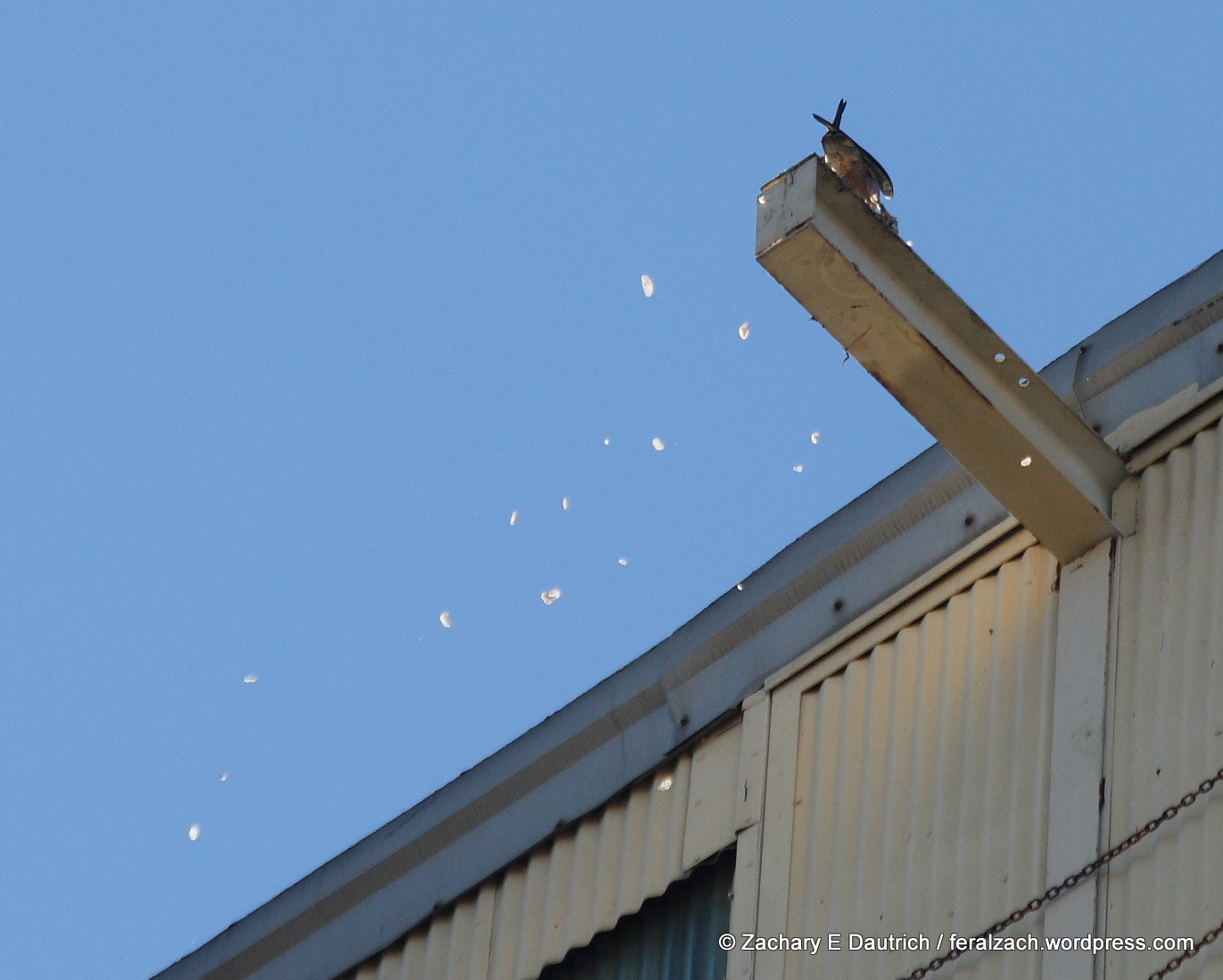
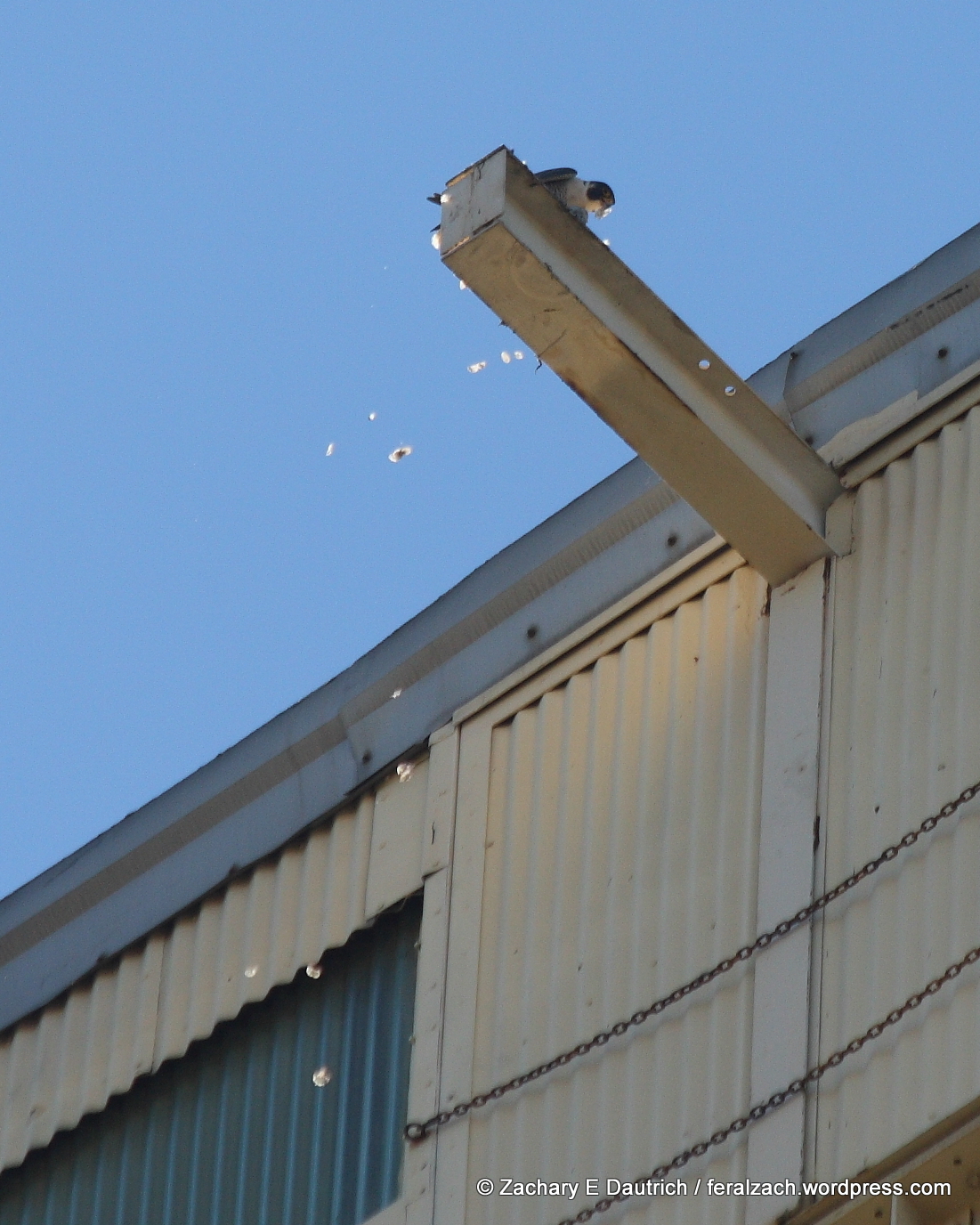

After a little while, his mate came flying in from the northwest over the waterway, and she didn’t seem to see him as she landed on the other tower. She started to e-chup (vocalize), and he let her know he was there with a few response calls. Usually this time of year, the fella would be offering meals to his mate as part of the courtship process, but he seemed intent on keeping this meal to himself at that moment. It is just the beginning of the courtship and mating process, so maybe he’s just not feeling the love quite yet.

the female falcon, Tremaine
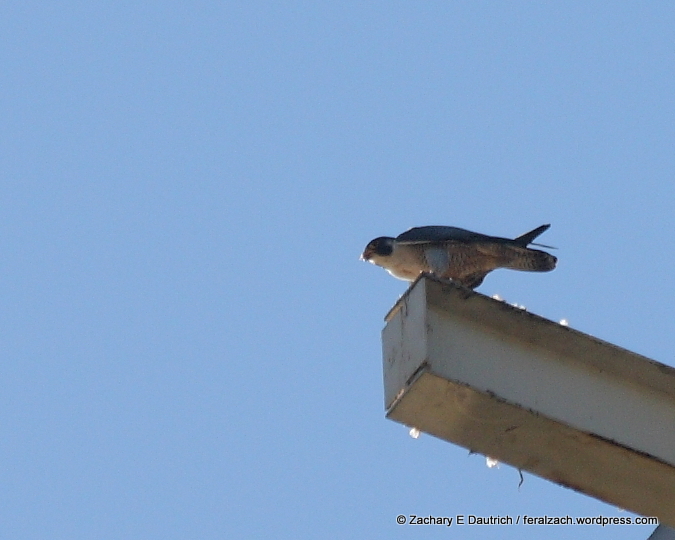
Hiko, finishing up his portion of breakfast
As Hiko was finishing his meal, Tremaine took off from her perch to investigate a little more into what Hiko was doing.
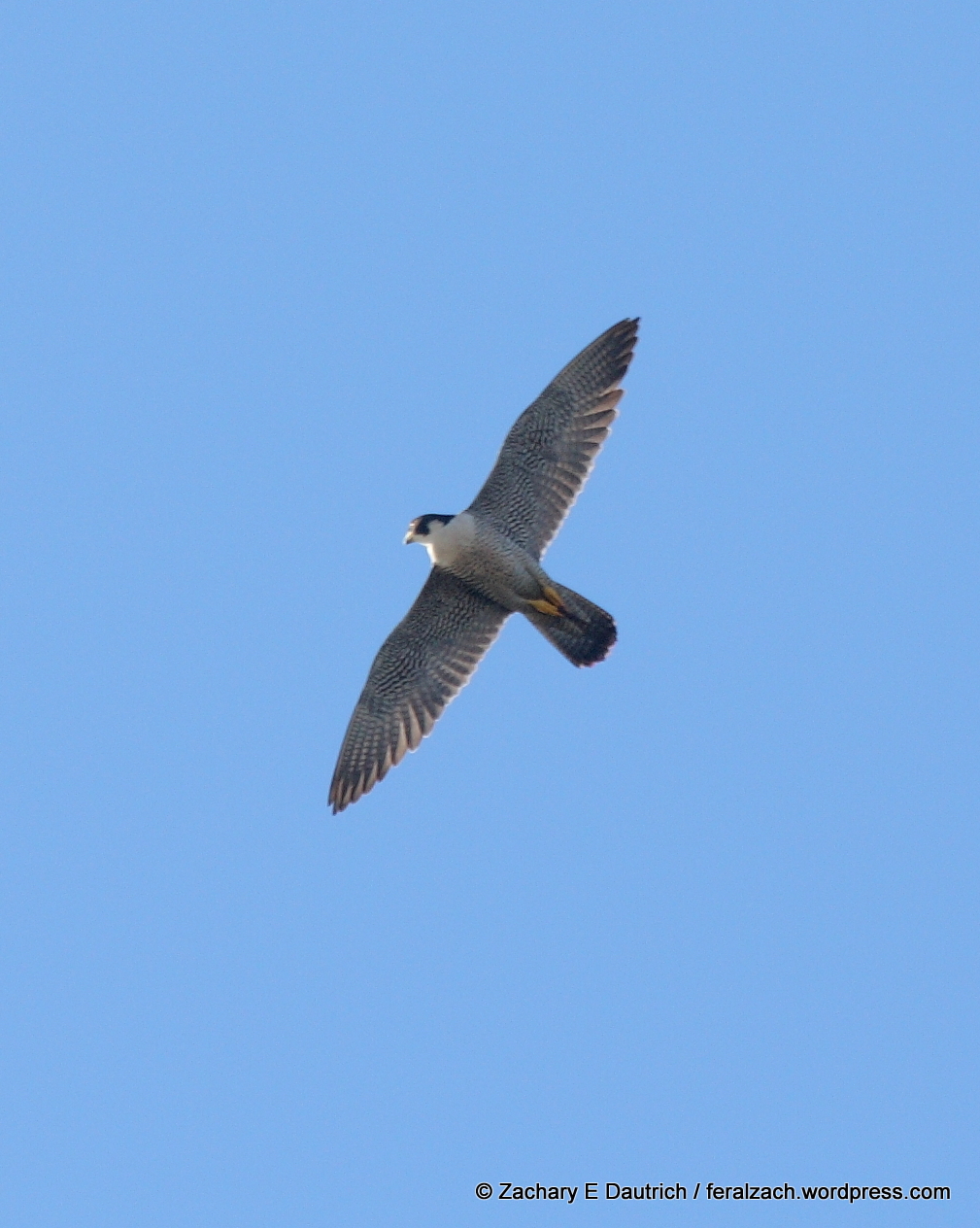
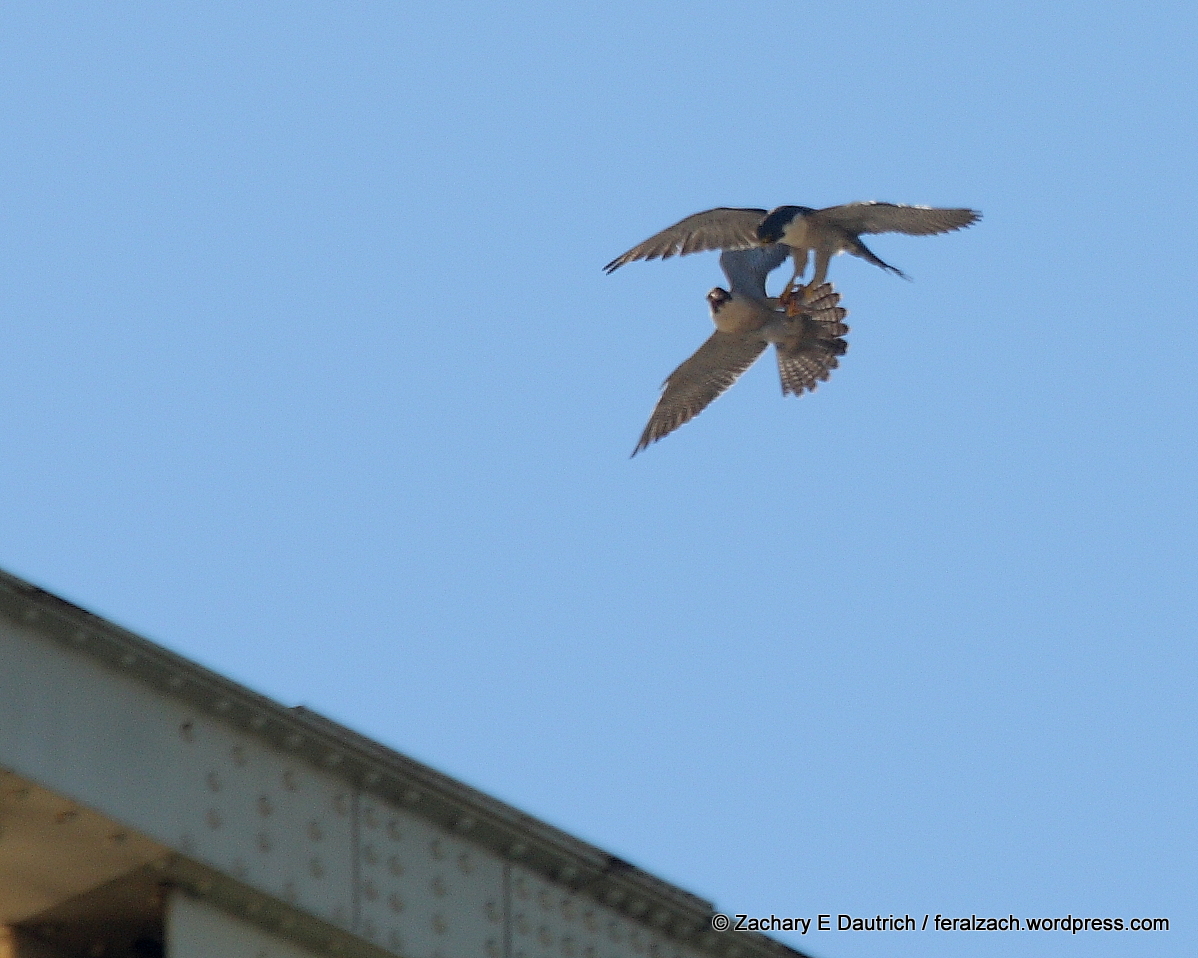
Tremaine landed back on the Alameda tower, and finally Hiko seemed moved to share his breakfast with her after being discovered hoarding his food. He took off with a portion of what was left and flew to her on the other tower. Typically, the tiercel would drop-off the food for the falcon as part of the courtship process, but at the last minute he had second thoughts about sharing and he veered away! Or perhaps he was flirting, falcon style. She immediately took off after him, and within seconds had “commandeered” her portion from Hiko in mid-air over the bridge! Good stuff.
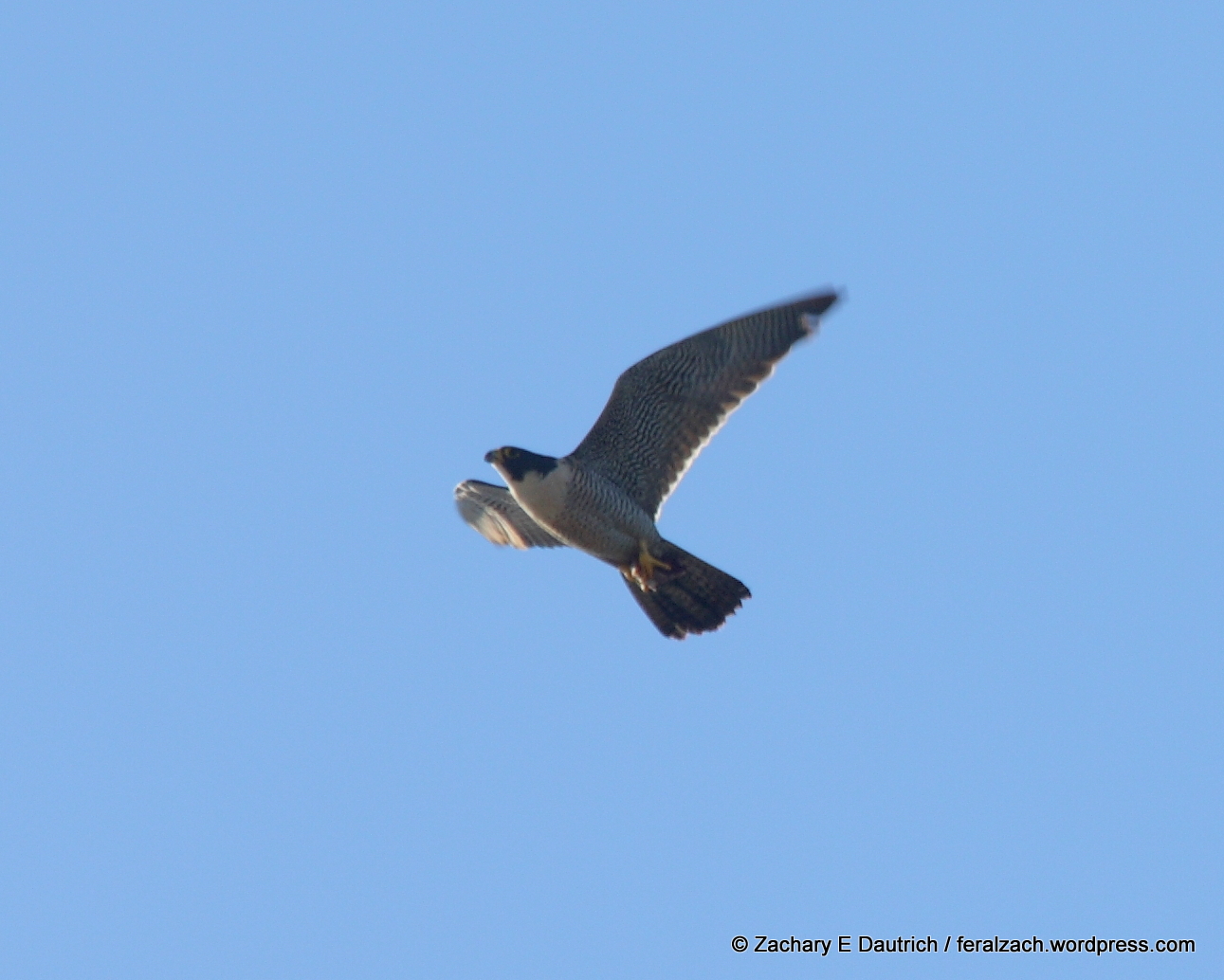
She took the small portion of the dove that he had and did a lap around the towers with it, then headed back to the Alameda tower to eat.
Tremaine with prey remains
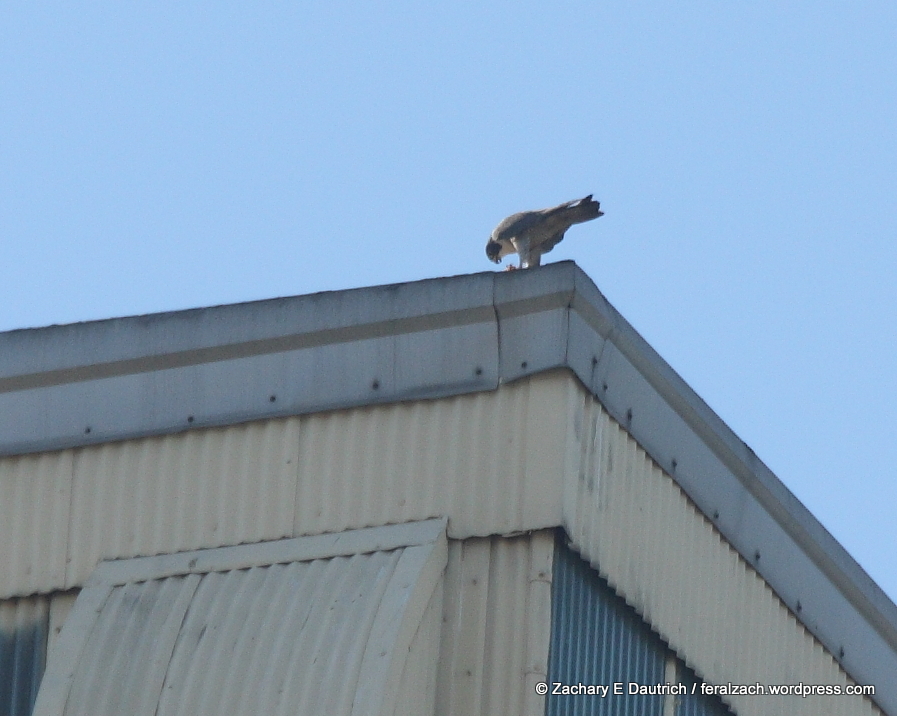
Tremaine eating
Hiko then did a little survey flight around the area and settled in near Tremaine on the Alameda tower to do some preening after his crop-busting breakfast.

Hiko
After Tremaine finished her portion, she flew over to the Oakland tower (interestingly the OPPOSITE tower that Hiko was on – I don’t think he won any extra points with his sharing “efforts”). The two settled into a mid-day lull as they digested their food and preened, and I left them to enjoy the sunny day.
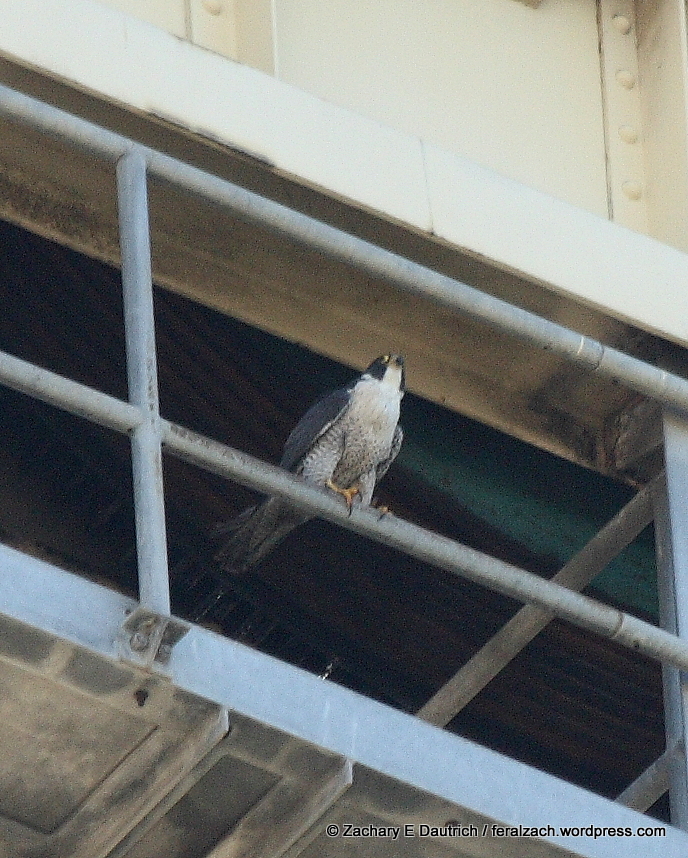
Tremaine
This is a shot of Tremaine when she was eating that I took with my camera phone through a friend’s scope (digiscoping, it is called). Not great quality but quite a zoom. You can see Tremaine has a full crop, she must have eaten something on her own before getting this “gift” from Hiko.

These birds are so beautiful, watching them fly, with such quickness and grace, never gets old.
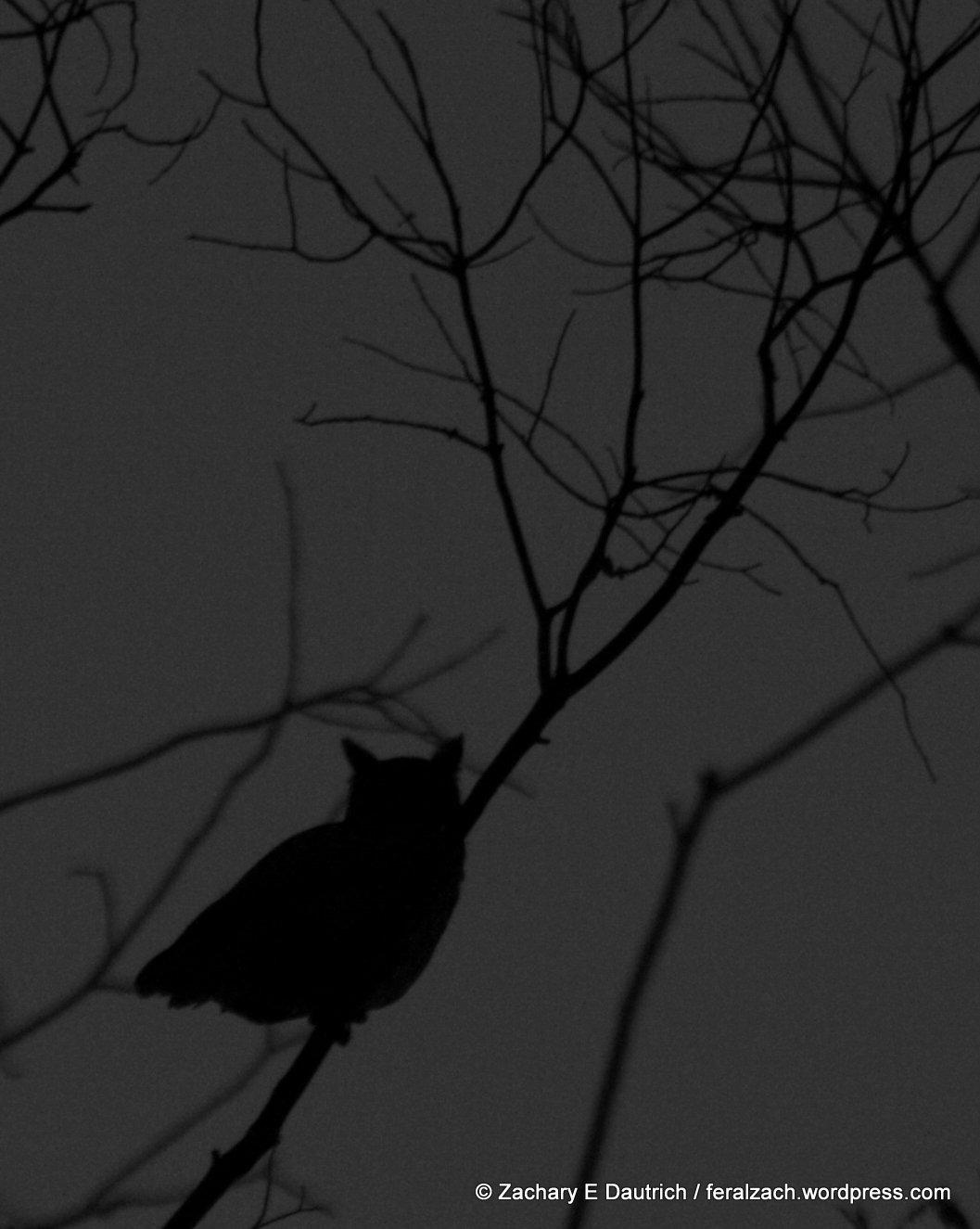

owl love
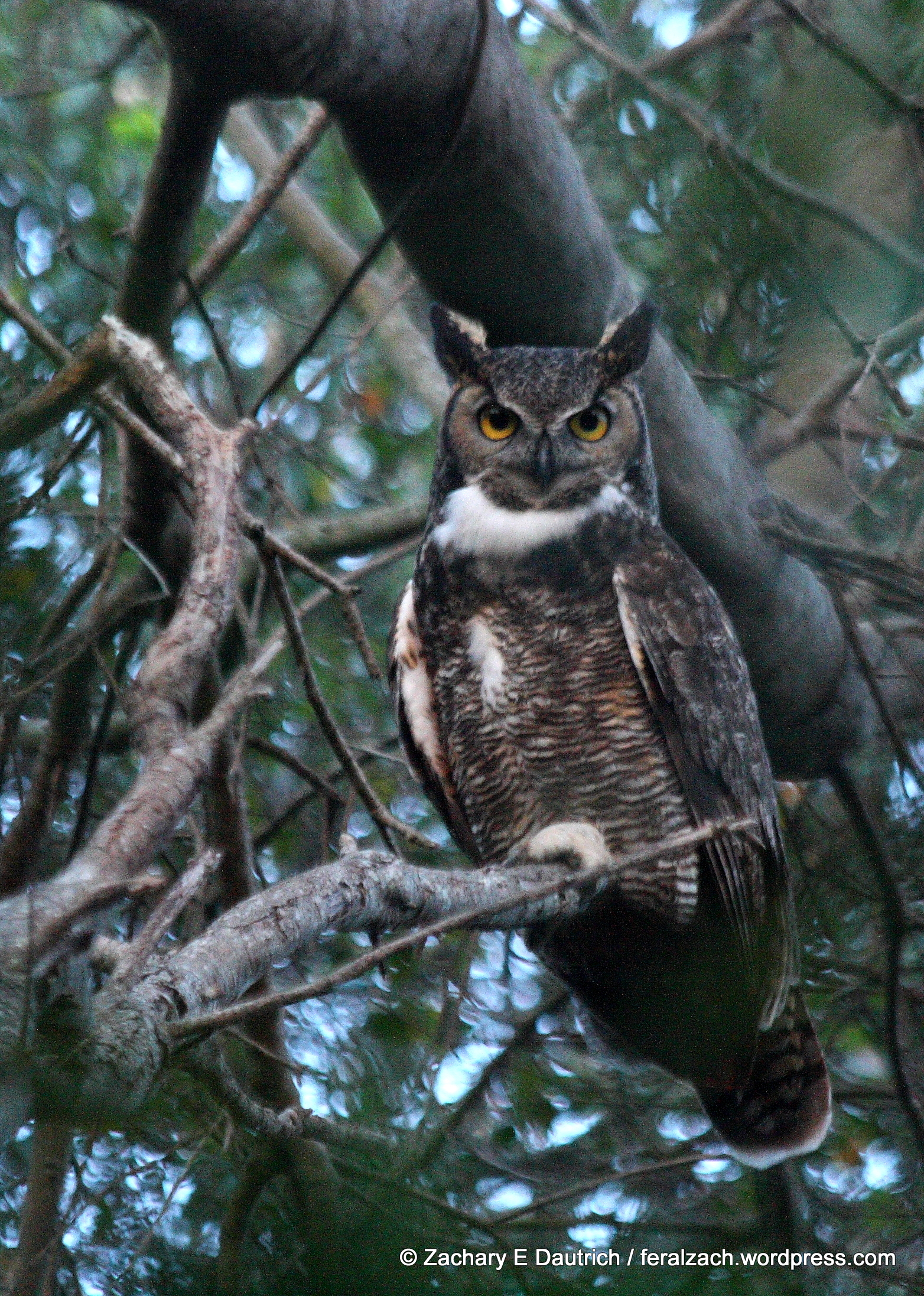
Well, I suppose it is appropriate THIS weekend to find the great-horned owls courting and flirting, and along with the predominate culture, inadvertently rubbing it in that I’m single. But at least they were kind enough to share their love with me, and not just that, they did it with enough daylight for a photo shoot – so I’m thankful for all of it.
It was a particularly mild evening, with very little wind, and all the animals seemed to be very active after a brief bit of rain last night followed by a warm afternoon and evening. I spent some time with one of the resident red-tailed hawks, who two days prior I caught in serious courting mode being pursued by her mate – but today she was just hanging out atop a post looking very regal.

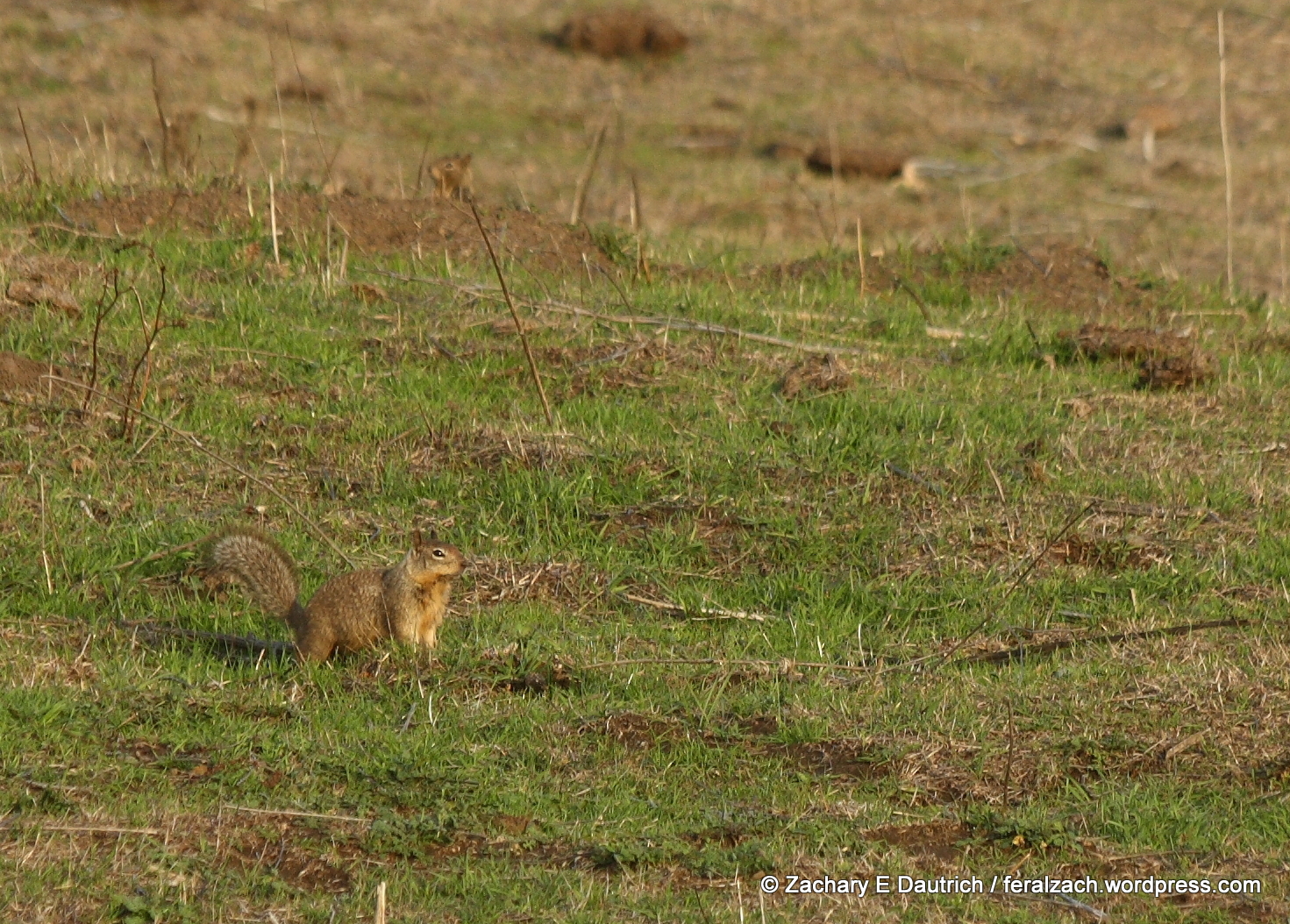
As I moved on, I was excited to find a small colony of CA ground squirrels, the first that I’ve found in Wildcat Canyon in the areas that I usually wander. There is a lot of gopher, cattle, human and dog activity over most of the open areas, so one has to really go to some of the more remote spots to find where the squirrels, rabbits, coyotes, deer and bobcat spend their time. Which of course I do.
The owls were vocal very early tonight, and the sun had not yet set when they began their hoots – which came at me from all directions, quite suddenly, as if an unseen conductor had waved his/her baton to start the show (wand? stick? whatever they conduct with …). As I made my way out of the open grassy area down into a wash populated with willows and live oaks that cuts down across the landscape, with all sorts of song birds actively feeding and socializing in the branches all around, I realized one of the owls was right by me.
She seemed to be hooting in her sleep, not quite awake yet but still making some loud vocalizations. Sleep-hooting, if you will. When I made my way under her tree, she gave me a good once-over then went back into her dream world for a few more moments of rest.
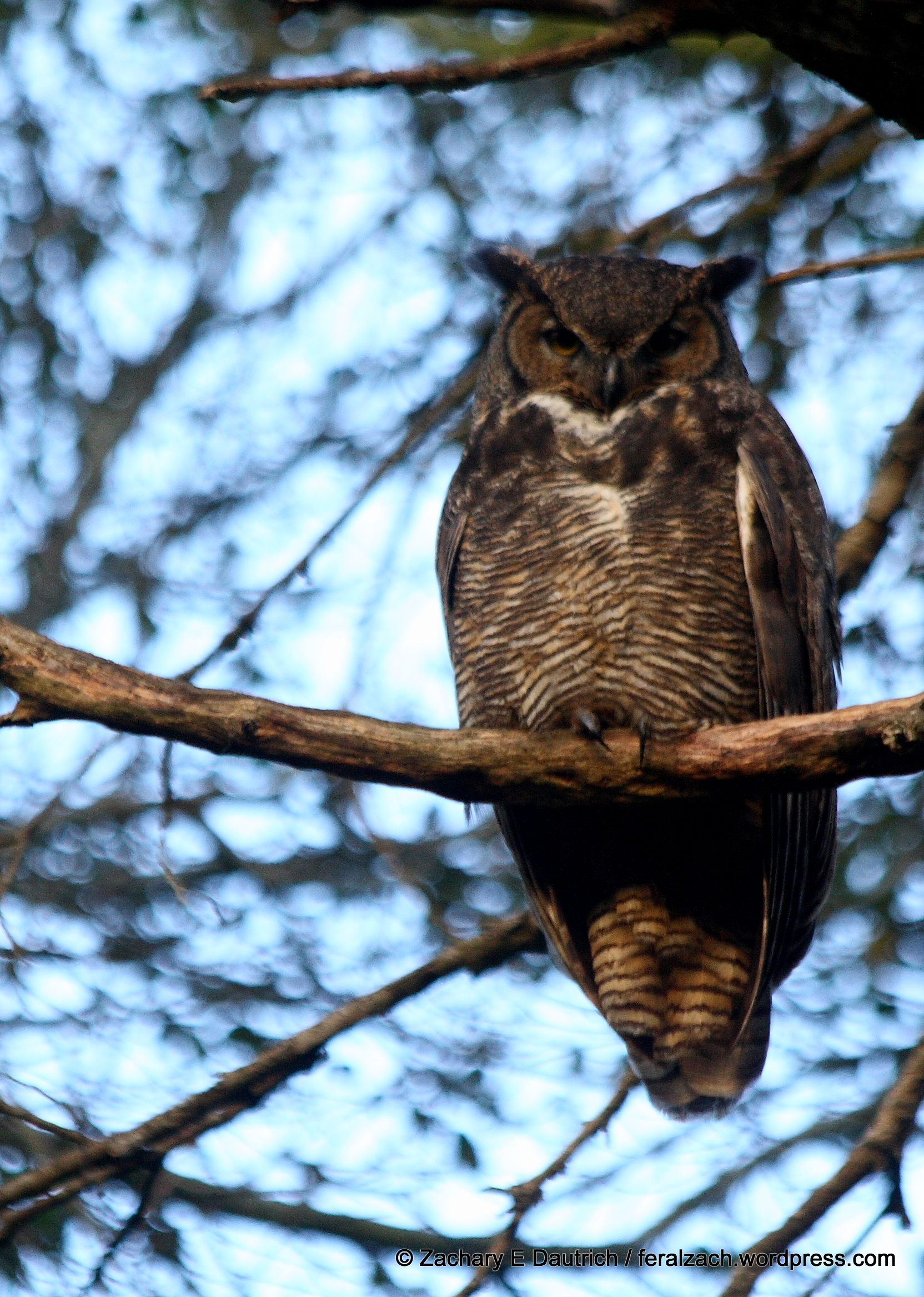
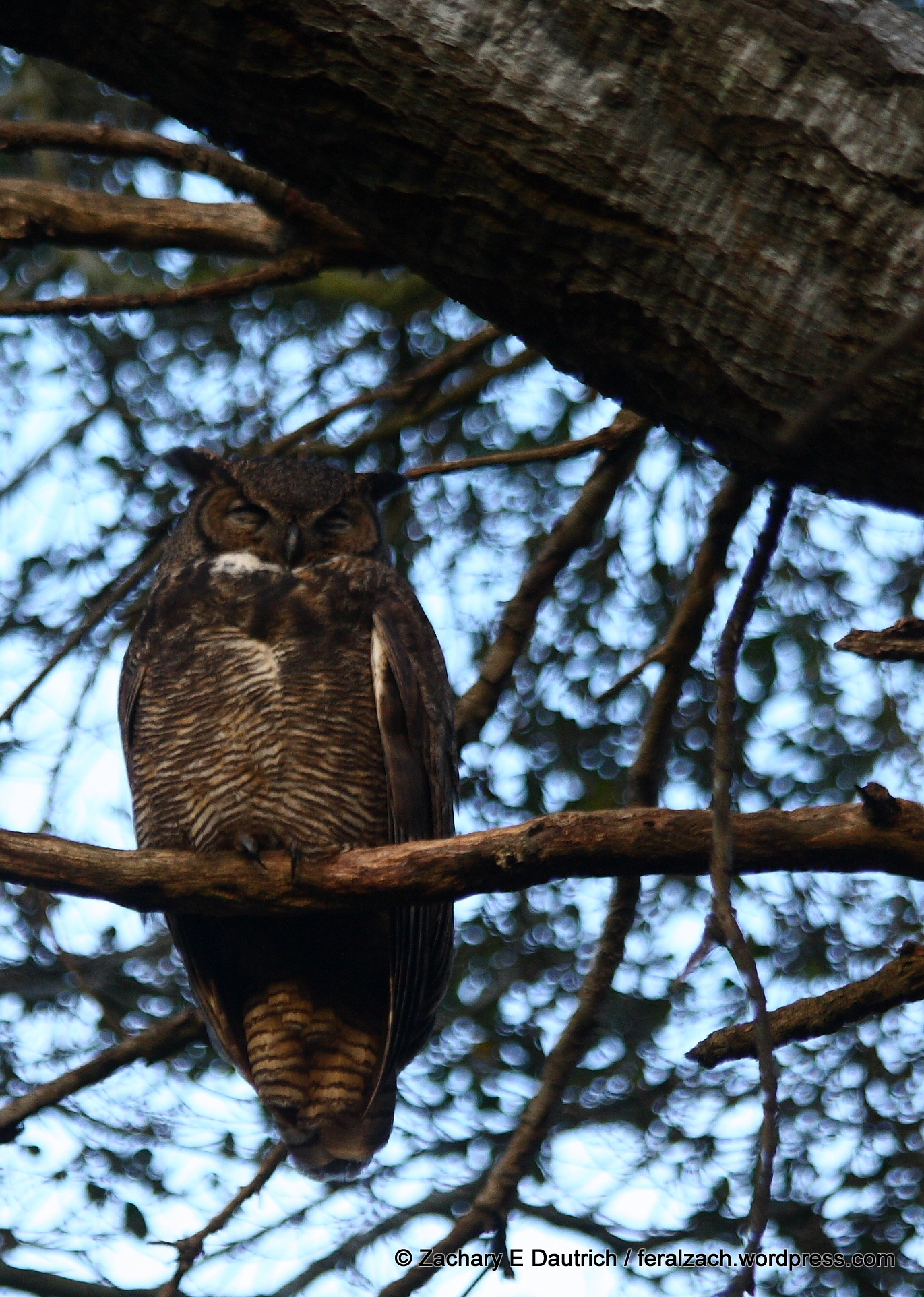
Getting to spend time so close to an animal like this is such a thrill and a blessing, and I settled in under the boughs of the Interior Live Oak Tree for 30 minutes watching her, with the sounds of all the small birds moving through the willows as background music for this evening’s show.
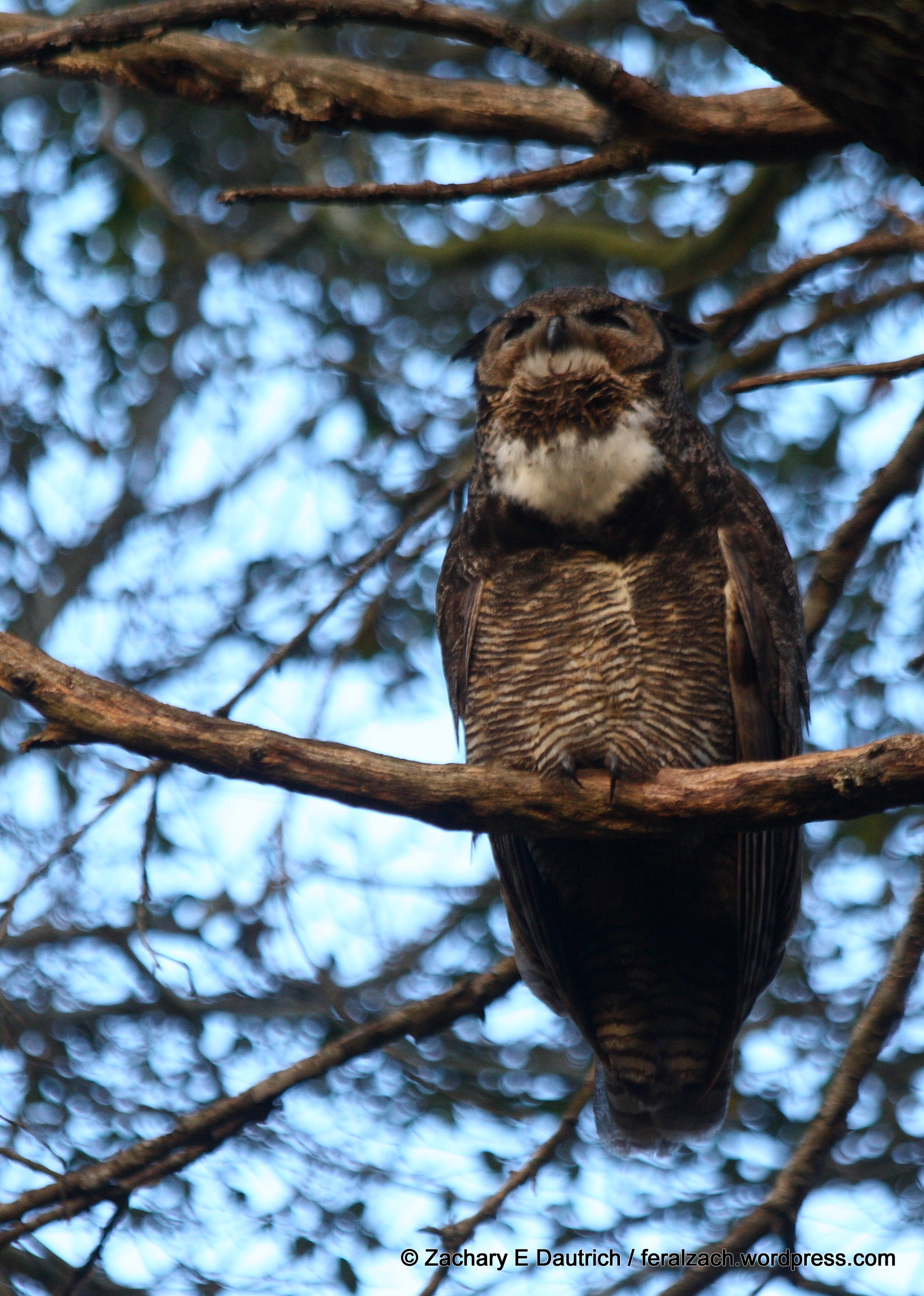
great-horned owl hooting

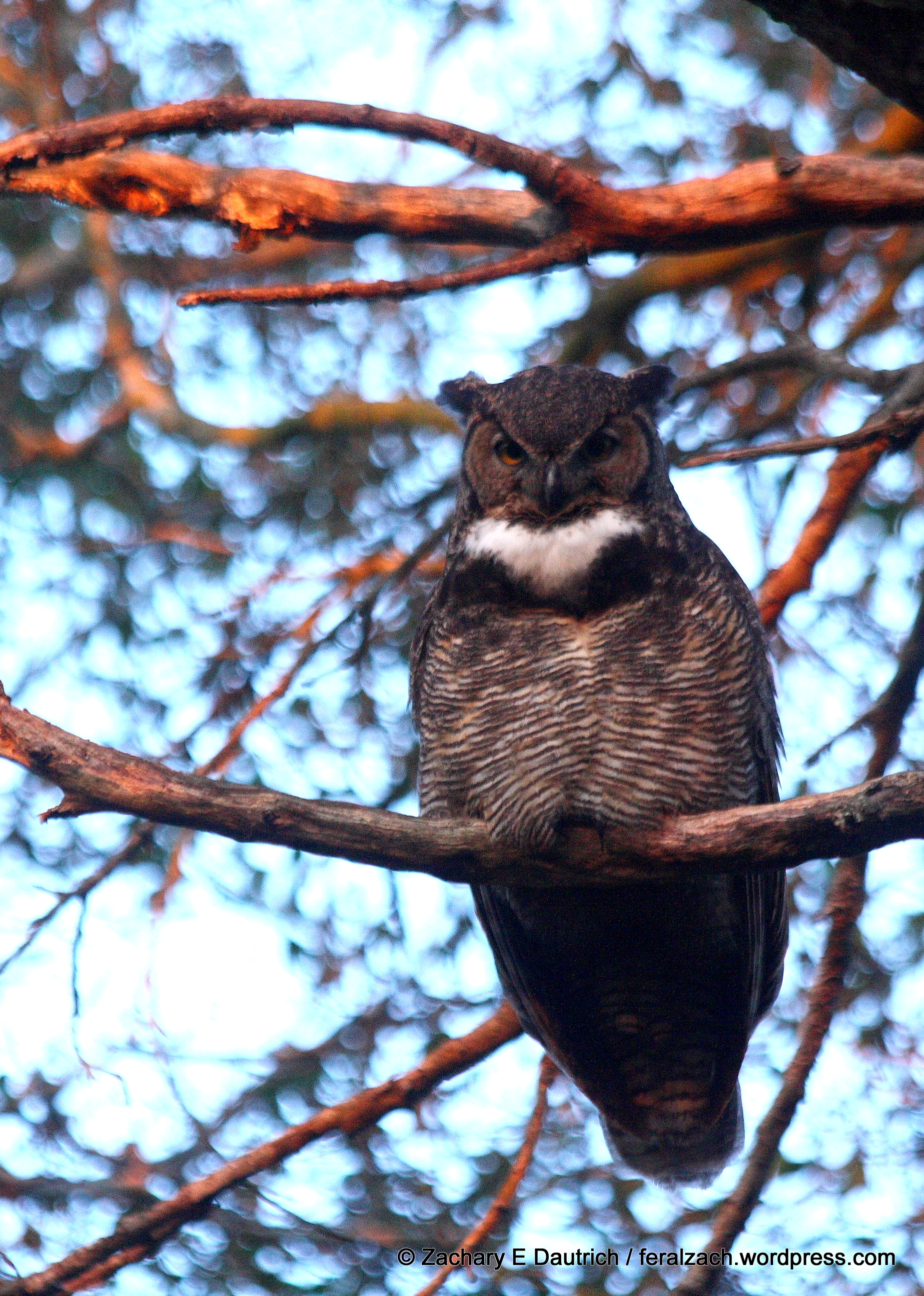
As she started to wake up, she did a bit of preening and then was suddenly focused intently on something to the south. After watching for several minutes, she gave some more hoots and started looking about with the wild eyes of an owl ready for the night. The same eyes that cats have when it’s a full moon or they are in their amped-up hunting state.


Within a few minutes, another owl landed in the tree from the direction that she had been staring, and he gave me the once-over after the two greeted each other with a series of endearing hoots and calls.

owl #2 enters scene, the male
The second owl, the male I presume (based on size/proportions and the tone of the hoots), took up a position on another branch not too far away as he made his way closer to the lady, but was still a little suspect of the biped watching below.
He gave me a few more looks before the allure of the lady finally swung his gaze upward to her feathered finery.

Finally he made his move, and landed right by her. He glared at me to let me know who was in charge, but I got the last laugh when after about 30 seconds the branch he was on broke and he had to relocate unexpectedly!

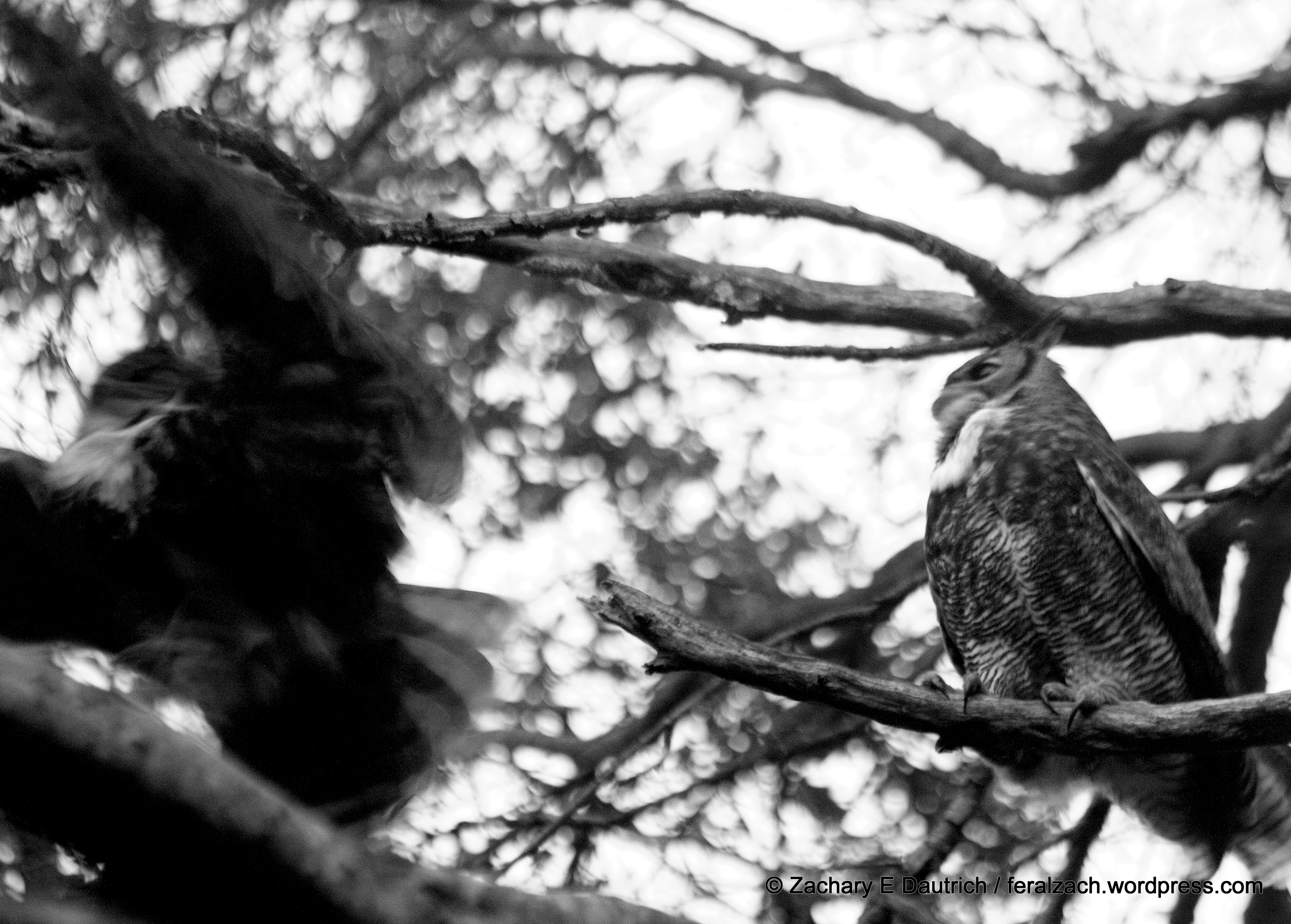
Ahhh, I guess owls are subject to immediate karma too sometimes, same as we humans when we let our egos act for us! Tough Guy takes the tough fall, ha!! A few moments later though he was redeemed when they rendezvoused a few trees up the wash. Then they made their way atop the Live Oak Trees together to start their evening, as I wandered away to end mine. What a special time to get to spend with them.

In addition to all that excitement, I’m pretty sure she cast a love spell on me too – and, I captured the exact moment when she wove her enchantment upon me (at least I’m hoping it was a love spell and not something more nefarious) …

Ok, as I look upon that picture, it looks kind of nefarious. I realize in comparison, the cupids one sees depicted all around this time of year sure don’t look quite like that when they’re shooting their cute little heart arrows – but I’ll go ahead and choose to believe it was a love spell. I’m definitely in love with them, so I guess it worked.
These birds might already have babies somewhere close by, and if not, they probably will soon. I often hear them up in the hills, along with other pairs of owls, and sometimes I get to see them – but usually it’s well after sunset, so the photo op’s are few and far between. It was fun to get to see them so close, and to spend such a long amount of time with them and in such good light tonight. I hope to see some owlets soon!
bobcat love
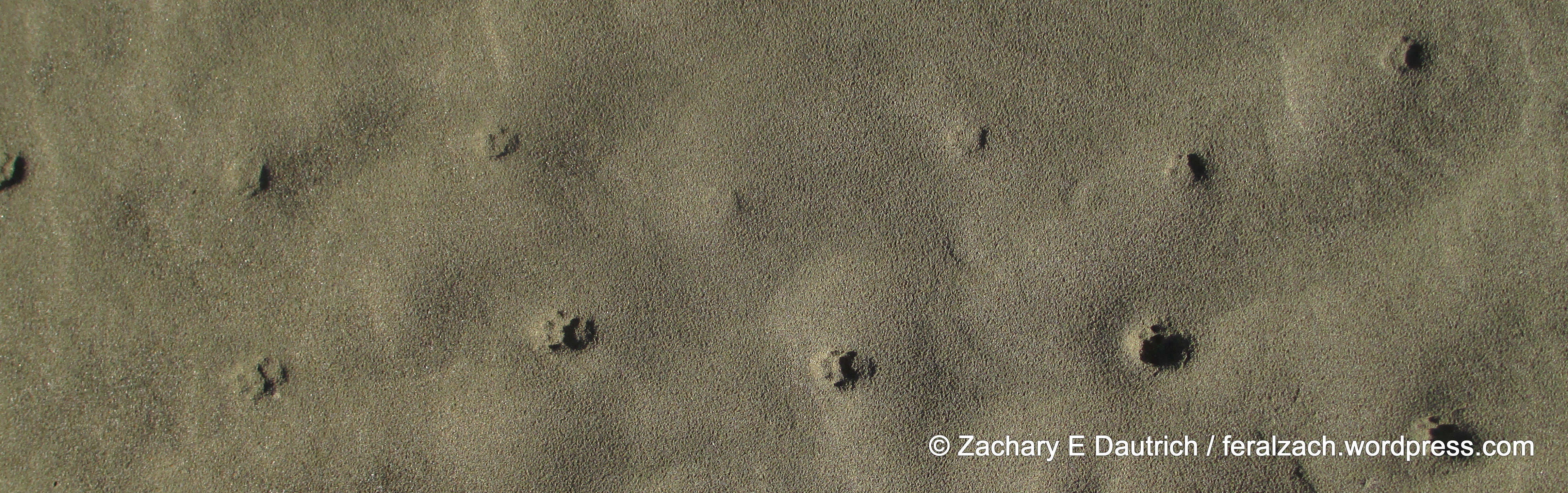
’tis the season
male and female bobcat walking together on the Salmon Creek spit, Sonoma County
more coyotes
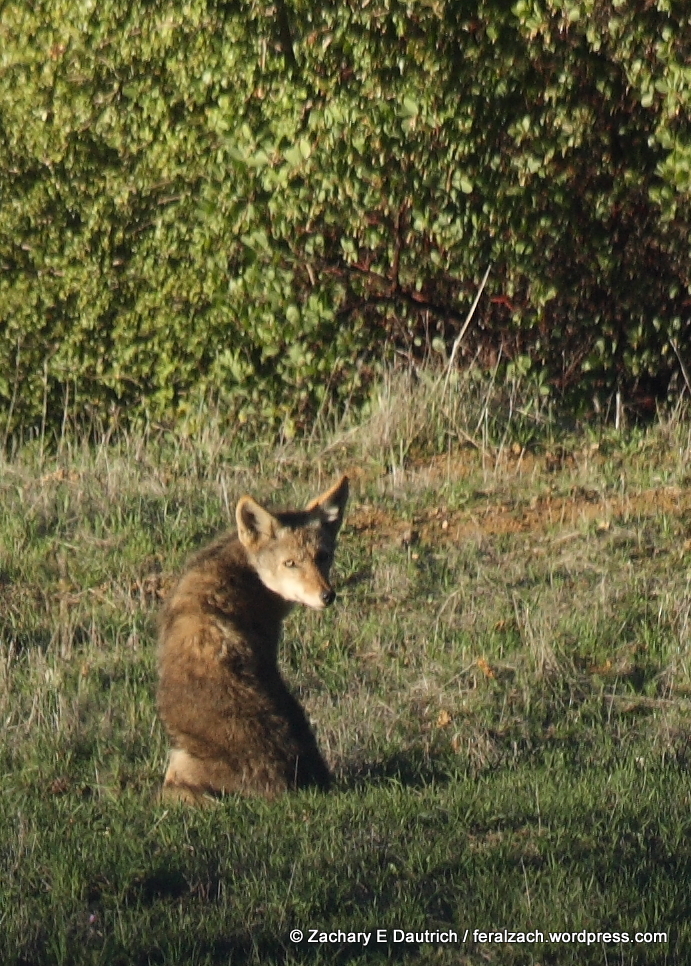
The coyotes in Wildcat Canyon live an interesting life … living on the outskirts of a major urban area in a mixed-use regional park. They share the space with people, dogs off-leash, cattle, and nosy trackers like me. I often see dogs chase these ‘yotes, but they always seem to evade with ease. Many times though I see them flowing over the grass covered hills, using little dips and drainages as cover in broad daylight unseen, with unsuspecting people and dogs walking just yards from them. They seem to have a sixth sense for avoiding discovery. And many times they are hunting gophers in these same areas, gingerly walking over the landscape in a slow, focused and methodical way, waiting for the furry prey to disturb the soil and give away their location just inches below the surface. Given the number of individuals I’ve seen/heard in a small area so far, I’d say they are doing pretty well.


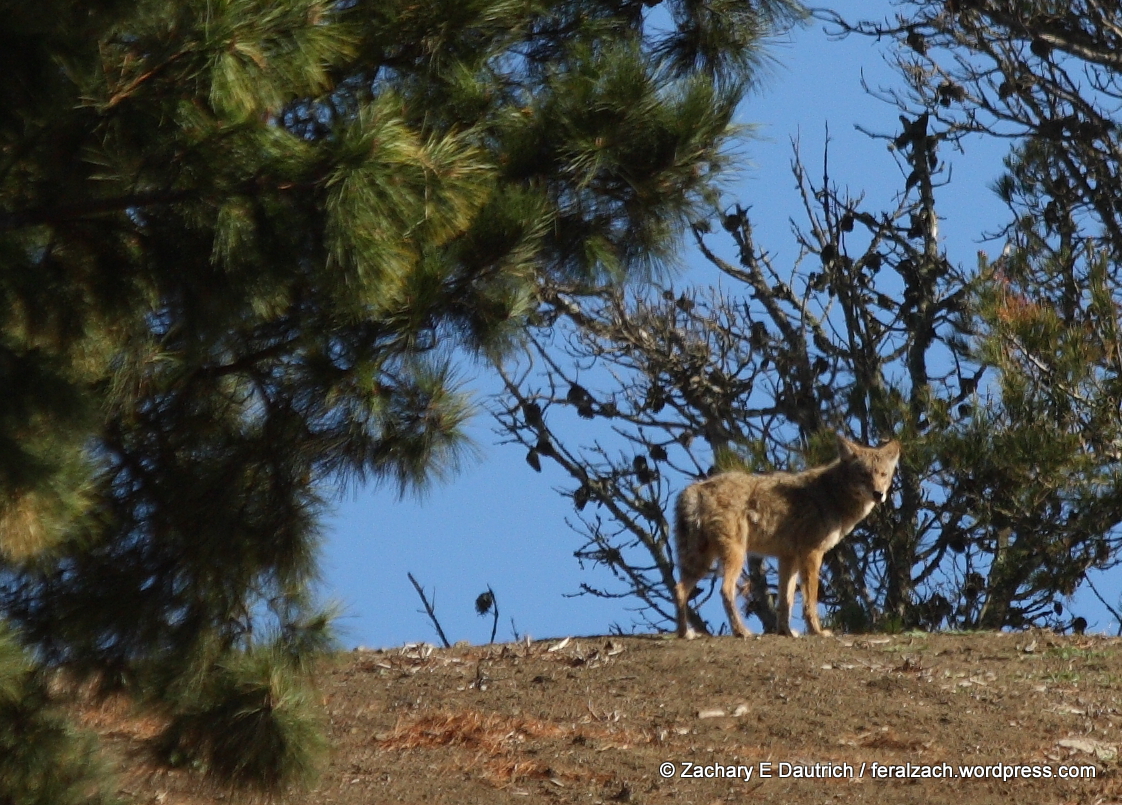
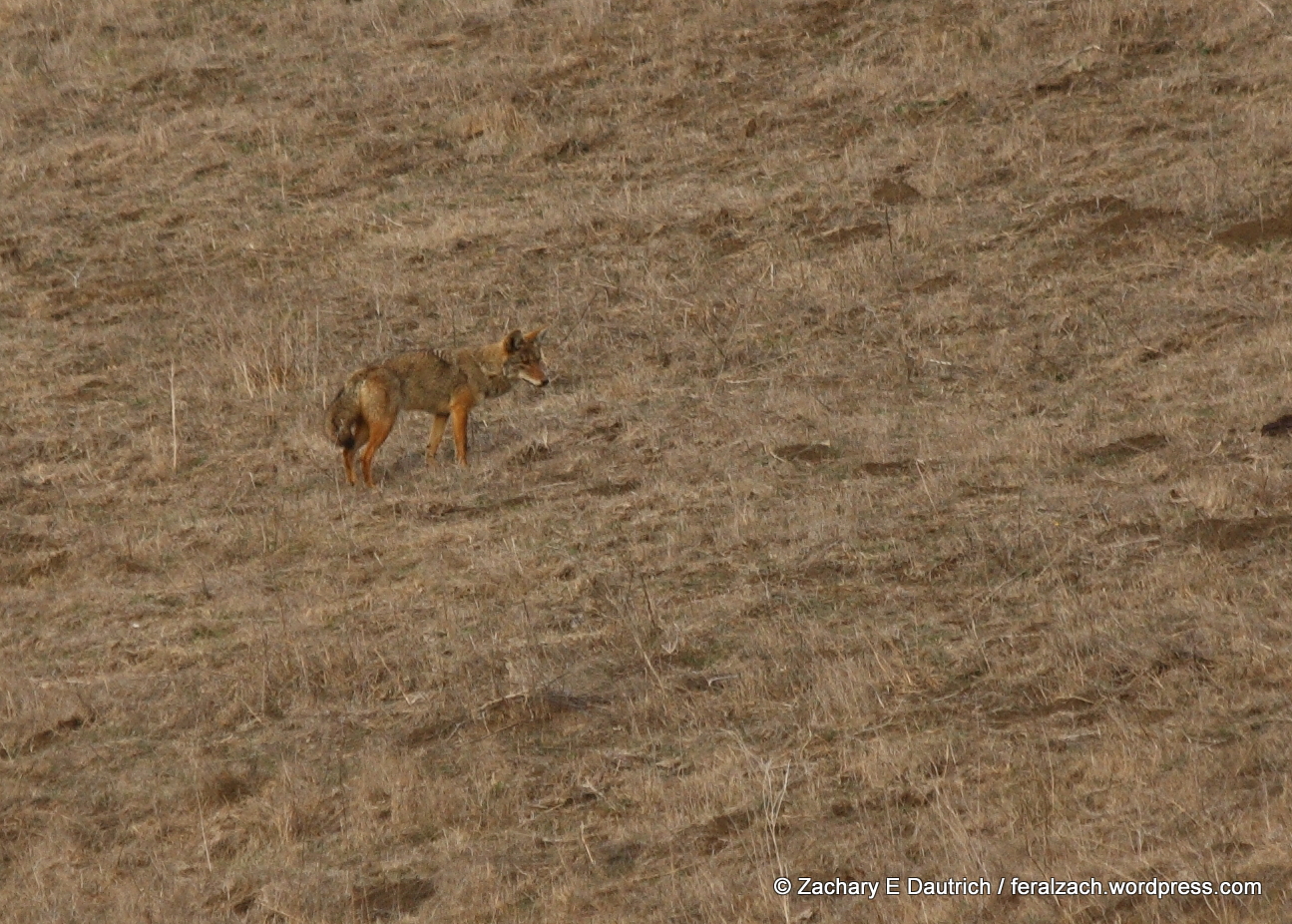
The female shown above is exceptionally beautiful, with a vibrant, glowing coat of mixed browns and grays and contrasting black fur along her spine and tail. She seemed really healthy, and she didn’t notice me as I photographed her scouring the hillside for gophers.
It is also the time for many birds to be courting, and the red-tailed hawks were out in numbers today after the brief rain, dancing and soaring through the blue skies along with two pairs of ravens. In an unusual role reversal, I saw one of the red-tails chase a raven – usually it’s the ravens/crows harassing the tails. Once the sun set, one of the multiple pairs of great-horned owls that call this area home were hooting to each other in the mixed Monterey Pine and Eucalyptus forest at the top of the hill. There is no better compliment to the still feeling just after sunset, when twilight has usurped the day and that electrical charge starts to build signaling the changing of shifts, time for the creatures of the night to start their day.
another adventure at the lagoon

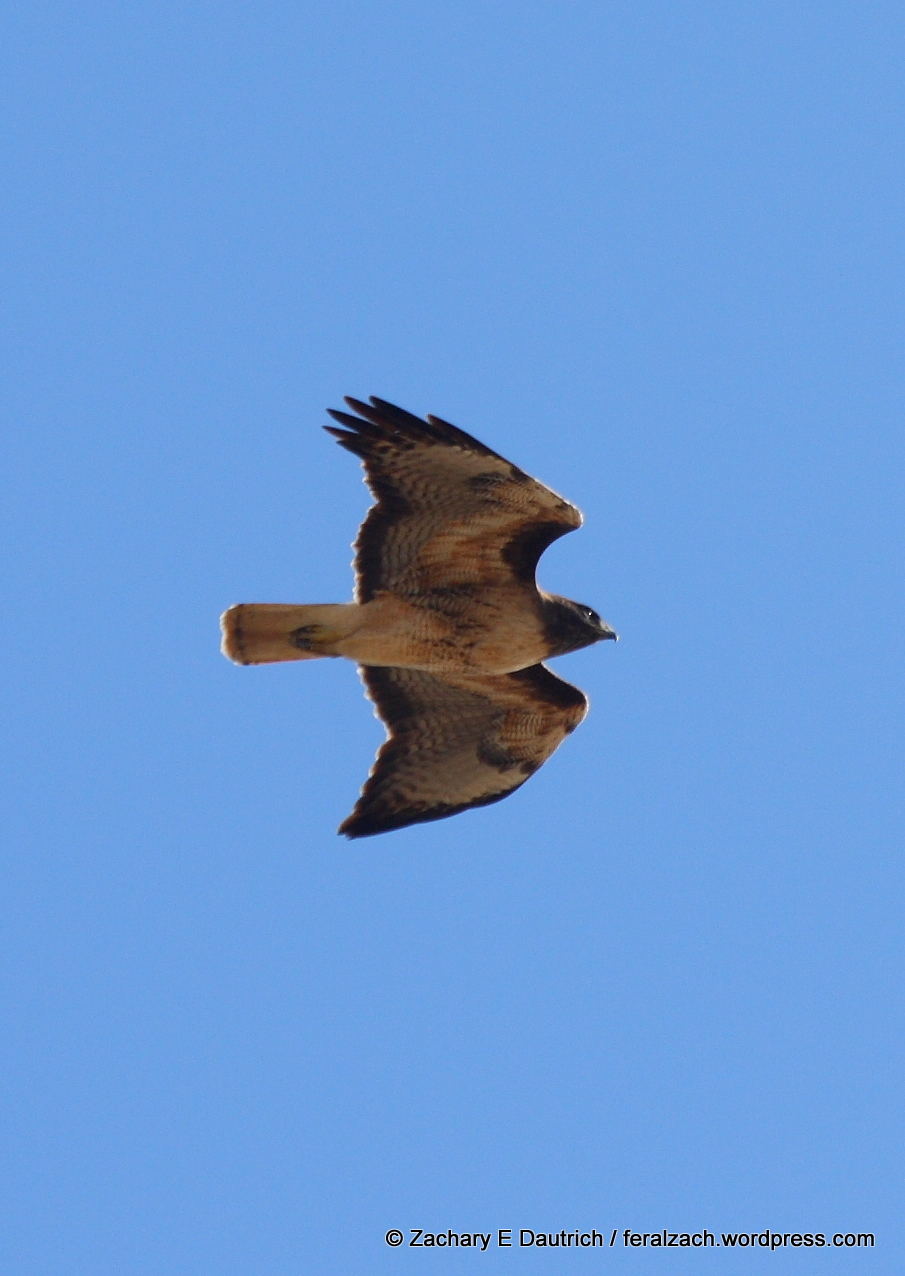
red-tailed Hawk (intermediate morph)
Sunday was a warm and clear day on the coast, strange weather for January – it felt like summer (well, summer anywhere besides the coast and the Bay area). We started the day by witnessing some interesting behavior by a couple of deer that caught our attention. The deer, which appeared to be doe and a yearling (nearly the same size), were standing with heads raised and their focus on something in the chaparral to the north of us. The yearling took off trotting, then bounding, right towards the path we were on, seemingly unconcerned with our presence. It then stopped and turned around, bounding back to its mother. The two of them then started a slow walk in the direction of the threat, with the mother in the lead. Shifting our position back down the trail, we were able to see what was causing the concern …


I was only able to catch the tail-end of the bobcat as he disappeared into a coyote bush (for the moment now a bobcat bush) – a large male that uses this particular territory who’ve we’ve tracked and seen around here before. Although I think it’s rare for bobcats to take down full grown deer in this area, fawns are fair game. This particular young one is probably big enough to be safe, but given the respect that the deer on this day showed towards him, and on another occasion when I witnessed his presence disturb them, I’d say he is still viewed as a threat. He seems to be a large bobcat based on his tracks and scat.
The most interesting part of this whole interaction was when the deer started to FOLLOW the bobcat – the doe literally walked right to where the cat had disappeared, and she seemed to be chasing HIM out of the area! Good stuff.
On the way in to the lagoons, I spotted an American bittern in a small pond along the pathway – I’ve seen one on the far shores of the larger lagoon, but never one so out in the open here. It was shaping up to be another good day, with lots of live animal sightings. Later in the day on the return trip it was still there and posed for some pictures in the beautiful light.
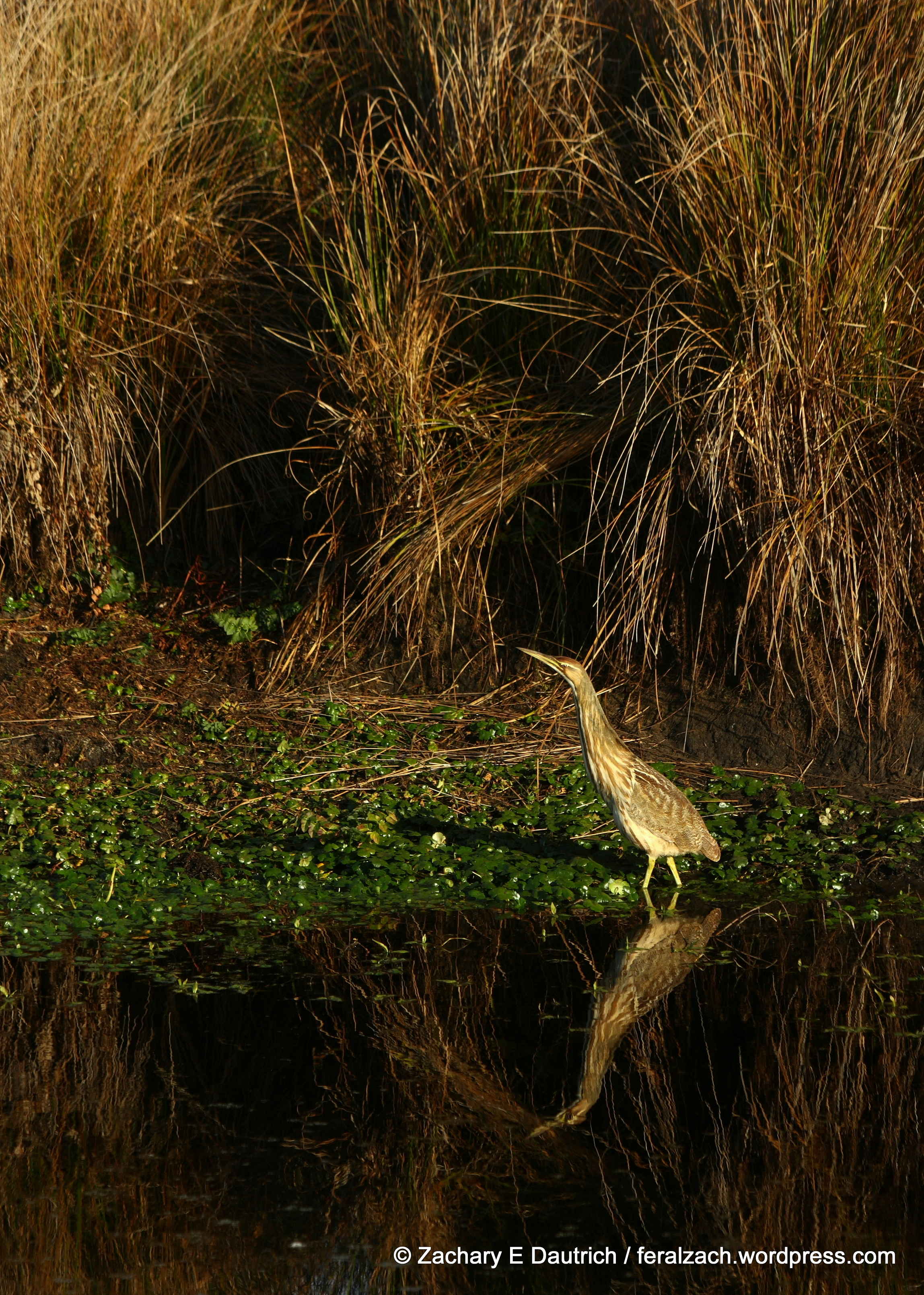
American bittern

American bittern
As we approached the lagoon, a resident great-blue heron was hunting in the shallows.

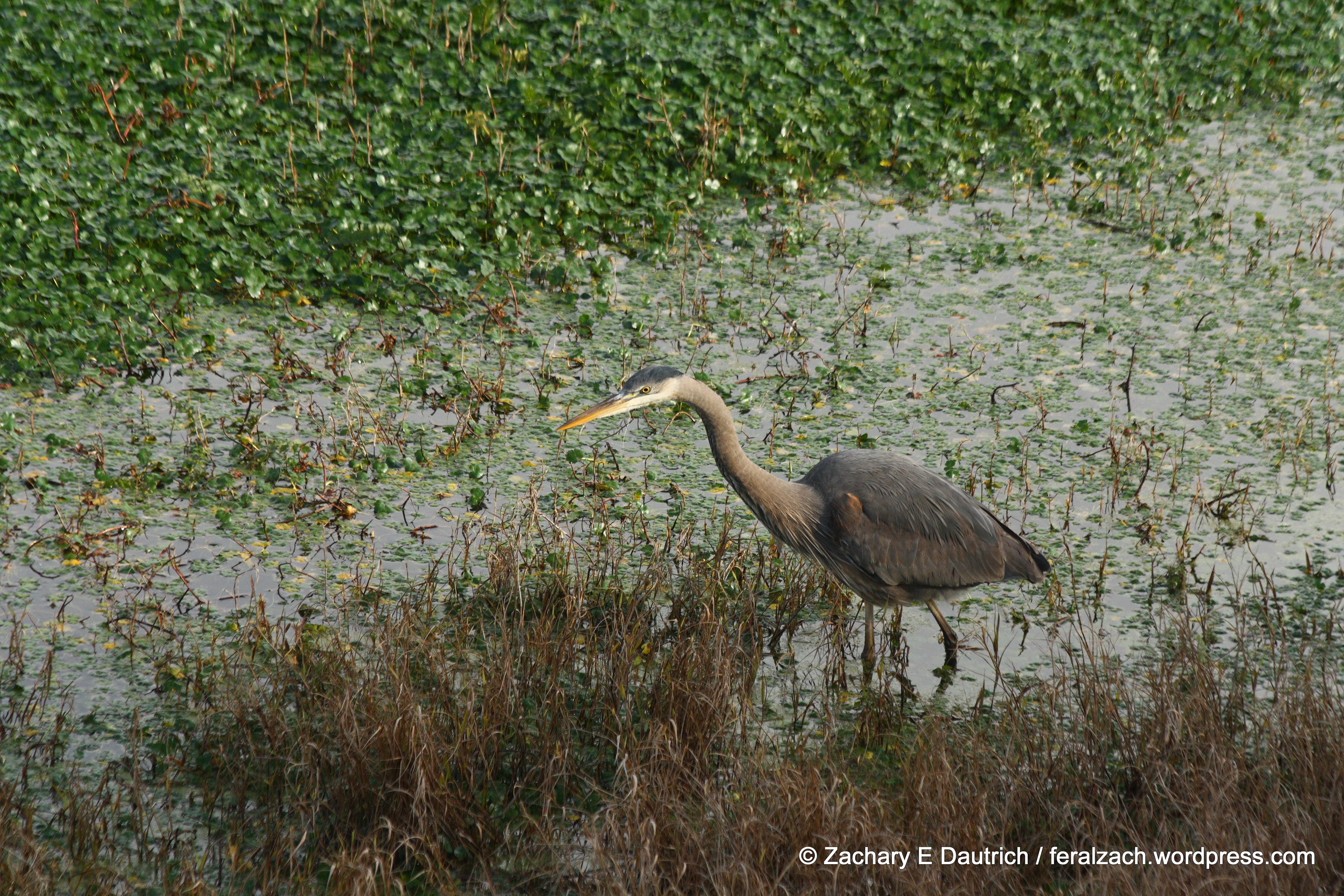
There were quite a few sets of trails and tracks on the dunes, but the striped skunks were most prevalent. This is their mating season, during which they really seem to be wandering around outside of their normal areas with higher frequency – sadly it is also marked by the large number of road kill skunks at this time of year. Notably absent was the female bobcat that usually patrols this area. It is also breeding season for the cats, so her daily patterns are likely interrupted by the breeding impulse. I also spotted at least one golden eagle soaring above the hills, only the second time I’ve seen one in this particular area. Along with a ferruginous hawk sighting (a somewhat rare winter visitor in this area) and the great view of an intermediate morph red-tailed hawk, we had some great raptor and other bird sightings. During the day at various times the family of otters was visible on the upper lagoon, but I never really was close enough for any pictures. Just their presence is a joy, watching them even from afar is so fun.
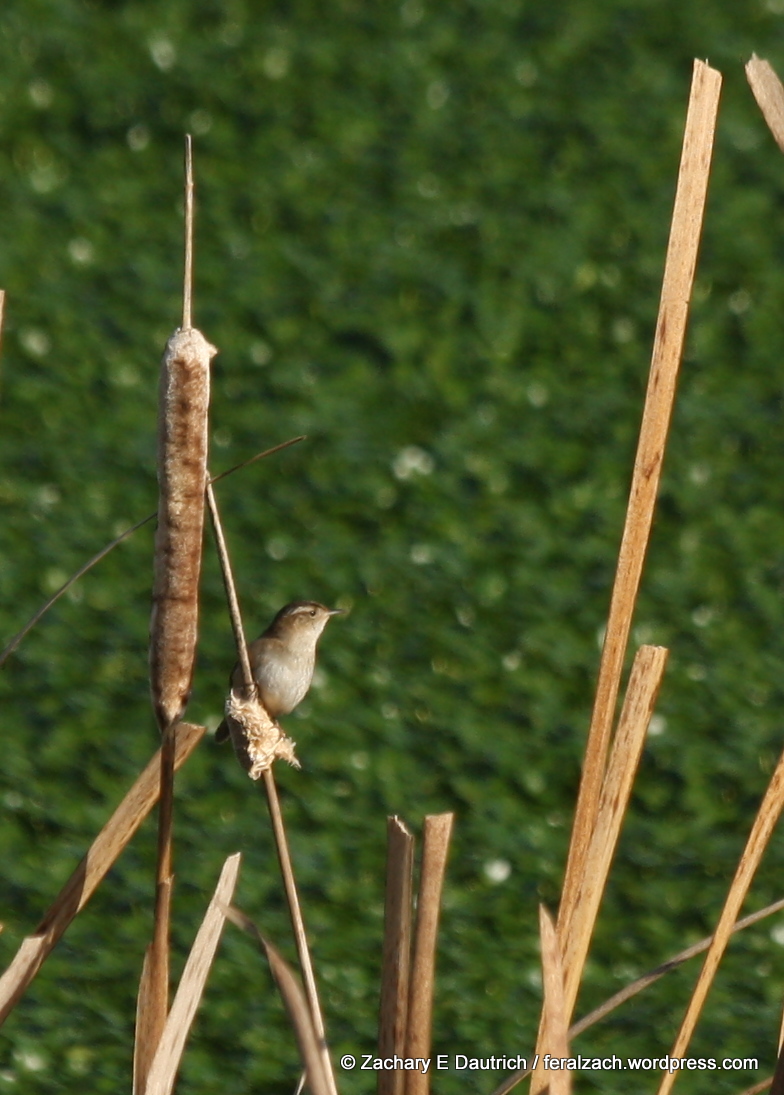
marsh wren

ferruginous hawk
As we were resting by the lagoon, a pie-billed grebe made it’s way out of the shallows by the cattails with quite a prize – after straining to identify what it was, we realized it was a small bass! The grebe paddled around with the fish in its beak for at least five minutes, occasionally shaking it and twice losing it in the water, but diving down and quickly recapturing it. Finally, after almost ten minutes, it downed the fish whole!!
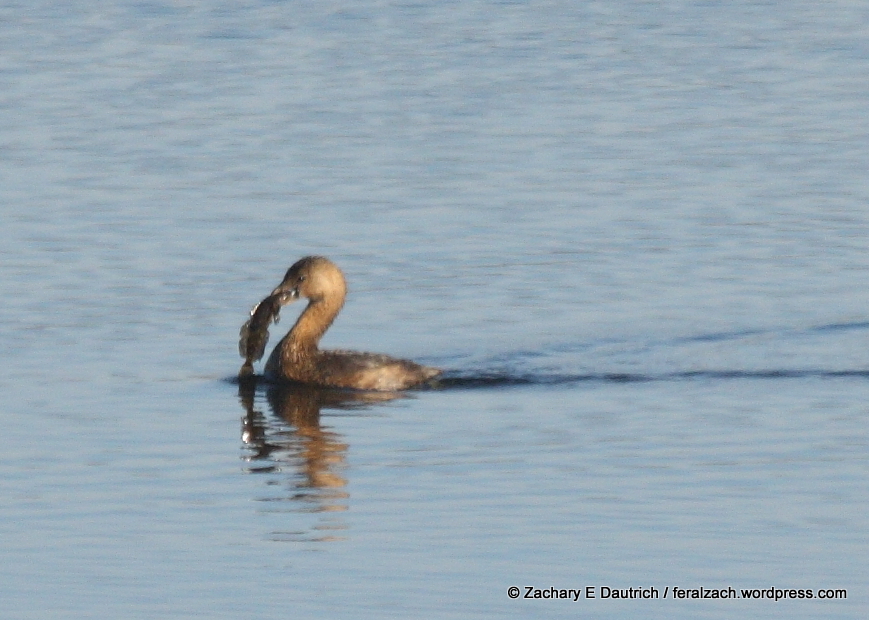

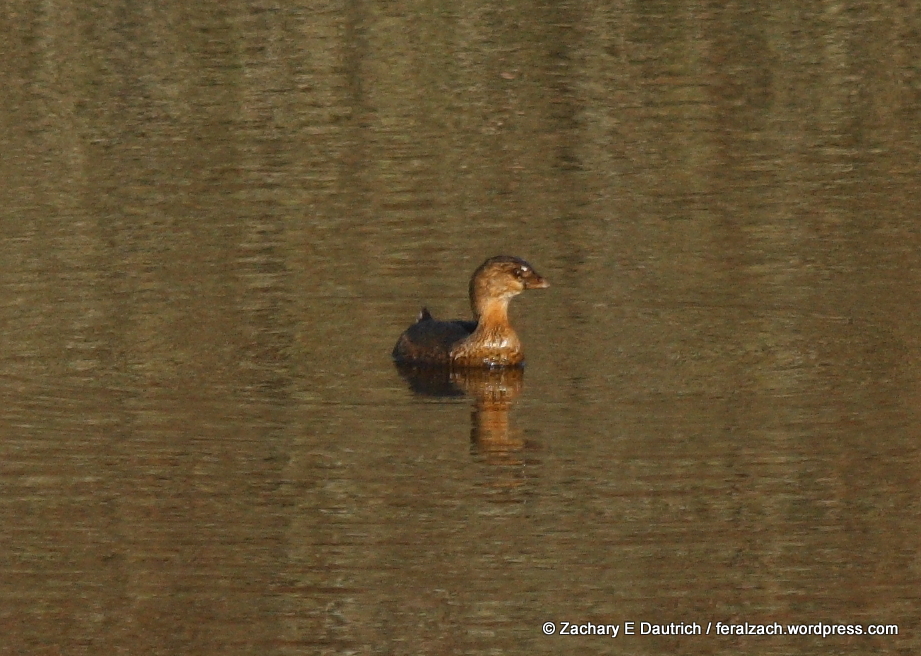
Impressive.
Another great day out there, I’m so thankful for that place and to be able to wander in it. Thanks also to Richard Vacha and everyone who participated in this Marin Tracking Club excursion for making it a fun and educational day.
 feralzach